In summary:
- Visible signs of water stress like wilting mean yield loss has already begun; the goal is pre-symptomatic detection.
- Plants communicate stress through invisible signals, primarily a rise in canopy temperature and changes in chlorophyll fluorescence.
- Thermal imaging can detect a “metabolic fever” 2-3 days before visual symptoms, while fluorescence can detect photosynthetic distress even earlier.
- Relying on a single metric like NDVI is misleading. A combined approach using thermal, soil, and ET data provides the most accurate forecast of water needs.
- Strategic sensor placement in representative zones is more critical than the total number of sensors.
The feeling of seeing a crop wilt under a hot sun is a familiar pain for any irrigator. It’s a clear, desperate signal for water. The problem is, by the time you see this signal, the plant has already been suffering for days. It has closed its pores, its metabolism has slowed, and the damage to its yield potential has already begun. We have been trained to look for these visible cries for help, but what if we could hear the plant’s silent whispers of distress long before they become screams?
Traditional irrigation often relies on fixed schedules or waiting for these lagging indicators. More modern approaches might use satellite NDVI maps or isolated soil moisture readings. While steps in the right direction, these methods often misdiagnose the problem or fail to provide a timely, complete picture of the plant’s actual experience. The key is to shift our perspective from a reactive repairman, fixing a problem that already exists, to a predictive caretaker, anticipating needs before they become critical.
This is not science fiction; it is plant physiology. A plant under stress engages in a silent, physiological conversation. It changes its temperature, the way it interacts with light, and the rate at which it draws water from the soil. Understanding this language is the true key to precision irrigation. This article will decode these early-warning signals. We will explore how to interpret the heat a plant radiates, listen to the light it emits, and place our technological ‘ears’ in the field to hear the first signs of thirst, allowing you to intervene not when the plant is dying, but when it first feels thirsty.
To provide a clear path through these advanced concepts, this guide is structured to build your understanding from the plant’s first whisper to a full-field strategy. Below is a summary of the topics we will explore to transform your irrigation from a reaction into a prediction.
Summary: Unlocking Pre-Symptomatic Stress Detection
- Why a Hot Canopy Means Your Crop Stopped Drinking?
- How to Measure Chlorophyll Fluorescence to Gauge Plant Health?
- Thermal Cameras or Visual Scouting: Which Finds Stress First?
- The Diagnosis Error That Leads to Wrong Foliar Applications
- Where to Place Sensors to Represent the Whole Field Correctly?
- Why Scheduling by Timer Wastes Water Compared to ET Data?
- Why NDVI Maps Can Be Misleading in Late-Season Corn?
- How to Reduce Water Usage by 20% With Soil Moisture Sensors?
Why a Hot Canopy Means Your Crop Stopped Drinking?
A healthy, well-watered plant is a master of evaporative cooling. Through tiny pores on its leaves called stomata, it releases water vapor in a process called transpiration. This is the plant’s equivalent of sweating; it’s a vital mechanism to regulate its temperature under the sun. However, when a plant begins to experience water scarcity, its first self-preservation instinct is to close these stomata to conserve moisture. It is, in effect, holding its breath.
This action has an immediate and measurable consequence: the plant stops sweating. Without the cooling effect of transpiration, the leaf surface temperature begins to rise above the ambient air temperature. This phenomenon is what I call a ‘metabolic fever’. It’s not a sign of sickness in the traditional sense, but an early, sensitive indicator that the plant’s internal water balance is tipping towards stress. It’s the very first, large-scale signal that the crop has stopped ‘drinking’ at its normal rate.
The temperature difference between a stressed and a healthy plant can be significant. In fact, research from thermal imaging studies shows that a 5°C temperature increase can be detected in water-stressed plants up to five days before any wilting becomes visible to the human eye. This makes canopy temperature one of the most powerful predictive tools at our disposal. A hot canopy is a direct, physiological message: “I am conserving water because I anticipate a shortage.”
Your Action Plan: Interpreting Canopy Temperature Signals
- Establish a Baseline: Identify a small, consistently well-watered reference area in your field. Its temperature is your “healthy” baseline against which all other measurements will be compared.
- Collect Thermal Data: Use a handheld infrared thermometer or a drone-mounted thermal camera to measure canopy temperatures across different zones of your field, ideally during the hottest part of the day (1-3 PM).
- Identify Hotspots: Look for areas where the canopy temperature is significantly higher (e.g., 3-5°C) than your well-watered baseline. These are your primary stress candidates.
- Ground-Truth the Signal: Before irrigating, visit the identified hotspots. Check the soil moisture. If the soil is dry, the cause is water deficit. If the soil is moist, the “fever” may be due to disease, pests, or soil compaction affecting root function.
- Log and Map: Record your findings over time. Mapping these thermal variations reveals patterns in your field, helping you move towards precision zone irrigation instead of uniform watering.
How to Measure Chlorophyll Fluorescence to Gauge Plant Health?
If canopy temperature is the plant’s breath, then chlorophyll fluorescence is the whisper of its metabolic engine. This signal is even more subtle and can appear even earlier than a thermal signature. To understand it, we must look inside the leaf at the process of photosynthesis. When a plant’s chlorophyll absorbs sunlight, it has three potential pathways for that energy: drive photosynthesis, dissipate it as heat, or re-emit a small fraction of it as light of a longer wavelength. This re-emitted light is chlorophyll fluorescence.
In a healthy, efficient plant, most of the light energy is used for photosynthesis. Very little is wasted as heat or fluorescence. However, when a plant experiences stress—from drought, heat, or nutrient deficiency—its photosynthetic machinery becomes damaged or overloaded. It can no longer use the light energy effectively. To protect itself from this excess energy, the plant begins to dissipate more of it as both heat and fluorescence. A sudden increase in fluorescence is therefore a direct cry for help from the plant’s cellular machinery, indicating that its ability to produce energy is compromised.
This is a profoundly sensitive metric. While thermal imaging detects the consequence of stomatal closure, fluorescence detects a problem within the core photosynthetic process itself. A study on maize, for instance, demonstrated that a key fluorescence parameter (Fv/Fm) changed significantly 12-24 hours before any thermal signatures appeared. The incredible precision of this method is why studies on chlorophyll fluorescence demonstrate an accuracy of over 80% in early stress detection. Measuring this requires specialized sensors, often called fluorometers, that emit a specific light pulse and measure the plant’s light response.

As you can see, the technology allows us to listen to this subtle light emission, turning an invisible stress signal into actionable data. It tells us not just that the plant is stressed, but that its fundamental ability to grow is being impaired, often days before the plant itself shows any outward sign of trouble.
Thermal Cameras or Visual Scouting: Which Finds Stress First?
The traditional method of walking the fields, or visual scouting, has been the cornerstone of farm management for centuries. It relies on the irrigator’s trained eye to spot the tell-tale signs of distress: leaf curling, wilting, or discoloration. While this method builds an intimate knowledge of the land, its fundamental limitation is that it is entirely reactive. By the time the human eye can perceive stress, the plant has already been suffering, and yield potential has been lost. The question for the modern irrigator is: which technology gives us the most valuable head start?
The answer lies in comparing the timelines of different detection methods. As we’ve discussed, subtle physiological changes precede visible symptoms by days. Chlorophyll fluorescence often gives the earliest warning at a cellular level, but its measurement can be complex. Thermal imaging, which detects the ‘metabolic fever’ of a plant, offers a powerful and practical advantage. It can survey large areas quickly via drones or ground equipment and provides a clear, map-based visualization of stress.
Comparing these methods reveals a clear hierarchy of pre-symptomatic detection. The following table, based on data from various agricultural studies, illustrates the typical lead time each method provides before stress becomes visually apparent.
This comparative analysis, sourced from a comprehensive review in the Precision Agriculture Journal, clearly shows the advantage of technological approaches.
| Detection Method | Lead Time Before Visual Symptoms | Accuracy | Coverage Area |
|---|---|---|---|
| Chlorophyll Fluorescence | 3-5 days | 80-94% | Leaf level |
| Thermal Imaging | 2-3 days | 85-97% | Canopy level |
| NDVI/Multispectral | 1-2 days | 75-85% | Field level |
| Visual Scouting | 0 days (baseline) | 60-70% | Plant level |
While visual scouting remains essential for ground-truthing and identifying issues like pests or disease, it is no longer the first line of defense. Thermal imaging provides a 2-3 day head start, a critical window to irrigate precisely and prevent yield loss. The most advanced approach, as experts suggest, is to combine these technologies.
The synergistic use of MS or HS [Multispectral/Hyperspectral] in combination with TIR [Thermal Infrared] for assessing crop water status provides the most comprehensive early warning system.
– Raddi et al., Precision Agriculture Journal
The Diagnosis Error That Leads to Wrong Foliar Applications
One of the most costly mistakes in modern agriculture stems from a simple diagnostic error: treating a symptom instead of its root cause. Advanced tools like multispectral imagery can show us a yellowing area in a field, for example. A common interpretation is a nitrogen deficiency, prompting a foliar application of nitrogen fertilizer. However, the irrigator is often left confused when the crop doesn’t respond, or its condition worsens. The mistake was not in the observation, but in the diagnosis.
The plant was indeed deficient in nitrogen, but not because there was none available. The true culprit was undetected water stress. When a plant is water-stressed, it cannot effectively uptake nutrients from the soil, no matter how abundant they are. The roots need water to transport dissolved nutrients into the plant’s vascular system. Without sufficient water, this transport system shuts down. The yellowing leaf wasn’t a sign of a soil problem; it was a symptom of a plant-wide logistics failure caused by thirst.
Applying foliar nutrients in this scenario is not only a waste of money and product, but it can also exacerbate the problem. A foliar spray can increase the osmotic stress on an already struggling plant, effectively making it “thirstier.” The correct response was not to add more nitrogen, but to alleviate the water stress that was preventing its uptake. Once irrigation is corrected and the plant’s transport systems are functioning again, it can often access the nutrients already present in the soil.
This is where pre-symptomatic detection becomes so critical. A thermal camera would have shown that the “nitrogen-deficient” zone was running a ‘metabolic fever’ days before it turned yellow. This signal would have correctly identified water stress as the primary issue, leading to a timely irrigation event instead of a misguided foliar application. Mistaking a symptom of thirst for a sign of hunger is an error that costs yield, time, and inputs.
Where to Place Sensors to Represent the Whole Field Correctly?
Investing in advanced sensor technology is only half the battle. A state-of-the-art soil moisture probe or thermal sensor is useless if it’s in the wrong place. Placing a single sensor in a low-lying, clay-heavy corner of a field will give you a perpetually “wet” reading, causing you to under-water the sandier, well-drained majority of the field. Conversely, placing it on a sandy knoll will trigger constant irrigation, wasting water and potentially causing root rot elsewhere. The question isn’t just *what* to measure, but *where* to measure it from.
A field is not a uniform entity; it’s a mosaic of varying soil types, elevations, and historical performance. The key to accurate monitoring is to embrace this variability through a strategy called Management Zone Delineation. This involves using data layers like historical yield maps, soil electrical conductivity (EC) surveys, or elevation maps to divide the field into distinct, logical zones. For example, you might identify a high-yield zone, an average-yield zone, and a consistently low-yield, stress-prone zone.
Instead of placing sensors randomly, you place them strategically within each of these representative zones. This approach transforms your data from a single, potentially misleading point into a nuanced, field-wide understanding. While there is no single magic number, precision agriculture research indicates that a minimum of 3 sensors per hectare is often needed for 85% accuracy in field representation, but their strategic placement is what truly unlocks their value.
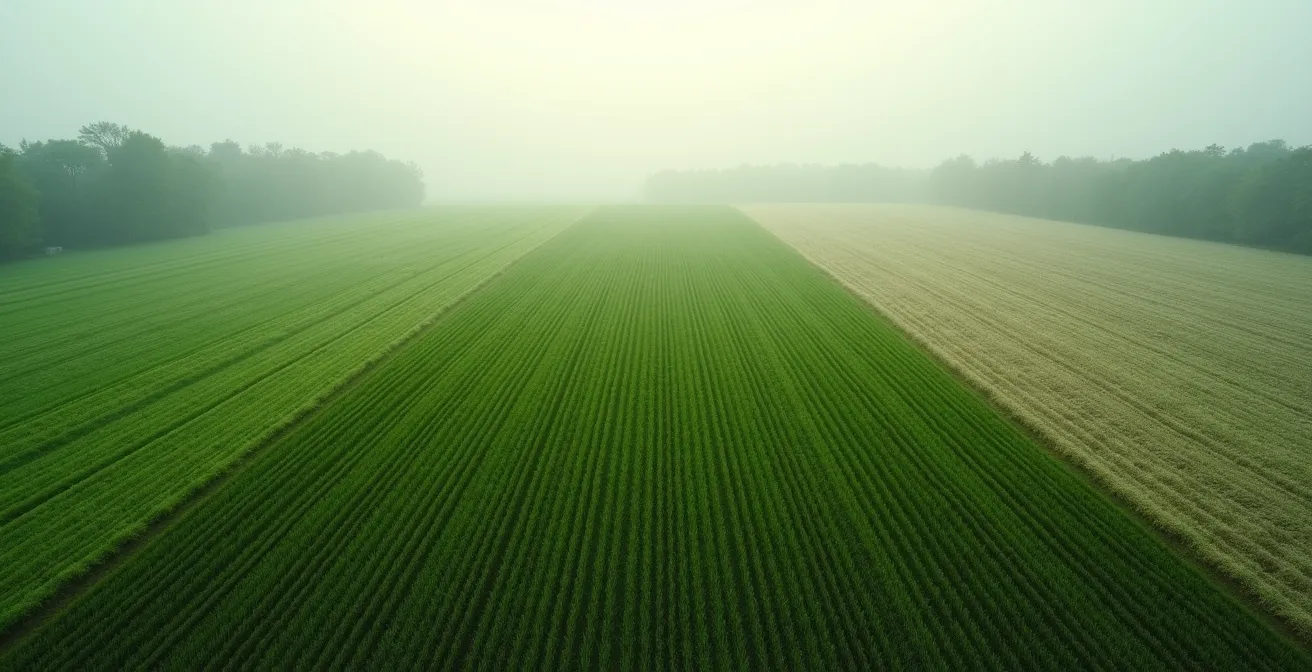
By monitoring the most vulnerable zones, you receive the earliest possible warning of impending stress for the entire field. This intelligent placement strategy is the bridge between collecting data and making truly informed irrigation decisions.
Case Study: Zone-Based Sensor Placement in Almonds
A California almond orchard, struggling with variable water needs, implemented a zone-based sensor placement strategy. Using historical yield maps and soil EC surveys, they identified three distinct management zones: a high-performing zone (40% of the area), an average zone (45%), and a vulnerable, sandy knoll area (15%). By placing soil moisture and thermal sensors specifically within the vulnerable zone, they received stress warnings a full two days earlier than they had with their previous, randomly placed sensors. This early warning enabled targeted irrigation that ultimately saved 20% on water usage while maintaining or even improving yields in the high-performing zones.
Why Scheduling by Timer Wastes Water Compared to ET Data?
Irrigating by the calendar—for example, applying a set amount of water every three days—is a legacy practice born of simplicity, not efficiency. It operates on a crucial, and flawed, assumption: that a crop’s water needs are constant. In reality, a plant’s thirst fluctuates dramatically day to day, driven by weather conditions like temperature, humidity, wind speed, and solar radiation. A cool, cloudy week may require half the water of a hot, dry, and windy one. A timer-based schedule is blind to this reality; it will over-water during cool spells and under-water during heatwaves.
The modern, data-driven alternative is scheduling based on Evapotranspiration (ET). ET is the combination of water evaporated from the soil surface (evaporation) and water released by the plant (transpiration). It is, in essence, the total amount of water that has actually left the field and needs to be replenished. ET data is calculated using local weather station information and crop-specific coefficients. It provides a daily, accurate measure of your field’s real-world water consumption.
Switching from a fixed timer to an ET-based schedule means you are responding directly to the plant’s environment. You are replenishing only what was lost. This prevents the significant waste associated with over-watering on low-demand days, which can lead to nutrient leaching, soil-borne diseases, and wasted energy for pumping. For instance, an Israeli vineyard that switched from a 7-day timer to ET-based scheduling found that during a cool week, their crops only needed 1.2 inches of water, not the standard 2 inches. This simple change prevented nutrient leaching and led to a 35% annual water saving while improving grape quality.
Using ET data transforms irrigation from a rigid, arbitrary task into a dynamic conversation with the environment. It ensures you are watering not based on what the calendar says, but on what the plant and the atmosphere have actually consumed, forming the foundation of a truly precise irrigation strategy.
Why NDVI Maps Can Be Misleading in Late-Season Corn?
The Normalized Difference Vegetation Index, or NDVI, has become a popular tool in precision agriculture. Derived from multispectral imagery, it measures the “greenness” of a crop, which is often correlated with plant health and biomass. In the early to mid-season, NDVI is a valuable tool for identifying zones of poor emergence or early-stage stress. However, as the season progresses and the crop canopy becomes dense, NDVI’s utility can become severely limited, especially in crops like corn.
The primary issue is NDVI saturation. NDVI measures the contrast between near-infrared light (which healthy leaves reflect strongly) and red light (which they absorb). Once a dense canopy is established (a Leaf Area Index or LAI of 3-4), the ground is completely covered. From this point on, even if the plant continues to grow and add leaf layers, the sensor looking down from above sees a uniformly “very green” surface. The NDVI value hits a plateau and stops increasing. As a result, it can no longer detect subtle variations in health or stress within that dense canopy. Remote sensing research confirms that NDVI can miss up to 30% of stress variations in saturated canopies.
This means that in late-season corn, two areas can have the exact same high NDVI value, yet one could be perfectly healthy while the other is experiencing significant water stress that is impacting grain fill. The NDVI map gives a false sense of security, showing a uniform green field while hidden problems are brewing underneath. To see through this green ceiling, irrigators must turn to more sensitive indices that are not as prone to saturation.
For a more accurate late-season assessment, consider these alternatives:
- NDRE (Normalized Difference Red Edge): This index uses the “red edge” band of light, which penetrates deeper into the crop canopy, making it more sensitive to chlorophyll content and nitrogen status in dense vegetation.
- SWIR (Short-Wave Infrared): Bands in the SWIR spectrum are highly sensitive to water content within the leaf tissue itself, providing a direct measure of water status regardless of canopy density.
- Thermal Indices (CWSI): As discussed, thermal data bypasses the “greenness” problem entirely by measuring plant function (transpiration) rather than just biomass. A hot spot on a thermal map is a clear stress signal, even if the NDVI map is a sea of green.
Key takeaways
- The most significant advances in irrigation come from detecting stress physiologically (heat, light) before it becomes visible (wilting).
- Technology is only as good as its placement. A strategy of ‘management zones’ is essential for sensors to provide representative data.
- Moving from fixed schedules to data-driven methods like Evapotranspiration (ET) and Management Allowable Depletion (MAD) offers the greatest potential for water savings.
How to Reduce Water Usage by 20% With Soil Moisture Sensors?
While advanced technologies like thermal and fluorescence imaging are powerful for detecting stress, the foundation of precision irrigation remains in the soil. Soil moisture sensors are the ground truth; they tell you exactly how much water is available to the plant’s roots. However, simply installing a sensor is not enough. The key to unlocking significant water savings—often 20% or more—lies in using the data to implement a specific irrigation strategy: Management Allowable Depletion (MAD).
MAD is a simple but powerful concept. Instead of trying to keep the soil at 100% capacity at all times (which is wasteful and can harm roots), you define a “refill point.” For many crops, this is set at 50% MAD, meaning you let the plants use half of the available water in the root zone before you irrigate. You then water only until the soil profile is refilled (e.g., to an 85% or 90% “full point”), leaving a buffer to capture any potential rainfall. This “irrigate-on-demand” approach, guided by sensor data, prevents unnecessary watering and ensures the plant has a healthy balance of water and oxygen in its root zone.
For example, a soybean farm that implemented this strategy set their refill point at 50% soil moisture depletion. By integrating this with weather forecasts to avoid watering before a rain event, they reduced water usage by 22% while maintaining yields. The choice of sensor is also important, as different types are better suited to different soils and budgets.
Choosing the right sensor depends on your specific field conditions and financial constraints, but all can enable a MAD-based strategy.
| Sensor Type | Best Soil Type | Accuracy | Cost Range | Maintenance |
|---|---|---|---|---|
| TDR (Time Domain) | All types | ±2% | $500-2000 | Low |
| Capacitance | Sandy/Loamy | ±3% | $100-500 | Medium |
| Tensiometer | Clay/Heavy | ±5% | $50-200 | High |
| Neutron Probe | Deep profiles | ±1% | $5000+ | Very Low |
By combining the right sensor with a MAD strategy, you move beyond guessing and start managing your water with the same precision you apply to your fertilizer and seed. This is how you achieve tangible reductions in water use without sacrificing the health or yield of your crop.
To truly shift from reactive to predictive irrigation, the next logical step is to integrate these physiological signals into a unified dashboard, creating a comprehensive health profile of your field that anticipates needs before they become critical losses.