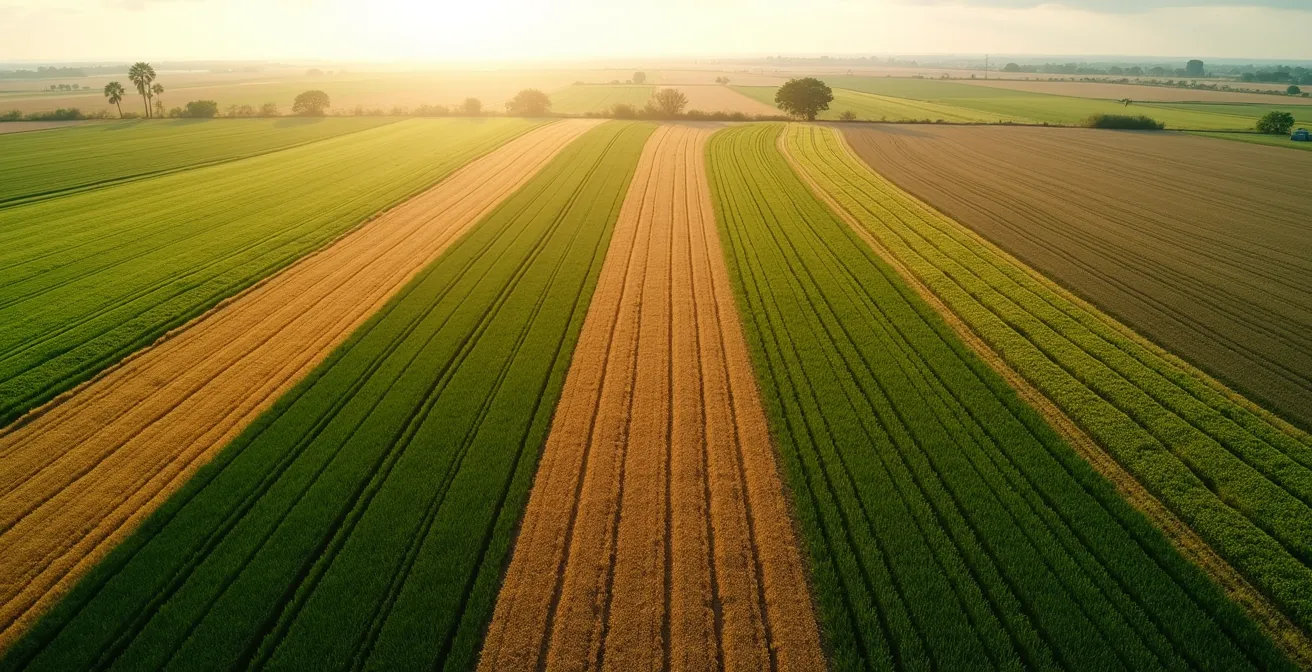
The highest nitrogen efficiency isn’t achieved by a single crop choice, but by orchestrating a multi-year rotation that treats your soil as a biological engine for fertility.
- Continuous monocultures, especially corn, systematically deplete soil nitrogen reserves and degrade soil structure, creating a dependency on costly synthetic inputs.
- Strategic sequencing, which balances nitrogen-fixing legumes, high-residue grasses, and deep-rooted crops, actively manufactures nutrients and improves soil health.
Recommendation: Shift from annual crop selection to a 4-year systemic plan that synchronizes crop needs, biological cycles, and termination timing to minimize external inputs and maximize profitability.
For generations, farmers have understood the intuitive wisdom of crop rotation. The old adages—don’t plant corn on corn, follow a grain with a legume—are staples of agricultural knowledge. Yet, in an era of tightening margins and volatile input costs, simply alternating crops is no longer enough. Many producers find themselves trapped in a cycle of diminishing returns, where yields plateau and the reliance on synthetic nitrogen fertilizers only seems to grow, despite following the “rules.”
The conventional approach often treats rotation as a checklist of actions: plant soybeans for nitrogen, use a cover crop to prevent erosion. This view, however, misses the bigger picture. It fails to address the complex, interconnected web of biology, chemistry, and physics happening beneath the surface. The real challenge isn’t just about what you plant, but about the strategic *orchestration* of the entire system over time. What if the most powerful tool for boosting nitrogen efficiency wasn’t in a bag, but in your calendar?
This is where we must shift our perspective. A truly efficient crop rotation is not a passive sequence but an active strategy for managing biological inputs. It’s about creating a system that manufactures its own fertility, suppresses its own pests, and builds resilience from the ground up. This guide moves beyond the basics to explore the mechanics of designing a long-term rotation plan that breaks disease cycles, boosts soil fertility, and ultimately reduces your dependency on costly external inputs.
We will deconstruct the elements of a high-performance rotation, from understanding the precise impact of monocultures to leveraging soil biology and predicting pest pressures. By the end, you will have a framework for planning a sequence that works as a cohesive, profitable system.
Summary: A Strategic Guide to Nitrogen-Efficient Crop Rotation
- Why Corn-on-Corn Yields Drop After Year 3?
- How to Structure a 4-Year Rotation Plan for Profitability?
- Soybeans or Canola: Which Prepares Wheat Better?
- The Herbicide Mistake That Kills Your Next Rotation Crop
- When to Terminate Cover Crops Before the Cash Crop?
- Why Fungal-Bacterial Ratios Matter for Soil Health?
- How to Diversify Crops to Insulate Income from Weather Shocks?
- How to Predict Pest Outbreaks Using Degree Days?
Why Corn-on-Corn Yields Drop After Year 3?
The phenomenon known as “continuous corn yield decline” is a well-documented challenge for producers. While the first couple of years may show stable or even strong results, a noticeable drop-off often occurs around the third or fourth year. This isn’t just a matter of bad luck; it’s a predictable outcome of an unbalanced biological system. Corn is a heavy feeder of nitrogen, and planting it repeatedly in the same field creates a compounding nitrogen deficit that synthetic fertilizers can only partially mask.
The core issue is a disruption of the soil’s natural nitrogen economy. In a diverse rotation, different crops contribute and consume nutrients at varying rates, maintaining a dynamic equilibrium. Continuous corn, however, places a relentless demand on the same nutrient pools. Research from a 14-year continuous corn study is telling: it shows that Nitrate-N levels dropped from 32 lb/acre to 12 lb/acre after just 4-5 years of continuous corn without fertilization. This demonstrates how quickly the soil’s readily available nitrogen is exhausted.
Beyond simple nutrient depletion, continuous corn monocultures also lead to a buildup of specific pathogens and pests that thrive on corn residue. This increased disease pressure forces the plant to expend more energy on defense, diverting resources away from grain production. Furthermore, the physical structure of the soil suffers. The lack of diverse root systems leads to compaction and a less favorable environment for the beneficial microbes responsible for nutrient cycling. Essentially, the soil becomes a less efficient engine, requiring ever-increasing amounts of external fuel (fertilizer) just to maintain performance.
How to Structure a 4-Year Rotation Plan for Profitability?
Moving away from monoculture requires a strategic, multi-year vision. A 4-year rotation plan is a common and effective framework because it allows for a balanced sequence of crop types—typically a grain, a legume, and one or two other complementary crops—to systematically build soil health and manage inputs. The goal is not just to change the crop each year, but to orchestrate a sequence where each crop sets the stage for the success of the next.
A profitable plan begins with mapping out the goals for each phase. For instance, a classic 4-year plan might look like this: Corn (high nitrogen user) -> Soybeans (nitrogen-fixing legume) -> Wheat (fibrous root system for soil structure) -> Cover Crop Cocktail (to build organic matter and suppress weeds). This sequence is designed so that the soybeans replenish the nitrogen consumed by the corn, and the wheat’s dense root system improves soil aggregation before a fallow period protected by a cover crop. The entire system is designed for synergy.

The visual of a planning matrix helps conceptualize how different factors interact over the four-year cycle. Profitability is insulated by this diversity. If corn prices are low one year, strong soybean or wheat prices can buffer the farm’s income. This structure also provides multiple windows for weed and pest management, preventing the buildup of resistant populations that often plague monocultures. It transforms farming from a reactive, single-season endeavor into a proactive, long-term system of asset management, where the primary asset is the soil itself.
Your Action Plan: 5-Point Audit for Systemic Rotation Planning
- Map Your Nitrogen Flow: List your planned crops for the next 4 years. Identify which are nitrogen-fixers (legumes), heavy consumers (e.g., corn), and moderate users. Ensure a nitrogen-depleting crop is always preceded by a nitrogen-contributing one.
- Assess Residue and Biomass: Inventory the residue levels of each crop. Will a low-residue crop like soybeans be followed by a high-biomass cover crop (e.g., cereal rye) to protect the soil surface and build organic matter?
- Analyze Root Architecture: Consider the rooting depths of your chosen crops. Plan to alternate deep-rooted crops (like canola or alfalfa) with shallower-rooted ones (like wheat) to break up compaction and mine nutrients from different soil layers.
- Scrutinize Herbicide Programs: Review the labels for every herbicide you plan to use. Identify any with long residual activity (carryover) and ensure they won’t negatively impact the next crop in your rotation. Note any plant-back restrictions.
- Integrate Market & Climate Variables: Evaluate your 4-year plan against market forecasts, labor availability, and regional climate patterns. Does the plan offer enough flexibility to adapt if market conditions or weather force a change?
Soybeans or Canola: Which Prepares Wheat Better?
The choice of a preceding crop has a significant impact on the performance of the following one, particularly for a crop like wheat. When deciding between soybeans and canola, farmers are essentially choosing between two different methods of preparing the soil. Both can be effective, but they operate through different biological and chemical mechanisms. The “better” choice often depends on the specific goals of the rotation and the existing condition of the soil.
Soybeans are the classic choice for their nitrogen-fixing capabilities. As a legume, soybeans form a symbiotic relationship with rhizobia bacteria, which convert atmospheric nitrogen into a form that plants can use. This process leaves a “nitrogen credit” in the soil for the subsequent crop. In fact, nitrogen management research shows that corn planted after soybeans often requires 30-50 lbs less nitrogen per acre compared to continuous corn. This same principle applies to wheat, reducing the need for synthetic N application and lowering input costs.
Canola, on the other hand, offers a different set of benefits. It is not a legume and does not fix nitrogen. Its primary advantage lies in its deep taproot system, which can break through compacted soil layers, improving water infiltration and aeration. This “biodrilling” creates a more favorable root environment for the following wheat crop. Additionally, as a brassica, canola releases natural compounds during decomposition that can have a biofumigant effect, helping to suppress certain soil-borne pathogens and nematodes that might affect wheat. The choice therefore becomes a strategic one: do you need to prioritize building your nitrogen economy (soybeans) or improving your soil’s physical structure and disease profile (canola)? In many advanced rotations, farmers might even alternate between them in different cycles to capture the benefits of both.
The Herbicide Mistake That Kills Your Next Rotation Crop
In a complex, orchestrated crop rotation, one of the most common and costly mistakes is overlooking herbicide carryover. While herbicides are a critical tool for weed management, some have long residual activity in the soil. What effectively controls weeds in one crop can be phytotoxic to the next, sensitive crop in the rotation, leading to stunting, injury, or complete crop failure. This creates an ecological cascade, where a decision made in April of one year can decimate a crop planted in May of the next.
The risk is especially high in rotations that include a diverse mix of broadleaf crops (like soybeans or canola) and grasses (like corn or wheat). Herbicides are often specific to one type, and what is safe for corn can be lethal to a subsequent broadleaf. Factors like soil pH, organic matter, and rainfall can all affect how quickly an herbicide breaks down. In dry years, for example, microbial activity is reduced, and herbicides can persist in the soil much longer than anticipated, creating a hidden trap for the next season.
The financial stakes of such a mistake are enormous. A successful rotation can dramatically reduce the need for inputs. For instance, long-term 26-year rotation studies reveal that 160 lb N/acre maximized corn yield after soybean, whereas continuous corn required up to 240 lb N/acre to achieve the same result. An herbicide carryover event that damages the soybean crop not only wipes out that year’s potential profit but also negates the nitrogen-saving benefits for the following corn crop, effectively doubling the economic loss. Careful planning and meticulous record-keeping are the only safeguards. Always read and adhere to the plant-back restrictions on herbicide labels, and consider how your specific soil and climate conditions might affect residual activity.
When to Terminate Cover Crops Before the Cash Crop?
Integrating cover crops is a hallmark of an advanced rotation system, but their benefits are only fully realized when their termination is timed correctly. The decision of when to terminate—whether through tillage, rolling, or herbicides—is a delicate balancing act. Terminate too early, and you sacrifice potential biomass and nitrogen fixation. Terminate too late, and the cover crop can compete with the cash crop for water and nutrients, or its residue can create a “green bridge” for pests.
The key lies in understanding the concept of metabolic timing in relation to the cover crop’s Carbon-to-Nitrogen (C:N) ratio. A young, green, and leafy cover crop (like vetch or clover) has a low C:N ratio. When terminated, its nitrogen-rich tissues decompose rapidly, releasing a quick burst of nutrients for the cash crop. This is ideal if you need an immediate N source for a heavy feeder like corn. Conversely, a mature, woody, and fibrous cover crop (like cereal rye that has gone to seed) has a high C:N ratio. Soil microbes will need to pull nitrogen from the soil to break down this carbon-rich material, a process called immobilization. This can temporarily tie up nitrogen, making it unavailable to the cash crop. This can be a strategic advantage if you want a slow-release of nutrients later in the season or a thick, weed-suppressing mulch.

The decomposition process, as shown in the residue, is the biological engine that drives nutrient release. The timing decision, therefore, must be aligned with the specific needs of the incoming cash crop. For corn, terminating a legume cover crop two to three weeks before planting often provides the best synchronization between nitrogen release and the corn’s period of high N uptake. For soybeans, which fix their own nitrogen, letting a cereal rye cover crop grow longer to maximize biomass for weed suppression can be a more effective strategy. There is no single right answer; there is only the right answer for your specific system and goals.
Why Fungal-Bacterial Ratios Matter for Soil Health?
Deepening our understanding of crop rotation requires looking beyond the plants themselves and into the soil microbiome. The soil is not an inert medium; it is a bustling ecosystem dominated by bacteria and fungi. The relative balance of these two groups, known as the fungal-to-bacterial (F:B) ratio, is a powerful indicator of soil health and has profound implications for nutrient cycling, particularly nitrogen.
In general, conventional tillage and high-nitrogen fertilizer use tend to promote a bacteria-dominated soil. Bacteria thrive on simple sugars and are highly efficient at breaking down “leaky” nutrients from fertilizers. However, this system is often inefficient, with much of the nitrogen lost to leaching or volatilization. Fungi, especially mycorrhizal fungi, operate differently. They form extensive hyphal networks that are more efficient at mining and storing nutrients from complex organic matter, like crop residue. A soil with a more balanced or slightly fungal-dominated F:B ratio tends to have better soil structure, water retention, and a more stable, slow-release nitrogen cycle.
A diverse crop rotation is one of the most effective ways to influence this ratio. Different crops exude different types of sugars from their roots and leave behind different types of residue (carbon sources), feeding distinct microbial communities. A rotation that includes low-disturbance crops and high-residue plants like small grains or perennial forages encourages the growth of fungal networks. This complexity builds a more robust internal nutrient cycling system. As one study highlights, the very design of the rotation directly impacts this hidden engine of fertility:
Internal N cycling is stimulated by cropping system complexity; however, N fertilization suppresses some of the benefits of temporal crop diversification.
– Research team, Complex crop rotations improve organic nitrogen cycling study
This means that simply adding more synthetic N can actually short-circuit the beneficial biological pathways you are trying to build with your rotation. The goal of a strategic rotation is to foster a healthy F:B ratio, creating a soil that can store and supply nitrogen more efficiently on its own.
How to Diversify Crops to Insulate Income from Weather Shocks?
Beyond the agronomic benefits, a well-designed crop rotation is a powerful financial risk management tool. Relying on a single crop, even a profitable one like corn, exposes a farm to significant risk from both market volatility and weather shocks. A year with a severe drought or a sudden drop in commodity prices can be devastating for a monoculture operation. Crop diversification acts as a built-in insurance policy, spreading risk across multiple crops and revenue streams.
Weather shocks, in particular, highlight the fragility of specialized systems. A mid-summer drought might decimate a corn crop, but a winter wheat crop already harvested would be unaffected. An early frost could damage late-maturing soybeans, while a short-season canola crop would have already been brought in. By including crops with different planting and harvesting windows, and varying water and temperature requirements, a diversified rotation ensures that a single adverse weather event is unlikely to wipe out the entire year’s income. This resilience is critical for long-term economic stability.
This strategy also provides a buffer against input price shocks. The less reliant a farm is on external nitrogen, the less vulnerable it is to spikes in fertilizer prices. Recent 2024 nitrogen rate trials revealed that zero nitrogen treatments could result in yield declines of 58-135 bu/ac, illustrating our current dependence. A rotation that actively builds soil N provides a natural hedge against this cost. The economic case for this systemic approach is becoming increasingly clear.
Case Study: The Rising Cost of Economic Optimum Nitrogen
A landmark 2024 study in Nature Communications analyzed US maize production from 1991 to 2021. Researchers found that the economic optimum nitrogen rate (the amount of N needed for maximum profit) has steadily increased over three decades. This suggests that soils are becoming less efficient at supplying nitrogen on their own, requiring more inputs for the same output. Critically, the study also calculated the “environmental optimum” rate, which accounts for the societal costs of nitrogen loss. They concluded that reducing N rates from the economic to the environmental optimum could cut US maize productivity by 6%, highlighting the difficult trade-off farmers face between profitability and sustainability. This data strongly supports the need for rotation strategies that can lower the economic optimum rate by improving the soil’s inherent fertility.
Key Takeaways
- Nitrogen efficiency is a system property, not a crop trait. It emerges from the planned interaction of diverse crops over multiple years.
- Herbicide carryover is a major financial risk in diverse rotations. Meticulous record-keeping and adherence to plant-back restrictions are non-negotiable.
- The timing of cover crop termination is a strategic decision based on the C:N ratio, which dictates whether nitrogen is released quickly or slowly for the cash crop.
How to Predict Pest Outbreaks Using Degree Days?
An advanced crop rotation system synchronizes not only nutrient cycles but also pest management. One of the most precise tools for this is the concept of Growing Degree Days (GDD), or degree days. Many insects and weeds have life cycles that are directly tied to temperature accumulation. By tracking GDD, producers can predict with remarkable accuracy when a specific pest will emerge or when a weed germination flush will occur, allowing for proactive, targeted interventions rather than reactive, broad-spectrum applications.
For example, the emergence of a key pest like the corn rootworm can be predicted based on the accumulation of degree days from the beginning of the year. A rotation can be designed so that a non-host crop (like soybeans) is planted in the year of predicted peak emergence, effectively starving the pest population. Similarly, GDD can forecast when major weed species like waterhemp will germinate. This allows for timely cultivation or a precisely timed herbicide application just before emergence, maximizing effectiveness while minimizing chemical use.
This predictive power extends to the soil microbiome itself. Microbial activity, which drives the mineralization of nitrogen from organic matter, is also temperature-dependent. By tracking soil temperature and GDD, a producer can better predict when the soil’s biological engine will be most active. This allows for the synchronization of nitrogen application (if needed) with periods of peak microbial activity and crop uptake, maximizing efficiency. Recent field trials with beneficial microbes showed that co-inoculation of seeds can significantly increase nitrogen use efficiency, and timing this with GDD-predicted activity peaks could amplify these benefits. Using degree days elevates farm management from a calendar-based schedule to a dynamic, biology-based system of orchestration.
By moving from a simple crop-swapping mindset to one of systemic orchestration, you can build a farm that is not only more profitable and resilient but also works in harmony with the underlying biological principles of the land. The next logical step is to take these principles and begin mapping out your own multi-year rotation strategy.