
For decades, the equation for agricultural success was simple: higher yield equals higher profit. The entire system, from breeding to fertilization, was engineered to maximize tonnage. This approach fed the world, a monumental achievement that saw productivity skyrocket. The USDA estimates that the average farmer in the United States feeds 155 people today, a dramatic increase from just 19 in 1940. But this relentless pursuit of quantity has come at a hidden cost—a gradual decline in the nutritional value of our food, often referred to as the “dilution effect.”
Farmers exploring niche markets are now at a pivotal crossroads. The conversation is shifting. Consumers, food processors, and health-conscious brands are no longer just asking “how much?” but “how good?”. They are seeking out foods with higher vitamin content, specific mineral profiles, and richer flavors. This isn’t just a trend; it’s the emergence of a new value chain where nutrient quality is a marketable, premium attribute. The standard advice to simply “improve soil health” is no longer enough. To capitalize on this shift, producers must move beyond philosophy and into the practical mechanics of nutrient-dense farming.
But what if the key to unlocking this new market wasn’t about completely overhauling your operation, but about mastering the hidden biological and market mechanisms that link soil microbiology to specific, bankable crop qualities? This article moves beyond the debate of quantity versus quality to provide a strategic roadmap. We will explore the agronomic principles that create nutrient density, the marketing strategies to capture its value, and the specific management practices that meet the exacting demands of this new agricultural frontier. It’s about turning “quality” from an abstract ideal into a measurable, profitable business model.
For those who prefer a condensed format, the following video offers a compelling overview of the core principles behind the nutrient density movement, providing a perfect complement to the detailed strategies discussed in this guide.
To navigate this in-depth exploration, we’ve structured the article to guide you from the foundational science to practical market application. The following summary outlines the key topics we will cover, each designed to build upon the last and provide a comprehensive understanding of the nutrient density opportunity.
Summary: From Soil Science to Market Success in Nutrient-Dense Farming
- Why Healthy Soils Produce Crops with More Vitamins?
- How to Market Zinc-Enriched Wheat for a Premium Price?
- Heirloom or Hybrid: Which Offers Better Nutritional Profiles?
- The Breeding Habit That Removed Flavor and Nutrition
- When to Harvest to Maximize Antioxidant Levels in Produce?
- Why Your Wheat Protein Drops Despite High Nitrogen?
- Why NPK Alone Cannot Sustain Soil Health for 20 Years?
- How to Grow Potatoes That Meet Fry-Processors’ Specifications?
Why Healthy Soils Produce Crops with More Vitamins?
The common saying “healthy soil, healthy plants” is an oversimplification. The real engine of nutrient uptake is the bustling, microscopic ecosystem within the soil. It’s not the soil itself that “gives” vitamins to the plant, but the complex biological processes mediated by fungi and bacteria. These microbes act as a digestive and delivery system, breaking down complex minerals and organic matter into forms that plant roots can readily absorb. Without this living “microbial bridge,” nutrients can remain locked up and unavailable, no matter how much fertilizer is applied.
Dr. Christine Jones, a renowned soil ecologist, quantifies this crucial relationship. According to her research at the Center for Regenerative Agriculture, “In biologically healthy conditions 85 to 90 percent of plant nutrient acquisition is mediated by microbes.” This explains why crops from biologically active soils are richer in vitamins and minerals. The diversity of the microbiome translates directly into a more diverse and complete menu of nutrients for the plant. The impact of this biological activity is not trivial. Research by the Bionutrient Food Association found up to a 90:1 variation in antioxidant levels between different carrots, a difference largely attributable to soil health.
Farms that actively cultivate this soil life see measurable results. A comprehensive study comparing farms using regenerative practices (like no-till, cover crops, and diverse rotations) against conventional neighbors showed a clear divergence. The regenerative farms produced crops with higher soil organic matter, better soil health scores, and demonstrably higher levels of certain vitamins and phytochemicals. This provides concrete evidence that focusing on soil biology is the foundational step to producing nutritionally superior crops.
How to Market Zinc-Enriched Wheat for a Premium Price?
Producing a nutritionally superior crop is only half the battle; capturing its value in the marketplace requires a targeted strategy. Marketing biofortified products like zinc-enriched wheat isn’t about competing on tonnage or price per bushel. It’s about selling a story of quality, health, and functionality to a niche audience willing to pay a premium. The key is to demonstrate a tangible benefit that resonates with a specific buyer, whether it’s an artisan baker, a health-food brand, or even the animal feed industry.
The value proposition for high-zinc wheat, for instance, extends beyond human nutrition. For bakers, higher zinc content can improve yeast fermentation and dough structure. For livestock producers, it can reduce the need for costly feed supplements. Success lies in identifying these specific B2B needs and building a marketing plan around them. This involves creating a transparent and verifiable value chain that proves the nutritional claim from field to final product.
This strategy moves from commodity selling to ingredient branding. Instead of being an anonymous supplier, the farmer becomes a partner in creating a premium end-product. The focus shifts from “How many tons did I grow?” to “What specific quality did I deliver, and who values it most?”.
Your Action Plan: 5 Steps to Market High-Zinc Wheat
- Forge B2B Partnerships: Partner with artisan bakeries and pasta makers to demonstrate improved fermentation and dough structure from higher zinc content. Provide samples and co-develop marketing materials.
- Implement Traceability: Develop a blockchain-based or similar traceability system showing zinc ppm levels from soil test to harvest, offering buyers verifiable proof of quality.
- Target Niche Feed Markets: Approach the animal feed B2B market, emphasizing how your wheat can reduce or eliminate the need for synthetic zinc oxide supplements, a significant cost and environmental concern for them.
- Create Educational Content: Develop clear, concise materials (sell sheets, website content) linking the zinc content in your wheat to proven consumer health benefits, which your B2B customers can then use in their own marketing.
- Certify Your Quality: Connect with seed suppliers to use certified zinc-enriched varieties and work with third-party labs to establish quality certification protocols that become your stamp of premium quality.
Heirloom or Hybrid: Which Offers Better Nutritional Profiles?
The choice between heirloom and hybrid varieties is a critical decision point for any farmer focused on nutrient density. For decades, plant breeding has prioritized traits essential for industrial agriculture: uniformity for mechanical harvesting, disease resistance for monocultures, and extended shelf life for long supply chains. This has overwhelmingly favored hybrid seeds, which offer predictable performance and high yields. However, this focus often came at the expense of flavor, aroma, and, most importantly, nutritional complexity.
Heirloom varieties, by contrast, are open-pollinated seeds passed down through generations. They represent a vast library of genetic diversity, often carrying traits for unique flavors and higher concentrations of specific phytonutrients that were bred out of their modern counterparts. While they may be less uniform and potentially lower-yielding in a conventional system, their nutritional profiles can be significantly richer. They are often better adapted to specific local conditions and can thrive in biologically active soils, where they can fully express their genetic potential for nutrient accumulation.
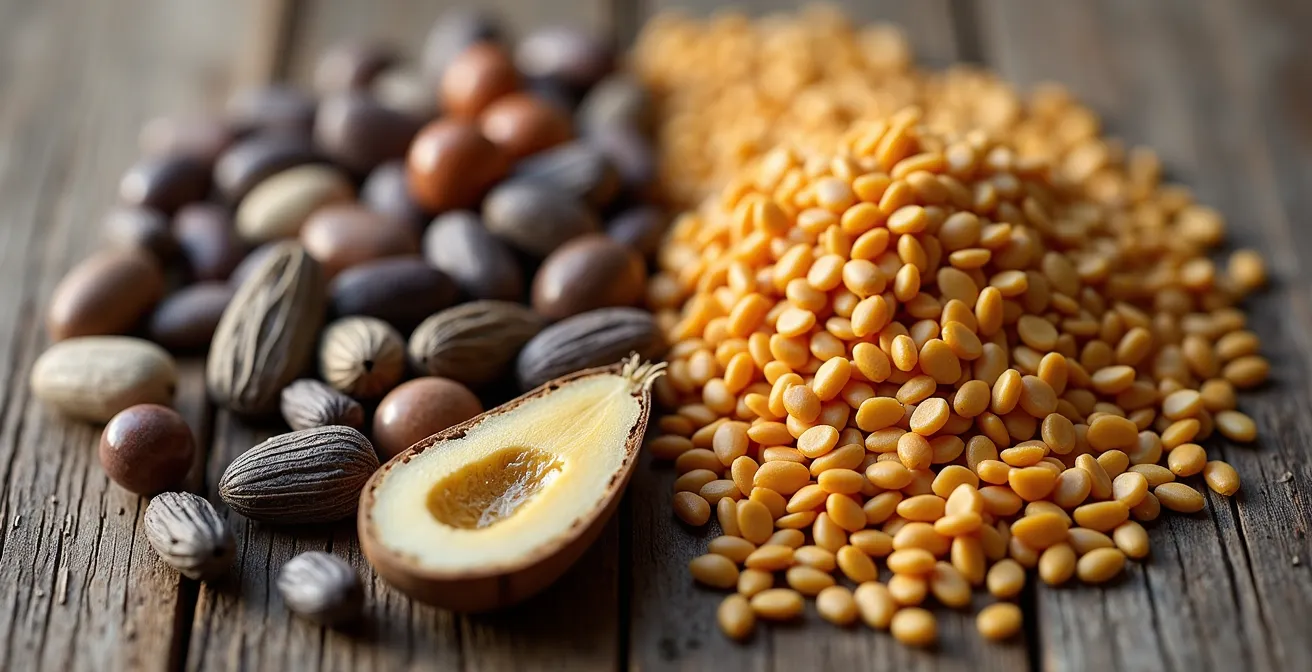
The visual difference between heirloom and hybrid seeds, as seen above, often hints at their internal complexity. The choice is not necessarily about one being universally “better” than the other, but about aligning genetics with goals. For a farmer targeting a commodity market based on tonnage, hybrids remain the logical choice. But for those aiming for a premium, nutrient-focused market, heirlooms offer a powerful tool for differentiation. Furthermore, emerging research shows that good genetics combined with regenerative practices can achieve both quality and quantity. For example, research comparing regenerative and conventional almond farms found that regenerative systems could maintain competitive yields while producing almonds with enhanced nutrient density.
The Breeding Habit That Removed Flavor and Nutrition
The decline in the nutritional content of modern produce is not an accident; it’s the direct result of a century of breeding decisions that systematically prioritized quantity over quality. To understand how we arrived here, it’s useful to view agricultural development in distinct phases. This historical context is essential for farmers looking to reverse the trend and build a business model around nutritional value.
As agricultural scientist Barbara O. Schneeman explained in the Journal of the Science of Food and Agriculture, this progression can be seen in three stages:
The first phase focuses on yield and ensuring an adequate supply of food. The second hones in on efficiency as a way to increase diversity among sources of nutrients. The third includes targeted ways to improve the nutrient density of particular crops.
– Barbara O. Schneeman, Journal of the Science of Food and Agriculture
For most of the 20th century, we were firmly in the first phase. The primary goal was to solve hunger by maximizing calories produced per acre. Plant breeders selected for traits like size, growth rate, and pest resistance—everything that contributed to higher tonnage. A side effect of this intense selection was the “dilution effect”: as plants grew bigger and faster, the concentration of vitamins, minerals, and phytonutrients within them often decreased. Flavor, which is closely linked to these compounds, diminished alongside them. We successfully engineered crops for yield, but inadvertently bred out their nutritional soul.
Today, we are entering the third phase. The market is beginning to demand crops that are not just big, but also nutritionally potent. This requires a conscious reversal of the old breeding habits, shifting focus from maximizing biomass to optimizing the synthesis of specific, health-giving compounds. It means selecting for flavor, for color, and for measurable nutrient content, turning yesterday’s forgotten traits into tomorrow’s premium products.
When to Harvest to Maximize Antioxidant Levels in Produce?
Maximizing the nutritional value of a crop doesn’t end with soil health and genetics; it extends to the precise moment of harvest. A plant’s nutritional content, particularly its level of antioxidants and other beneficial phytochemicals, is not static. It fluctuates throughout the ripening process, often peaking within a very narrow window. Harvesting too early or too late can mean leaving a significant portion of the crop’s potential value in the field.
Plants produce many of these compounds, such as phenolics and flavonoids, in response to environmental signals and stressors. They are part of the plant’s natural defense system. The peak of ripeness often coincides with the peak accumulation of these protective, and for humans, highly nutritious, compounds. For example, a tomato’s deep red color indicates high levels of lycopene, a powerful antioxidant. Harvesting it pale and allowing it to “ripen” in transit will never achieve the same nutritional profile as one picked at its peak from the vine.

This principle is backed by data. Studies on farms in California and Connecticut showed that spinach from regenerative farms had four times higher levels of phenolics than its conventional counterpart, a difference amplified by optimal harvest timing. The challenge for farmers has always been how to measure this peak in real-time. Historically, it was based on experience and visual cues. Today, technology is providing a more precise solution. The Bionutrient Institute, for instance, has developed a handheld spectrometer. This device uses light to provide a real-time, non-destructive measurement of nutrient levels in a plant, allowing a farmer to identify the exact moment of peak nutritional quality for harvest. This turns a subjective art into a data-driven science.
Why Your Wheat Protein Drops Despite High Nitrogen?
One of the most frustrating experiences for a grain farmer is investing heavily in nitrogen (N) fertilizer, seeing lush, green growth, and then discovering at the mill that protein levels are disappointingly low. This common problem perfectly illustrates the flaw in the “more is better” approach to fertilization. It’s a classic case of the dilution effect, where rapid biomass growth outpaces the plant’s ability to form complete, high-quality proteins. The issue isn’t a lack of nitrogen, but a bottleneck caused by the absence of another crucial nutrient: sulfur (S).
Nitrogen is the basic building block of amino acids, but two essential amino acids required for protein synthesis in wheat, methionine and cysteine, contain sulfur. Without adequate available sulfur, the plant can’t complete the protein-building process. It has plenty of nitrogen-based components but lacks the key “fasteners” to assemble them into the final product. The plant continues to pack on starchy biomass, effectively diluting the protein that it has managed to create. As soil health expert David Montgomery notes in a paper for Frontiers in Sustainable Food Systems, this is often a biological problem: “In a degraded soil with poor microbial life, even abundant applied N isn’t converted and delivered to the plant efficiently during the critical grain-fill period.”
The solution lies in balanced nutrition. Applying sulfur alongside nitrogen, especially during the later stages of growth, ensures the plant has all the necessary components for efficient protein synthesis. This “Agronomic Precision” approach moves beyond simply feeding the crop NPK and focuses on providing a complete diet that supports specific quality outcomes.
This table from an analysis of nutrient interactions clearly shows how a balanced approach outperforms a nitrogen-only strategy for building protein.
| Factor | High N Only | Balanced N+S | Impact on Protein |
|---|---|---|---|
| Biomass Growth | High | Moderate | Dilution effect with N only |
| Amino Acid Formation | Limited | Complete | S required for methionine/cysteine |
| Protein Percentage | Lower | Higher | Complete proteins need both |
| Late Season Uptake | Poor | Efficient | Sulfur improves N utilization |
Why NPK Alone Cannot Sustain Soil Health for 20 Years?
For much of the 20th century, synthetic NPK (Nitrogen, Phosphorus, Potassium) fertilizers were seen as a miracle, allowing farmers to achieve massive yields from their land. The model was simple: treat the soil like an inert medium, calculate what the crop removes, and replace it from a bag. This chemical-input model worked remarkably well in the short term, masking underlying issues and driving the “Green Revolution.” However, a 20-year or longer view reveals this approach to be fundamentally unsustainable. It’s like trying to live on a diet of energy drinks and vitamin pills; you can function for a while, but eventually, the system breaks down.
Relying solely on NPK ignores the living component of soil: the vast ecosystem of microbes, fungi, and invertebrates that are responsible for soil structure, water retention, and the natural cycling of nutrients. High concentrations of synthetic fertilizers, particularly nitrogen, can be harsh on this ecosystem, leading to a decline in soil organic matter and microbial diversity. As the biological life of the soil wanes, its physical structure degrades. It becomes compacted, less able to absorb and hold water, and far more susceptible to erosion by wind and rain.
The consequences of this long-term degradation are stark. An extensive study of the US Corn Belt, a region heavily reliant on synthetic inputs for decades, revealed a sobering reality. Research published in Frontiers in Sustainable Food Systems found that topsoil had been completely eroded from about one-third of the region over the past century. This loss of the most fertile soil layer has reduced the area’s overall crop yields by an estimated 6%, a deficit that is only masked by the application of even more synthetic fertilizer. This creates a vicious cycle of degradation, where ever-increasing inputs are required just to maintain a baseline of productivity on a fundamentally depleted resource.
Key Takeaways
- True nutrient density is driven by a living soil ecosystem, where microbes make nutrients available to plants.
- Marketing nutrient-dense crops requires a shift from commodity selling to ingredient branding, focusing on specific B2B benefits and traceability.
- Agronomic success depends on balanced nutrition (e.g., Nitrogen + Sulfur) and precise timing (e.g., harvest) to optimize specific quality traits.
How to Grow Potatoes That Meet Fry-Processors’ Specifications?
For farmers supplying the food processing industry, nutrient density isn’t an abstract health concept—it’s a set of precise, measurable specifications that directly impact profitability. In the case of potatoes destined for French fries, the key metric is specific gravity. This measurement of the potato’s density (solids content vs. water) is a proxy for its starch content. A higher specific gravity is highly desirable for processors, and achieving it requires a finely tuned agronomic strategy that goes far beyond simply maximizing tuber size.
Processors pay a premium for high specific gravity because it translates directly to a better, more profitable final product. As experts at Winfield United Agricultural Research note, “Higher specific gravity driven by balanced nutrition means lower oil absorption, resulting in a healthier, less greasy, and cheaper-to-produce final product for the processor.” Less water in the potato means less energy is needed to fry it, and less oil is absorbed during cooking, leading to a crispier, more desirable texture. Achieving this quality starts with meticulous nitrogen management, as excessive nitrogen can delay tuber maturation and lower the specific gravity.
The goal is to provide just enough nitrogen to build a healthy plant canopy without promoting excessive vegetative growth late in the season. This requires a shift from large, single applications to a more dynamic approach of monitoring and adjusting nutrient levels throughout the growing cycle.
Your Checklist: Nitrogen Management for High Specific Gravity Potatoes
- Early Season Foundation: Apply moderate N to establish a healthy plant framework without triggering excessive, leafy vegetative growth that can delay tuber initiation.
- Mid-Season Monitoring: Monitor petiole nitrate levels weekly. This data allows you to “spoon-feed” the crop, maintaining levels in the optimal range without over-applying.
- Pre-Bulking Reduction: Begin to reduce N application as the tubers start to bulk. This signals the plant to shift its energy from growing leaves to filling out the potatoes with starch.
- Final Four Weeks Cutoff: Cease all N application in the final 3-4 weeks before vine kill. This is critical to promote maturation and minimize the accumulation of reducing sugars, which cause undesirable browning during frying.
- Post-Harvest Verification: After harvest, test a sample of your potatoes for specific gravity and perform fry tests to verify they meet the processor’s specifications and to inform next year’s strategy.
The shift from a quantity-focused to a quality-driven agricultural model is not just a passing trend but a fundamental realignment with both biological realities and market demands. As we’ve seen, this involves a deeper understanding of soil microbiology, a strategic approach to genetics, and precision in both nutrient management and harvest timing. It’s about seeing crops not as bulk commodities, but as functional ingredients with specific, marketable attributes. For farmers willing to embrace this complexity and master these new levers of production, the future promises not just sustainability, but enhanced profitability and a stronger position in the value chain. Begin today by analyzing your market to identify a single, high-value nutritional trait, and build your strategy to deliver it with verifiable excellence.