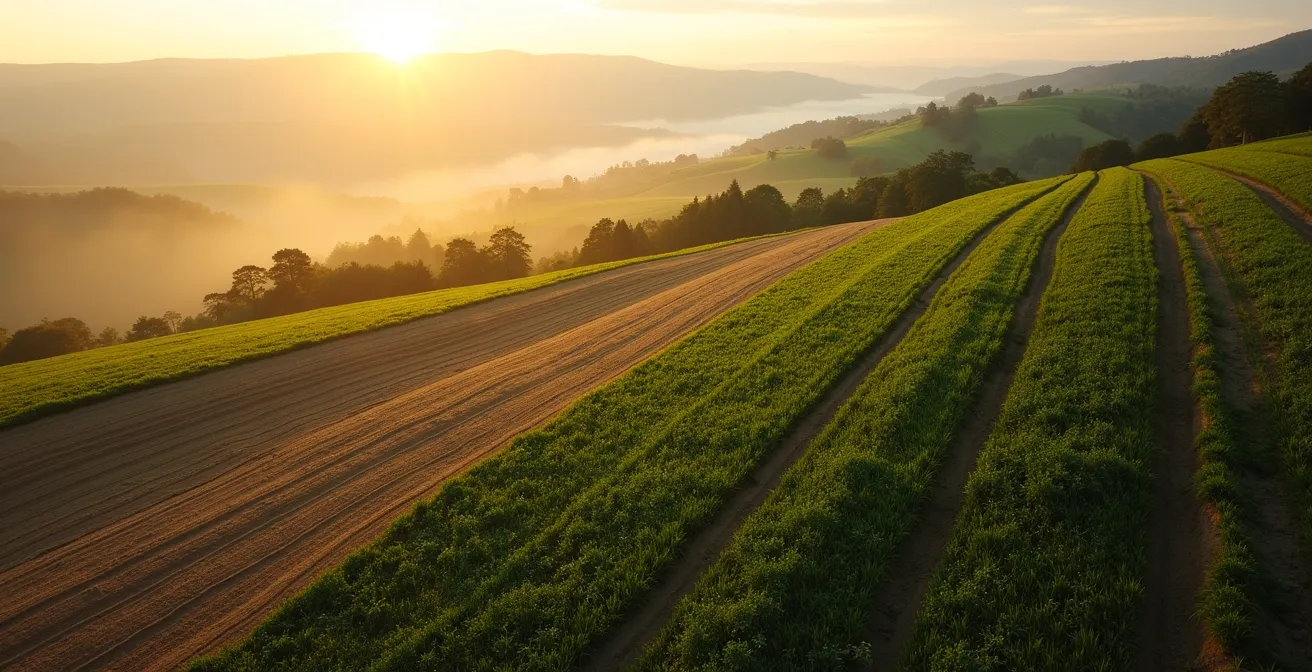
Gully formation is not just soil loss; it’s a structural failure of your farm’s water management system that costs thousands in lost assets and yield.
- Quantify the economic cost of each millimeter of topsoil to establish its asset value.
- Implement engineered structures like properly sized waterways and terraces to control water’s energy.
Recommendation: Shift from reactive repairs to a proactive, whole-farm ecosystem design to build long-term resilience and profitability.
That first small rill after a heavy rain is a warning sign. Ignored, it carves deeper with every storm, eventually becoming a gully—a scar on the land that snags equipment, complicates planting, and bleeds your most valuable asset into the nearest ditch. Many farmers react by plowing it over or throwing some seed into the channel, hoping for the best. These are temporary patches on a deep, systemic problem.
As a soil conservation engineer, I can tell you that the key to stopping gullies is to stop thinking of them as a nuisance and start treating them as a symptom of a structural failure. The real issue is the uncontrolled energy of moving water. Your farm is a hydrological system, and when that system is out of balance, it fails. The goal isn’t to fight the water, but to re-engineer the landscape to safely guide it, transforming a destructive force into a manageable flow.
This approach requires a shift in mindset: from reactive repair to proactive design. It means viewing your topsoil not as dirt, but as a capital asset with a quantifiable value that must be protected. It means understanding the physics of water flow on your specific slopes and implementing engineered solutions that provide long-term stability.
This guide will provide a structural framework for that process. We will first quantify the real cost of inaction to understand the stakes. Then, we will explore a series of proven engineering and agronomic solutions, treating each as a component in a resilient, profitable, and permanent farm ecosystem. It’s time to build a defense that lasts.
To navigate this comprehensive guide, we will break down the problem into its core components. The following summary outlines the key areas we will cover, from understanding the economic impact of soil loss to implementing specific structural and biological barriers that will protect your land for generations.
Summary: A Structural Guide to Preventing Gully Erosion
- Why Losing 1mm of Topsoil Costs More Than You Think?
- How to Size a Grassed Waterway for heavy Rain Events?
- Terraces or Contours: Which Solution Fits Your Slope?
- The Fall Tillage Habit That Accelerates Spring Erosion
- Where to Plant Windbreaks to Protect Light Sandy Soils?
- Why Non-PC Emitters Fail on Hilly Terrain?
- Why Planting Thick in Sandy Knolls Lose You Money?
- How to Build a Drought-Resilient Farm Ecosystem?
Why Losing 1mm of Topsoil Costs More Than You Think?
Every millimeter of lost topsoil isn’t just dirt; it’s a direct withdrawal from your farm’s most valuable capital asset. This is not an abstract environmental concern but a hard economic reality. The top layer of your soil is a finite resource, rich in organic matter and essential nutrients that drive your farm’s productivity. When it washes away, you are losing more than just a growing medium; you are losing fertility, water-holding capacity, and ultimately, yield potential.
The financial impact is staggering. A comprehensive analysis in North Dakota quantified this loss at approximately $1,113 for every inch of topsoil lost per acre. This figure accounts for the direct loss of nutrients like nitrogen, phosphorus, and potassium, as well as the invaluable organic matter that underpins soil health. To put it in perspective, a seemingly minor erosion event can represent a significant, unrecoverable financial loss across your entire operation.
This loss of your soil asset translates directly to reduced performance at harvest. The relationship between topsoil depth and crop yield is direct and unforgiving. As the most fertile layer thins, crop performance suffers, requiring higher inputs to achieve the same results, further squeezing your margins.
This data from Illinois demonstrates the clear, quantifiable link between soil erosion and yield. Even moderate erosion leads to a significant drop in productivity, while severe cases can be devastating to your bottom line. Protecting your topsoil is not an expense; it is the most fundamental investment in your farm’s long-term profitability.
| Erosion Level | Topsoil Removed | Corn Yield Loss |
|---|---|---|
| Low | 15 cm | 8.8% |
| High | 30 cm | 19.6% |
| Extreme (root-restricting subsoils) | Variable | Up to 24% |
How to Size a Grassed Waterway for heavy Rain Events?
A grassed waterway is not a simple grass strip; it is a carefully engineered hydraulic channel designed to manage the kinetic energy of concentrated water flow. Its purpose is to slow water velocity, prevent scouring, and safely convey runoff from your fields. An undersized waterway will be overwhelmed and eroded during a major storm, defeating its purpose. An oversized one may be inefficient. Proper design is critical for its success and longevity.
The design process begins with a thorough assessment of the watershed area that drains into the waterway. You must calculate the total acreage that contributes runoff to determine the volume of water the channel needs to handle during a peak storm event. Modern climate realities mean designing for historical norms is no longer sufficient. A robust waterway should be engineered to handle, at minimum, a 1-in-50-year storm event for your specific catchment size. This ensures resilience against the increasing frequency of extreme weather.
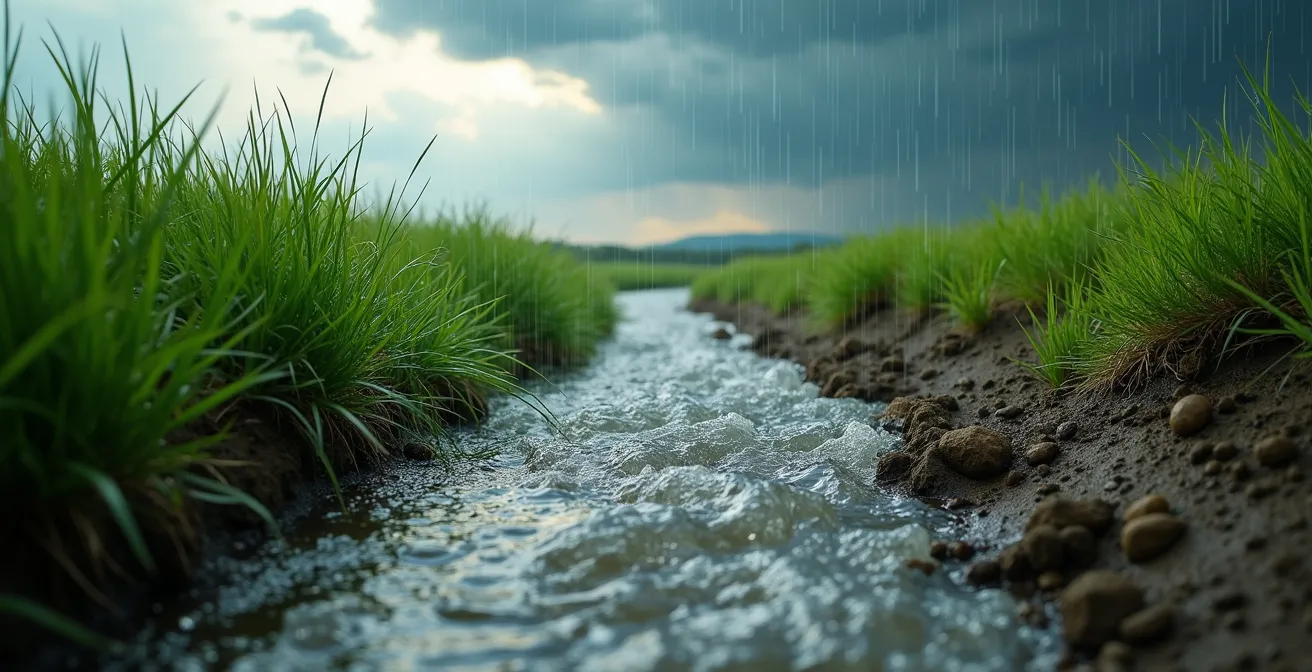
As the diagram illustrates, the shape of the waterway is as important as its size. Modern designs favor a wide, shallow, parabolic shape over a deep, narrow V-shape. This configuration is crucial for several reasons: it’s safer and easier to cross with large, modern farm equipment, it spreads the water flow over a larger area to reduce its erosive force, and it is easier to establish and maintain a dense stand of vegetation. Integrating tile drainage along the sides can further enhance performance by managing subsurface water.
Your Action Plan: Designing Climate-Adapted Grassed Waterways
- Calculate the total drainage area and segment ephemeral gully areas into shorter, manageable sections, potentially using terraces to intercept flow.
- Design the channel capacity for at least a 1-in-50-year storm event, based on the specific size and slope of your catchment area.
- Use a shallow design depth (e.g., 1 foot) with a wide, parabolic channel to accommodate modern equipment and reduce water velocity.
- Flatten the side slopes (e.g., 10:1 ratio or flatter) to make the waterway easy to cross and farm over.
- Install parallel tile drainage along each side of the waterway to manage subsurface water and keep the channel stable and dry between rain events.
- Establish a dense, resilient stand of perennial vegetation, such as a mix of sod-forming grasses, to provide a durable armor against scouring.
Terraces or Contours: Which Solution Fits Your Slope?
Once you move beyond gentle undulations, managing water’s energy requires more than just in-field practices; it demands structural intervention. Terraces and contour farming are two foundational engineering tools for shortening slope length and reducing water velocity. However, they are not interchangeable. Choosing the right solution depends entirely on the specific topography of your field. Applying the wrong one can be ineffective or even counterproductive.
Contour farming is the practice of performing all field operations, like planting and tilling, along lines of consistent elevation. The small ridges created by this practice act as thousands of tiny dams, slowing runoff and increasing water infiltration. It is a highly effective, low-cost solution for gentle slopes, typically under 8%. On steeper terrain, however, the volume and velocity of water can easily overwhelm these small ridges, leading to breaches and concentrated erosion.
Terraces are earthen embankments or channels built across the slope. They are a much more significant structural intervention designed for steep slopes, often greater than 12%. Terraces break a long, steep slope into a series of shorter, flatter ones. Each terrace intercepts runoff and directs it to a stable outlet, like a grassed waterway. While highly effective, achieving a 50% reduction in soil loss is possible, they represent a significant upfront investment in earthwork and require careful planning to integrate with equipment patterns.
The decision between these two powerful tools is a classic engineering trade-off analysis, balancing effectiveness, cost, and operational impact. The following matrix provides a clear framework for selecting the most appropriate system for your land.
| Factor | Terraces | Contour Farming |
|---|---|---|
| Ideal Slope Range | >12% steep slopes | <8% gentle slopes |
| Initial Investment | High (earthwork required) | Low (change in planting pattern) |
| Maintenance Cost | Moderate (structural upkeep) | Low (annual planning) |
| Equipment Impact | Creates point rows, reduces efficiency | Minimal turning radius issues |
| Erosion Reduction | Up to 50% on steep slopes | 30-40% on moderate slopes |
The Fall Tillage Habit That Accelerates Spring Erosion
One of the most destructive habits for soil’s structural integrity often occurs in the fall. The conventional wisdom of performing fall tillage to “clean up” fields and prepare a seedbed for spring leaves the soil dangerously exposed. An aggressively tilled field, especially with implements like a chisel plow or disk, enters the winter and spring seasons without its natural armor: crop residue. This bare, pulverized surface is left vulnerable to the full force of winter winds and, more critically, the intense rains of spring thaw.
This practice fundamentally compromises the soil’s ability to withstand erosive forces. As the University of Nebraska’s CropWatch extension highlights in their publications, the issue is twofold:
Tillage destroys soil structure and reduces the residue cover, leaving the soil surface more prone to erosion and runoff.
– University of Nebraska CropWatch, CropWatch Extension Publication
By breaking up soil aggregates, tillage destroys the very pores and channels that allow water to infiltrate. Instead of soaking in, rainwater runs off the surface, gaining speed and energy as it goes. Without the protective blanket of residue to absorb the impact of raindrops and slow the flow, this runoff easily detaches soil particles, initiating the process of rill and gully erosion. The difference between a tilled and an untilled field is not subtle.
The quantitative data on this is stark. A study from North Carolina demonstrated that a conventional system using a chisel and disk resulted in a staggering 33.3 tons of soil loss per acre per year. In stark contrast, a no-till system on the same soil type lost only 1.2 tons. This isn’t a marginal difference; it’s a fundamental divergence in the long-term stewardship of your soil asset. Resisting the urge for fall tillage and embracing practices that maintain residue cover is a critical first step in building a structurally sound and resilient field.
Where to Plant Windbreaks to Protect Light Sandy Soils?
The principles of erosion control are not limited to water. Just as uncontrolled water flow carries away soil, the energy of wind can be equally destructive, particularly on fields with light, sandy, or organic soils. Wind erosion strips away the finest, most fertile particles, leaving behind less productive sand. The solution, much like with water, is to engineer a barrier that interrupts the energy flow: a windbreak.
A windbreak is a strategic planting of trees and shrubs designed to reduce wind speed on its leeward side, creating a zone of protection for soil and crops. It is not just a “tree line”; its placement, density, and composition are critical engineering considerations. A properly designed windbreak doesn’t stop the wind but rather lifts it and slows it down, causing it to drop any soil particles it is carrying and reducing its ability to pick up more.
The key to effective placement is understanding the “zone of protection.” A general rule of thumb is that a windbreak protects an area downwind for a distance of approximately 10 times its height (10H). Therefore, a 40-foot-tall windbreak will provide significant wind speed reduction for up to 400 feet. For large fields, this may require a series of parallel windbreaks. They should always be planted perpendicular to the prevailing, most damaging wind direction for maximum effect.

Beyond erosion control, windbreaks are a cornerstone of an integrated, resilient farm system. As this image of a mature windbreak shows, the benefits are multifaceted. They provide valuable shade for livestock, create habitat for beneficial insects and pollinators, can reduce crop moisture stress, and in some cases, provide an additional source of income from timber or fruit. By strategically integrating these living structures, you are building a more robust and buffered agricultural ecosystem.
Why Non-PC Emitters Fail on Hilly Terrain?
The principle of managing energy to prevent erosion applies at the micro-level, too. On hilly or undulating terrain, your irrigation system itself can become an unwitting source of erosion if not engineered correctly. Drip irrigation is often promoted as a water-wise and erosion-friendly choice, and while that can be true, the specific type of emitter used is the critical factor that determines success or failure on slopes.
The problem is physics: water pressure changes with elevation. In a standard drip system using non-pressure-compensating (Non-PC) emitters, the emitters at the lowest points of the field receive the highest pressure. This causes them to discharge significantly more water than emitters at the top of the slope. This creates two problems: the top of the hill is under-watered, stressing crops and leaving dry soil vulnerable, while the bottom is over-watered. This localized saturation can trigger runoff and soil erosion, creating gullies right at the base of your rows.
The solution is an engineering one: using pressure-compensating (PC) emitters. These emitters have a built-in diaphragm that regulates the flow rate, ensuring that each emitter delivers the same amount of water, regardless of its position on the slope or the pressure in the line. This uniform application prevents both the under-watering at high points and the erosive over-watering at low points. Using PC emitters is non-negotiable for any drip system on sloped ground.
Case Study: Pressure Compensating Emitter Performance on Slopes
Analysis of irrigation systems on hilly terrain demonstrated that pressure compensating (PC) emitters maintain uniform water distribution despite elevation changes. This prevents both over-watering at low points, which is a primary cause of localized erosion, and under-watering at high points, which leaves soil dry and vulnerable. In contrast, systems using non-PC emitters showed a dramatic 40-60% variation in water application rates across the same slopes, directly contributing to runoff and inefficient water use.
Why Planting Thick in Sandy Knolls Lose You Money?
Applying a uniform, “factory” setting to a naturally variable field is an engineering mistake that costs money. A prime example is applying a single, high-population planting rate across an entire field that includes sandy knolls or eroded hilltops. While aiming for a high plant population makes sense in productive, high-organic-matter zones, it is a financially losing strategy on low-water-holding, low-fertility soils.
Sandy knolls are, by their nature, resource-limited environments. They hold less water and fewer nutrients than the rest of the field. Forcing a dense population of plants to grow in such a constrained area is a recipe for failure. Instead of thriving, the plants are forced into intense competition with each other for scarce resources. This stress leads to weak, spindly plants that produce smaller ears or pods, or may not produce a harvestable yield at all.
As agricultural researchers have pointed out, this competition negates any potential benefit of high density in these specific zones. This insight is critical for optimizing inputs and maximizing profitability.
Excessive plant density on low water-holding capacity soils forces plants to compete for scarce resources, resulting in lower yields for the entire population.
– Southland Organics Agricultural Research Team, Farming Techniques That Prevent Erosion
You are essentially paying for seed, fertilizer, and other inputs that will not provide a positive return on investment. In the most severely eroded areas, this strategy can be devastating. Extensive erosion research shows that up to 90% yield reduction can occur in these root-restrictive, shallow lands. The smart, engineered approach is to use variable rate planting technology. By reducing the seeding rate on these sandy knolls, you reduce input costs, lessen plant stress, and allow the remaining plants to access enough resources to produce a more optimal yield, turning a losing proposition into a managed one.
Key Takeaways
- Topsoil is a financial asset; its loss has a direct, quantifiable cost in nutrients and yield potential, reaching over $1,000 per inch per acre.
- Engineered structures are essential. Grassed waterways and terraces are not just grass and dirt; they are hydraulic channels and structural supports that must be designed for specific slope and storm conditions.
- Soil’s structural integrity is paramount. Fall tillage destroys this structure and removes its protective residue armor, dramatically accelerating spring erosion compared to no-till systems.
How to Build a Drought-Resilient Farm Ecosystem?
Building a truly resilient farm is the ultimate goal of soil engineering. It’s about creating a holistic system that not only withstands the force of a heavy downpour but also thrives during a prolonged drought. The strategies that prevent erosion are the very same strategies that build drought resilience. The connection is water. An erosion-prone system sheds water, while a resilient system captures, stores, and makes it available to crops.
The foundation of this system is soil organic matter, built through practices like no-till farming and cover cropping. Maintaining a permanent “armor” of crop residue and living plants on the soil surface does more than just deflect raindrops. This layer feeds soil biology, which in turn builds stable soil aggregates. These aggregates create a sponge-like structure, full of macropores that allow water to infiltrate rapidly instead of running off. Research confirms that 100% no-till adoption could prevent 95% of erosion over the next century, safeguarding this crucial structure.
Cover crops are a particularly powerful tool in this system. They keep a living root in the soil during fallow periods, building organic matter and creating root channels for water infiltration. A study on cover crop impacts showed a single cereal rye cover crop could reduce soil loss by 60% and nitrate leaching by around 30%. This not only keeps valuable nutrients in your field but also dramatically improves your soil’s water-holding capacity, making more moisture available to your cash crop during dry spells.
Ultimately, a drought-resilient ecosystem is one where every drop of rain is seen as a resource to be captured, not a problem to be shed. By focusing on building soil health through minimized disturbance, continuous cover, and maximizing biodiversity, you are engineering a system that is structurally sound, biologically active, and economically robust in the face of climatic extremes.
The journey from a reactive to a proactive approach to soil management is the single most important investment you can make in the long-term viability of your farm. Begin today by evaluating your fields, identifying critical areas, and implementing one of these structural or biological solutions to build a more resilient and profitable operation for the future.