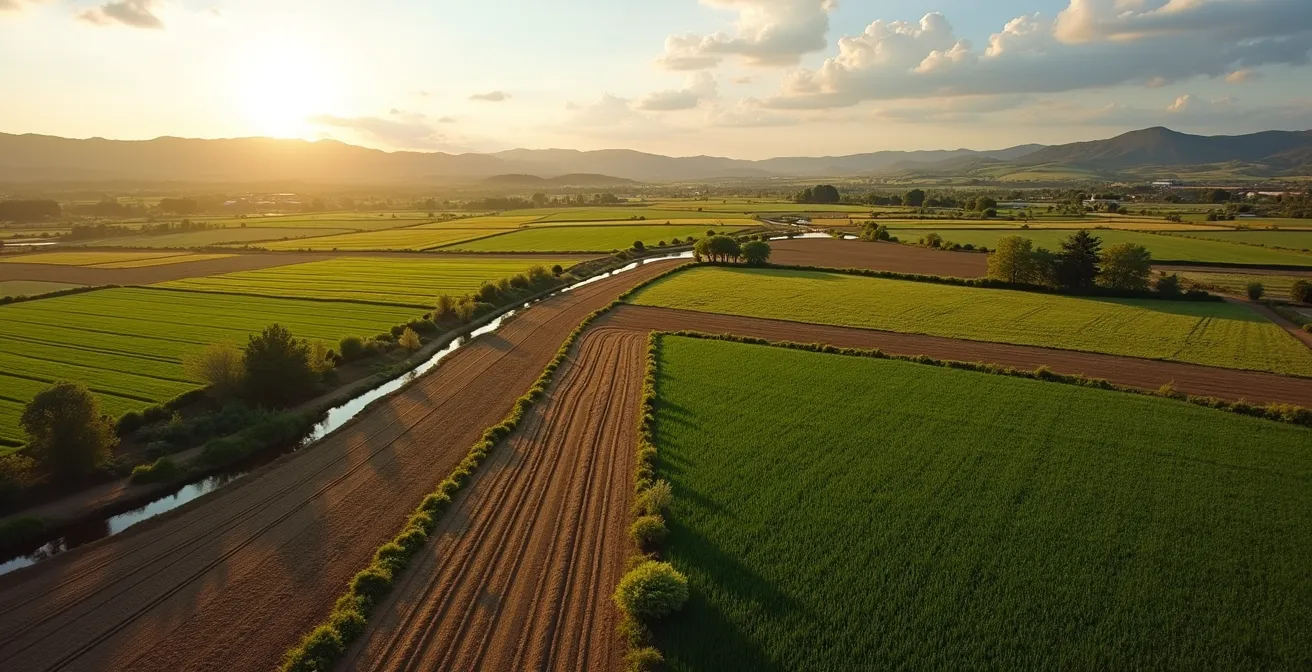
Building a drought-proof farm is not about isolated tactics but about re-engineering your farm’s entire operating system to be inherently resilient and self-regulating.
- Soil health is the foundation, where a 1% increase in organic matter can save thousands of gallons of water per acre.
- True resilience extends beyond the field to include economic insulation through crop diversity and supply chain independence.
Recommendation: Shift your mindset from defensive survival to proactive ecosystem design, focusing on systemic interdependence rather than single-point solutions.
For farmers in regions battling erratic rainfall, the threat of drought is a constant pressure. The conventional response often involves a frantic search for solutions: drilling deeper wells, switching to a single “drought-tolerant” crop, or installing more efficient sprinklers. While these measures can offer temporary relief, they are often just short-term patches on a systemic problem. They treat the symptoms of a brittle agricultural model rather than addressing the root cause, keeping the farm in a perpetual state of vulnerability, always one failed rain away from a crisis.
But what if the goal wasn’t merely to survive the next dry spell? What if you could engineer a farm ecosystem so resilient that it treats water scarcity not as a catastrophe, but as a manageable variable? The key is a paradigm shift: moving away from fighting nature with costly, high-energy inputs and toward designing a self-regulating system that works with natural cycles. This approach focuses on building a farm with high metabolic efficiency, where resources like water and nutrients are captured, stored, and cycled with minimal loss. True drought resilience is not found in a single technology or crop, but in the intelligent integration of soil biology, crop diversity, water intelligence, and supply chain autonomy.
This guide provides a strategic blueprint for this transformation. We will explore how to turn your soil into a massive water reservoir, use crop diversification for economic insulation, and leverage data to make irrigation decisions with surgical precision. By the end, you will have a framework for building a farm that doesn’t just endure drought, but is fundamentally structured to thrive in a volatile climate.
To fully grasp the foundational role of soil in this system, the following video offers a compelling visual immersion into why soil health is the starting point for all agricultural resilience. It perfectly complements the strategies we are about to discuss.
To navigate this strategic framework, we have structured the key pillars of a resilient farm ecosystem into distinct components. The following summary outlines the path we will take, from the microscopic life in your soil to the macro-economic forces that impact your bottom line.
Summary: A Blueprint for a Drought-Resilient Farm Ecosystem
- Why Increasing Organic Matter by 1% Save Thousands of Gallons?
- How to Diversify Crops to Insulate Income from Weather Shocks?
- Agroforestry or Windbreaks: Which Protects Crops Better?
- The Supply Chain Reliance That Bankrupts Farms During Crises
- When to Shift Planting Dates to Dodge Summer Heat Waves?
- Why Scheduling by Timer Wastes Water Compared to ET Data?
- Why Relying Solely on Intuition Risks 30% of Your Yield?
- How to Reduce Water Usage by 20% With Soil Moisture Sensors?
Why Increasing Organic Matter by 1% Save Thousands of Gallons?
The most powerful and cost-effective water reservoir on any farm is not a tank or a pond; it’s the soil itself. A farm’s ability to capture and hold rainfall is directly tied to its soil organic matter (SOM). Healthy soil, rich in carbon, acts like a sponge. The complex structures created by decomposed plant material, microbial life, and root systems create pore spaces that absorb water, preventing it from running off the surface or evaporating. This principle of “ecosystem engineering” starts from the ground up, turning your land into an active participant in water management.
The numbers are staggering. According to USDA data, every 1% increase in soil organic matter can result in the soil holding as much as 25,000 gallons of additional water per acre. This isn’t just a marginal gain; it’s a fundamental shift in your farm’s metabolic efficiency. Instead of water being a transient resource you must constantly replenish through irrigation, it becomes a stored asset within your production system. This stored moisture provides a critical buffer during dry spells, sustaining crops long after the last rain and reducing the immense pressure on groundwater or surface water sources.
Case Study: Gabe Brown’s Regenerative Farm
Gabe Brown’s farm in North Dakota is a testament to this principle. Faced with drought, he didn’t invest in more irrigation; he invested in his soil. By implementing no-till practices and ensuring living roots were always in the ground, he dramatically increased his soil’s natural water infiltration. As documented in his book “Dirt to Soil” and highlighted by the NRDC, this approach allowed his farm to capture and retain rainwater effectively, transforming depleted dirt into a highly productive, resilient ecosystem that plans for the long-term.
Action Plan: Build Soil Organic Matter for Water Retention
- Apply 1-2 tons of high-quality compost per acre annually, aiming for a compost with 50-60% organic matter content and a water-holding capacity over 100%.
- Implement no-till or reduced tillage practices to preserve the soil’s natural structure and microbial networks, which are crucial for water absorption.
- Use diverse cover crop mixes continuously to add organic material, protect the soil surface from erosion and evaporation, and feed soil biology.
- Maintain crop residues on the fields after harvest to act as a mulch, reducing water loss and steadily adding carbon back into the soil.
- Choose composts with a tested water holding capacity of 100% or higher to ensure you are maximizing the water retention benefit per application.
How to Diversify Crops to Insulate Income from Weather Shocks?
Relying on a single crop, or monoculture, is a high-stakes gamble in a volatile climate. A single pest outbreak, a poorly timed heatwave, or a market price collapse can wipe out an entire year’s income. Crop diversification, or polyculture, is a powerful strategy for volatility insulation. By cultivating a mix of crops with different growing seasons, water needs, and market outlets, you build a portfolio of revenue streams. If one crop fails due to specific weather conditions, others may thrive, buffering your farm’s overall financial health.
This strategy is about more than just risk management; it’s about building a more robust and productive agroecosystem. Different plants explore different soil depths with their roots, cycle different nutrients, and attract a wider range of beneficial insects and microbes. This systemic interdependence enhances the overall health and productivity of the farm. For instance, intercropping deep-rooted grains with shallow-rooted legumes can improve soil structure and nutrient availability for both. With global food demand projected to rise significantly, creating resilient and productive systems is paramount. The United Nations estimates a 60% increase in food demand by 2050, a need that brittle monocultures cannot reliably meet.

This diversification extends beyond cash crops. Integrating livestock, timber, or fruit-bearing perennials creates stacked enterprises on the same land base, each contributing to the farm’s ecological and economic stability. It’s a move from a simple production line to a complex, interconnected, and far more resilient economic web. This approach mimics the diversity of a natural ecosystem, which is inherently more stable than any man-made monoculture.
Agroforestry or Windbreaks: Which Protects Crops Better?
Protecting crops from harsh, drying winds is a cornerstone of water conservation. Wind accelerates evaporation from the soil surface and increases transpiration from plants, rapidly depleting precious moisture. The traditional solution is a windbreak—typically a single or double row of trees or shrubs planted to slow the wind. While effective, this approach can be upgraded to a far more productive and integrated system: agroforestry.
Agroforestry is the intentional integration of trees and shrubs into crop and animal farming systems to create environmental, economic, and social benefits. It takes the concept of a windbreak and elevates it into a multi-functional component of the farm ecosystem. While a traditional windbreak’s primary function is wind reduction, an agroforestry system provides that same protection while also generating additional income, improving soil health, and boosting biodiversity. It’s a prime example of systemic interdependence, where one element serves multiple strategic functions.
The choice between a simple windbreak and an integrated agroforestry system depends on a farm’s long-term strategic goals. A windbreak is a faster, more straightforward solution for immediate wind protection. Agroforestry is a longer-term investment in building a complex, resilient, and multi-revenue system. A comparison reveals the distinct advantages of each approach.
| Feature | Traditional Windbreaks | Integrated Agroforestry |
|---|---|---|
| Wind Protection | High – reduces wind speed 50-80% | Very High – multi-layered protection |
| Water Conservation | Moderate – reduces evaporation | High – shade + mycorrhizal networks |
| Income Generation | None – maintenance cost only | Multiple – nuts, fruits, timber, fodder |
| Soil Health Impact | Limited to edge effects | Extensive – fungal networks throughout |
| Biodiversity Support | Moderate – single species rows | High – multiple habitat layers |
| Establishment Time | 3-5 years | 5-10 years for full benefits |
The Supply Chain Reliance That Bankrupts Farms During Crises
A farm can have the healthiest soil and the most efficient irrigation, but if it depends entirely on external supply chains for critical inputs, it remains profoundly vulnerable. Droughts and other climate crises don’t just impact fields; they disrupt transportation, manufacturing, and markets. A sudden spike in the price of synthetic fertilizer, a shortage of imported animal feed, or a disruption in fuel delivery can cripple a farm’s operations and erase its profit margins, regardless of its harvest. This reliance is a hidden fragility in the modern agricultural model.
Achieving resource sovereignty is a critical pillar of drought resilience. This means systematically reducing dependence on external inputs and cultivating on-farm solutions. For example, developing a robust composting system transforms on-farm “waste” into a valuable fertilizer, insulating the farm from the volatile global fertilizer market. Growing a portion of your own animal feed or forming local feed cooperatives can buffer against price shocks. The economic cost of these disruptions is immense; a report from the National Integrated Drought Information System found that since 1980, 26 major droughts cost the U.S. at least $249 billion. Much of this economic damage stems from the cascading failures of brittle supply chains.
Building this independence requires a strategic mapping of all external dependencies—from seeds and fuel to fertilizers and feed. Once identified, a plan can be made to systematically replace them with internal or local alternatives. Creating community seed banks with neighboring farms preserves genetic diversity and ensures access to locally adapted seeds. Implementing renewable energy systems, like solar-powered pumps, reduces reliance on a fluctuating fuel market. Each step toward resource sovereignty is a step toward building a farm that controls its own destiny, with an economic structure as resilient as its soil.
When to Shift Planting Dates to Dodge Summer Heat Waves?
One of the most predictable effects of a changing climate is the shifting of seasons, with summer heat waves arriving earlier and lasting longer. For many crops, the flowering and grain-filling stages are the most vulnerable to extreme heat and water stress. A perfectly healthy crop can see its yield decimated if a multi-day heatwave strikes during this critical reproductive window. Relying on traditional planting calendars without adapting to these new patterns is a recipe for failure.
A proactive resilience strategy involves shifting planting dates to dodge the most brutal summer heat. This might mean planting earlier in the spring to ensure the crop’s critical reproductive phase is complete before the peak of summer. In some regions, it could mean shifting to late-summer or fall planting for certain crops to take advantage of cooler temperatures and autumn rains. This tactical adjustment requires careful observation of long-term weather patterns and a deep understanding of each crop’s specific lifecycle. The urgency is clear; in regions like California, the Department of Water Resources has warned that by 2050, every year has a 50% chance of being an extreme drought year, making adaptive timing essential.
This strategy must be paired with the right crop selection. Scientists have successfully developed varieties of key staples like rice, maize, and wheat that are more tolerant of heat and water shortages. Combining these improved genetics with adaptive planting calendars creates a powerful, synergistic effect. The goal is to create a “temporal niche” for your crops, a window in the calendar where they can thrive by avoiding the worst climatic stressors. It’s a low-cost, high-impact adjustment that moves farming from a rigid schedule to an intelligent, responsive dance with the changing climate.
Why Scheduling by Timer Wastes Water Compared to ET Data?
In the quest for water efficiency, many farms have upgraded their hardware to drip or micro-sprinkler systems. While these systems are a massive improvement over flood irrigation, simply installing better hardware is only half the battle. The most common mistake is to run these efficient systems on a fixed timer schedule—irrigating for the same duration, at the same time, every day or two. This approach completely ignores the single most important factor in a plant’s water needs: the weather.
A timer-based schedule is a blunt instrument. It over-waters on cool, cloudy, or humid days, wasting water and potentially causing root disease. It under-waters on hot, dry, and windy days, causing crop stress and yield loss precisely when water is most critical. The strategic alternative is scheduling irrigation based on evapotranspiration (ET) data. ET is the combination of water evaporating from the soil surface and transpiring from the plant’s leaves. It is, in effect, a precise measurement of how much water your crop is actually using and losing to the atmosphere each day. This data, available from local weather networks or calculated with on-farm sensors, allows a farmer to replace only the water that was lost since the last irrigation cycle.
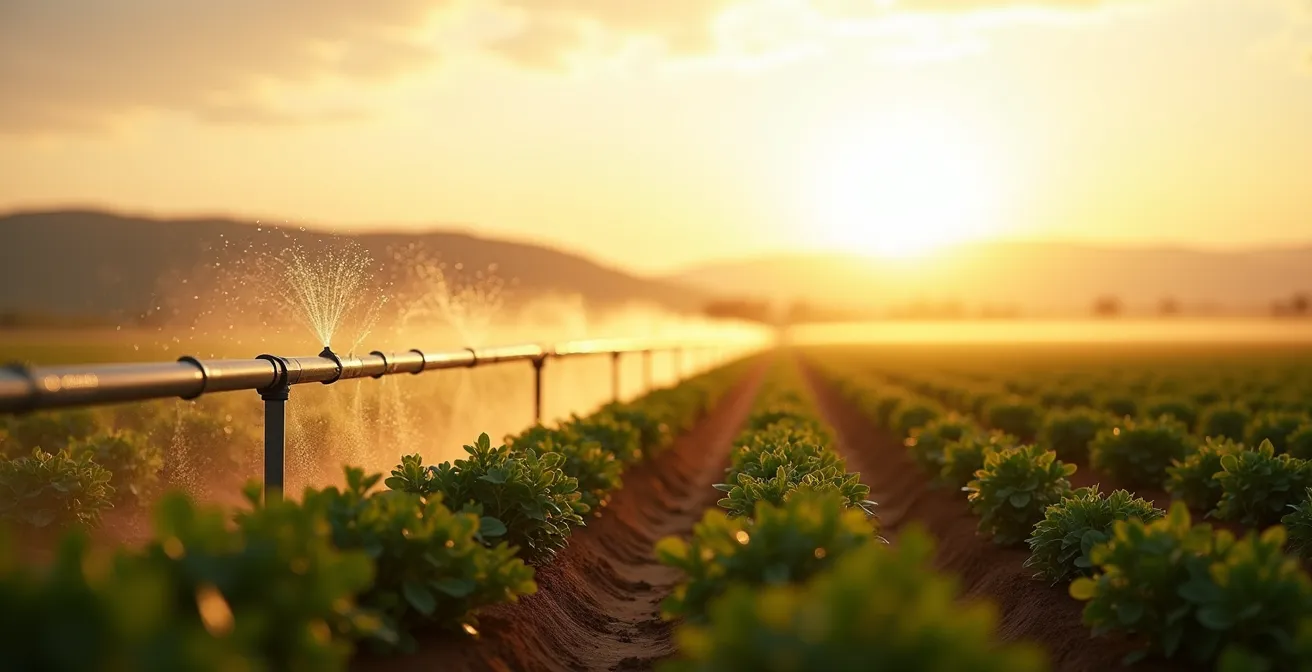
This data-driven approach transforms irrigation from guesswork into a precise, resource-efficient operation. It ensures the crop gets exactly what it needs, when it needs it, maximizing growth while minimizing waste. While upgrading the physical system is important—efficient systems like drip irrigation can significantly reduce agricultural water use—the intelligence behind the schedule is what unlocks the full potential of that hardware. It’s the difference between having a high-performance tool and knowing how to use it with expert skill.
Why Relying Solely on Intuition Risks 30% of Your Yield?
Farming has always been a blend of art and science, with generations of success built on experience and a “feel” for the land. This intuition is invaluable, but in an era of unprecedented climate volatility and tight margins, relying on it alone can be a costly liability. Intuition can’t accurately quantify the water-holding capacity of your soil, the precise nutrient deficit in a specific field, or the real-time water stress a crop is experiencing. Decisions based on “what feels right” can easily lead to over- or under-watering, inefficient fertilizer application, and missed opportunities, potentially risking a significant portion of a farm’s yield.
Data-driven farming is not about replacing the farmer’s experience; it’s about augmenting it with precise, actionable intelligence. It provides a quantitative basis for the qualitative “feel” a farmer has. For example, intuition might suggest a field is dry, but a soil moisture sensor can tell you exactly how dry, at what depth, and whether it has crossed a critical stress threshold for your specific crop. This allows for a targeted response instead of a generalized one. It’s the difference between “I think it needs water” and “It needs 0.75 inches of water in the next 12 hours to avoid yield loss.”
This approach moves the farm from a reactive to a proactive management style. For instance, knowing that each 1% increase in soil organic matter not only holds more water but also provides up to 30 pounds of available nitrogen per acre allows a farmer to make smarter, data-informed decisions about fertilizer inputs. Healthier soil, fostered by practices like no-till and cover cropping, becomes a measurable asset that directly translates to reduced input costs and enhanced resilience. Relying on data isn’t about losing the “art” of farming; it’s about giving the artist a far better set of tools to create a masterpiece of efficiency and resilience.
Key Takeaways
- True drought resilience is a systemic farm redesign, not a collection of unrelated tactics.
- Soil organic matter is your most valuable water storage asset, directly impacting your farm’s ability to weather dry spells.
- Economic resilience is as important as ecological resilience; diversify crops and reduce supply chain dependencies to insulate your income.
How to Reduce Water Usage by 20% With Soil Moisture Sensors?
While ET data provides a macro view of water needs, soil moisture sensors provide the critical ground-truth. These sensors, placed at various depths in the root zone, give a direct, real-time measurement of the water available to your plants. This technology closes the loop on precision irrigation, allowing a farmer to verify that the water being applied is actually reaching and staying where it’s needed. They are the final checkpoint in a data-driven water management strategy, often enabling water usage reductions of 20% or more by eliminating guesswork entirely.
By using sensors, a farmer can set precise upper and lower moisture thresholds. Irrigation is triggered only when the soil moisture drops to the lower limit, preventing plant stress. The system then shuts off as soon as the moisture level reaches the upper limit, preventing over-watering, nutrient leaching, and waterlogging. This creates a perfect, resource-efficient environment for crop growth. In the broader context of agricultural water use, this level of precision is revolutionary. While alternative systems like hydroponics demonstrate extreme efficiency by using up to 90% less water than traditional farming, they represent a complete shift away from soil. Soil moisture sensors offer a way to achieve massive efficiency gains *within* a soil-based ecosystem.
This transition from intuition to data-driven, sensor-verified irrigation is the hallmark of a resilient, 21st-century farm. It embodies the principle of working smarter, not harder, using technology to enhance and validate the health of the natural system you are managing. As regenerative pioneer Gabe Brown states, this approach is foundational to success.
For a producer to turn a profit, they must have a healthy, fully functioning soil ecosystem. The Drought-Resilient Farm is the blueprint for achieving successful results.
– Gabe Brown, Rancher and Regenerative Pioneer, Bismarck, ND
To truly build a farm that thrives on volatility, begin today by implementing these strategies. Start with the soil, measure your progress with data, and strategically design a system where ecological health and economic profitability are one and the same.
Frequently Asked Questions on Building a Drought-Resilient Farm
How much water can soil hold per 1% increase in organic matter?
Every 1% increase in soil organic matter allows the soil to hold as much as 25,000 gallons of additional water per acre. Furthermore, each pound of organic matter itself can hold up to 20 pounds of water, turning your soil into a highly effective natural sponge.
What are the main soil health practices that increase drought resilience?
The key practices for building healthier, more resilient soil include: implementing reduced- or no-till farming to preserve soil structure, using diverse cover crops to continuously feed soil biology, and practicing effective mulching and crop residue management to protect the soil surface and reduce evaporation.
How does increased organic matter affect nitrogen availability?
Beyond water retention, increasing soil organic matter also enhances nutrient cycling. Each 1% increase in organic matter can provide up to 30 pounds of additional available nitrogen per acre, reducing the need for synthetic fertilizers and lowering input costs.