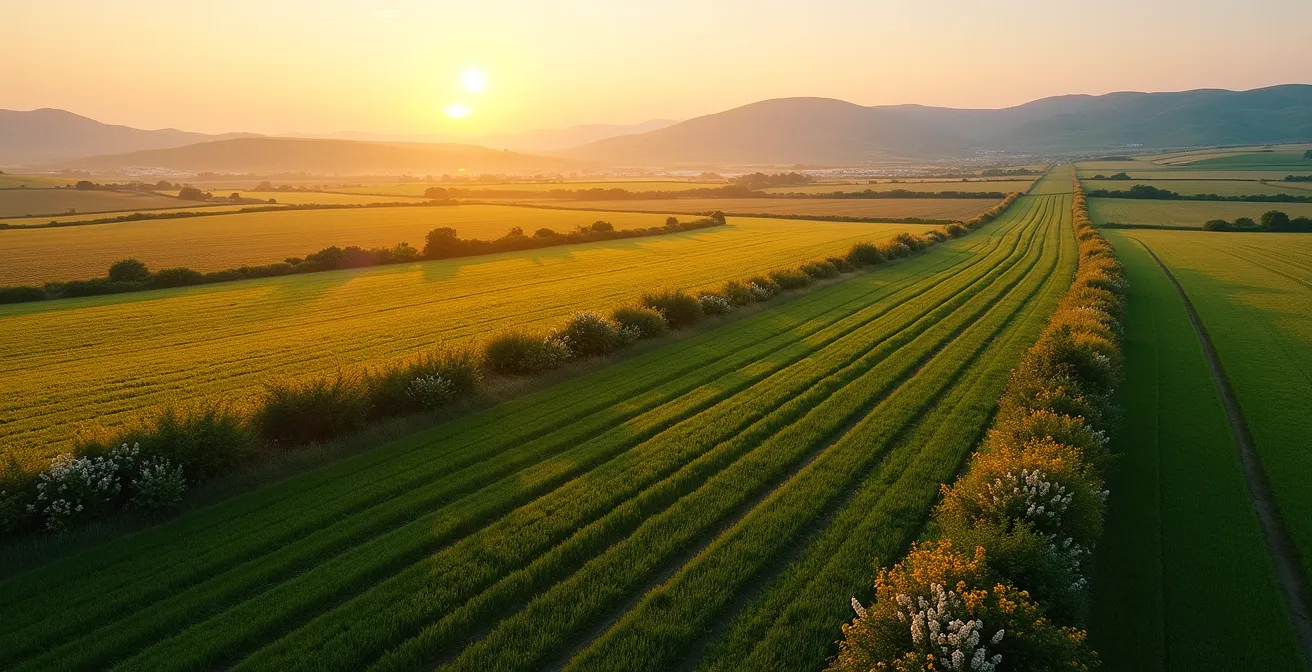
In summary:
- Large, uniform fields act as barriers, preventing beneficial insects from reaching pest populations in the center of your crops.
- Designing an “insect highway system” with corridors like beetle banks and hedgerows provides the infrastructure for natural pest control to thrive.
- The choice of plants, the placement of corridors, and a “benign neglect” maintenance strategy are more critical than simply planting flowers.
- Strategic design can lead to dramatic reductions in insecticide use, turning your farm into a self-regulating ecosystem.
For many farm owners, the rhythm of the seasons is accompanied by the constant, costly battle against pests. The conventional approach often feels like a war of attrition fought with increasingly expensive insecticides, with nature cast as the adversary. We see vast, uniform fields and view them as models of efficiency, yet from an ecological perspective, they are deserts, creating massive logistical challenges for the very allies we need most: beneficial insects.
The common advice to “plant some flowers” for pollinators, while well-intentioned, barely scratches the surface of the issue. It’s like building a single bus stop in a city with no roads and expecting a functional transit system. The real challenge isn’t a lack of beneficial insects; it’s a lack of infrastructure for them to live, hunt, and travel across the agricultural landscape.
But what if we could reframe the problem? Instead of fighting nature, what if we designed our farms to harness its power? The key is to stop thinking about pest control as an external input and start thinking of it as a built-in service, engineered directly into the farm’s layout. This is the essence of designing agro-ecological corridors: creating a functional, farm-wide “insect highway system” that allows predators and parasitoids to move from their habitat refuges to where they’re needed most.
This guide moves beyond simplistic solutions to provide a holistic framework for farm design. We will deconstruct the barriers that current landscapes present, explore the architectural principles of effective corridors, and detail the strategic maintenance required to keep this natural pest control system running at peak efficiency. It’s a shift from agronomist to architect, where you design the conditions for nature to do the work for you.
This article provides a comprehensive roadmap for transforming your farm’s landscape into a powerful tool for natural pest management. Below is a summary of the key design principles and strategies we will cover to help you build a resilient, self-regulating agricultural ecosystem.
Summary: A Blueprint for Your Farm’s Insect Highway System
- Why Large Fields Prevent Beneficial Insects from Traveling?
- How to Select Native Plants for Effective Beetle Banks?
- Hedgerows or Flower Strips: Which Hosts More Pollinators?
- The Drift Error That Wipes Out Your Beneficial Insects
- When to Mow Field Margins to Protect Nesting Birds?
- How to Maintain Refuges to Keep Parasitic Wasps Active?
- Where to Plant Pollinator Strips for Maximum Pest Control?
- How to Use Beneficial Insects to Control Crop Pests Effectively?
Why Large Fields Prevent Beneficial Insects from Traveling?
Imagine your farm from the perspective of a ladybug. A vast, monoculture field of soybeans or corn is not a buffet; it’s an ocean. While food may be plentiful in pockets, crossing the expanse is a perilous and often impossible journey. This concept of “landscape friction” is the single greatest barrier to effective natural pest control. Most beneficial insects are not long-distance travelers. Their operational range is surprisingly limited, making large, unbroken fields into ecological dead zones far from the field edge.
Research provides concrete numbers for this limitation. For example, ground beetles, voracious predators of pests, are often limited to a range of 30-45 meters from their overwintering sites. Hoverflies, whose larvae consume aphids, can disperse further but are most effective within 50-100 meters. This means that in a field that is 400 meters wide, the central 200 meters receives virtually no natural pest control service from these crucial allies living on the margins. You are essentially leaving the heart of your crop undefended.
This is why simply having a nice hedgerow at one end of the farm is insufficient. The beneficials, such as ladybugs that can consume up to 50 aphids per day, are unable to “commute” to the pest outbreaks happening in the field’s center. Without a network of corridors or “insect highways” to break up these large expanses, you are creating isolated islands of habitat, not an integrated, functioning ecosystem. The goal of agro-ecological design is to reduce this friction by building the infrastructure that brings predators and pests together.
How to Select Native Plants for Effective Beetle Banks?
Once we accept the need for “insect highways,” the next step is to build them. A beetle bank is a prime example of this ecological infrastructure. It’s a raised strip of land, typically sown with perennial grasses, designed specifically to provide year-round habitat for ground-dwelling predators like spiders and carabid beetles. The key to their success, however, lies in plant selection. Using native perennial bunch grasses is paramount.
Unlike turf-forming grasses, native bunch grasses (like big bluestem or indiangrass) grow in distinct clumps. This tussock-forming structure is a marvel of habitat architecture. It creates a warm, dry, and protected microclimate at the base of the plant, which is ideal for overwintering insects. The deep, intricate root systems stabilize the soil, while the space between the bunches provides a network of sheltered “highways” for predators to hunt. Non-native or generic pasture grasses simply do not offer this complex, multi-functional habitat.
A 2012 study on potato fields provides a powerful example. Researchers found that beetle banks planted with native big bluestem and indiangrass led to a significant increase in the mortality of Colorado potato beetle larvae, thanks to higher populations of harvestmen and spiders. These native grass banks acted as permanent refuges, protecting predators from the disturbances of planting and harvesting in the adjacent crop rows. They are not just strips of plants; they are living communities and structural refuges.

As this visualization of a beetle bank’s structure shows, the value is both above and below ground. The choice of native plants creates a resilient, low-maintenance ecosystem that functions as a 24/7 predator-rearing facility, perfectly positioned to deploy pest control services into your crops.
Hedgerows or Flower Strips: Which Hosts More Pollinators?
When planning your farm’s ecological infrastructure, it’s crucial to understand that not all habitats are created equal. Both flower strips and hedgerows provide resources, but they play fundamentally different roles in your farm’s ecosystem. The choice between them depends on your long-term goals: are you building a “fast-food restaurant” or a “complete living community”?
As sustainability expert Miguel Altieri notes, this metaphor perfectly captures the distinction. In an interview with SARE Sustainable Agriculture Research, he explains:
Position flower strips as ‘fast-food restaurants’ providing quick resources with rapid establishment, while hedgerows serve as ‘complete living communities’ offering food, long-term shelter, nesting, and overwintering sites.
– Miguel Altieri, SARE Sustainable Agriculture Research
Flower strips, typically composed of annual wildflowers, are excellent for providing a quick, abundant source of nectar and pollen for foraging adult insects. They establish quickly (often in a single season) and can be rotated with crops. However, their value is primarily seasonal. They offer little in the way of nesting sites or overwintering habitat, which are essential for supporting the complete life cycle of many beneficial species.
Hedgerows, in contrast, are a long-term investment in deep ecological function. Composed of multiple vertical layers—trees, shrubs, and herbaceous plants—they provide a permanent structure. This complexity offers not only food but also nesting cavities in woody stems, protected overwintering sites in leaf litter, and alternative prey to sustain predator populations when crop pests are scarce. While they take longer to establish, they build a resilient, year-round hub of biodiversity.
Ultimately, a truly resilient farm needs both. The most effective strategy is an integrated one, using permanent hedgerows as the backbone of your “insect highway system” and deploying flower strips as tactical, high-energy service stations along the way.
| Feature | Flower Strips | Hedgerows |
|---|---|---|
| Establishment Time | 1 season (fast) | 3-5 years (slow) |
| Vertical Layers | Single herbaceous layer | Multiple: trees, shrubs, herbs |
| Pollinator Services | Nectar/pollen only | Food + nesting + overwintering |
| Flexibility | Annual rotation possible | Permanent investment |
| Maintenance | Annual reseeding | Minimal after establishment |
| Species Supported | Mainly foraging adults | Complete life cycles |
The Drift Error That Wipes Out Your Beneficial Insects
You can design the most sophisticated insect highway system in the world, but a single, poorly-timed pesticide application can bring the entire system crashing down. Spray drift is the catastrophic failure of an agro-ecological system. It’s the equivalent of bombing your own highways. Broad-spectrum insecticides are indiscriminate; they don’t distinguish between a pest aphid and a beneficial ladybug, and their airborne drift can contaminate and neutralize the very habitat refuges you’ve worked so hard to establish.
The irony is that by building this ecological infrastructure, your reliance on these chemicals should plummet. A landmark 2021 study in PNAS demonstrated that well-implemented Integrated Pest Management (IPM) systems, which rely heavily on biological controls, can lead to a staggering 95% reduction in insecticide applications. The goal is to make these chemicals a tool of last resort, not a routine practice. However, during the transition phase or for targeted spot treatments, mitigating drift is a non-negotiable responsibility.
Protecting your investment in beneficials requires a systemic approach to spraying. This means going far beyond legal minimums for buffer zones and adopting a mindset of absolute prevention. It involves changing equipment (drift-reducing nozzles), timing (spraying only in calm, cool conditions), and strategy (spot-treating outbreaks instead of blanket applications). It also means designing physical barriers, like dense grass strips, that can act as “drift catchers” to protect sensitive corridor areas. Every application must be preceded by a risk assessment that considers the safety of your on-farm allies.
Action Plan: Risk Mitigation Checklist for Spraying Near Corridors
- Use drift-reducing nozzles that produce larger, heavier droplet sizes.
- Spray only during calm conditions, typically early morning or evening, avoiding temperature inversions.
- Establish mandatory buffer zones of 50 feet or more beyond legal requirements around all corridors and water sources.
- Select pesticides with low volatility and shorter half-lives to minimize residual impact.
- Plant dense, non-flowering grass barriers adjacent to corridors to act as physical drift catchers.
- Always monitor wind speed and direction with an on-site anemometer before and during application.
- Prioritize spot treatments for localized pest outbreaks over blanket, field-wide applications.
When to Mow Field Margins to Protect Nesting Birds?
Maintenance of your ecological corridors is as crucial as their initial design, but “maintenance” in this context often means purposeful, structured inaction. A tidy, uniformly mowed field edge might look clean, but to wildlife, it’s a sterile desert. The goal is not neatness, but functional messiness. This is especially true for protecting ground-nesting birds and overwintering insects that rely on the structure of tall grasses and wildflowers.
The timing and pattern of mowing are critical variables. Mowing an entire field margin in a single pass during the nesting season (typically late spring and early summer) is a catastrophic event that destroys nests, removes food sources, and eliminates shelter. The solution is a strategy of rotational or patchwork mowing. This approach treats field margins not as a single unit, but as a mosaic of different habitats at different stages of succession.
European studies have validated this approach, demonstrating that mowing only one-third of field margins annually preserves critical habitats. By leaving two-thirds of the area undisturbed each year and rotating the mowed section, you ensure there is always continuous refuge available. Furthermore, maintaining a higher cutting height of 15-20cm (6-8 inches) leaves behind enough stubble to provide shelter for insects and small mammals, preventing the total annihilation of the habitat structure.

This practice of “benign neglect” requires a shift in aesthetic. A healthy, functional field margin is not a manicured lawn; it is a vibrant, slightly unkempt community teeming with life. It is a visual confirmation that your farm is providing the resources needed for a diverse array of species, including the beneficial birds that are themselves excellent pest controllers.
How to Maintain Refuges to Keep Parasitic Wasps Active?
Among the most effective soldiers in your natural pest control army are parasitic wasps. These tiny, often unnoticed insects are incredibly efficient, laying their eggs in or on pest species like caterpillars, aphids, and whiteflies. When the wasp larvae hatch, they consume their host from the inside out. To keep a healthy, active population of these allies on your farm, you must provide for their specific and sometimes peculiar needs.
Maintaining a refuge for parasitic wasps is an exercise in what can be called “benign neglect.” Unlike the curated beauty of a flower garden, a good wasp habitat looks a bit wild. They require more than just flowers for nectar (though plants from the Apiaceae family, like dill and fennel, are particularly valuable). They need undisturbed soil for pupation, hollow stems and dead wood for nesting, and even alternative hosts—other non-pest insects—to sustain their populations when your primary crop pests are not present.
Studies on species like the Encarsia wasp, a key biological control for whiteflies in greenhouses and fields, show they can achieve up to a 40% parasitization rate under ideal conditions. Creating these ideal conditions is the goal. This means leaving a portion (20-30%) of your refuge areas completely unmowed year-round. It means leaving a log pile to slowly decay. It means providing a shallow water source with pebbles for them to land on. It is a conscious decision to cultivate a habitat that is structurally complex and a little bit messy, providing the diverse resources these highly specialized insects require to complete their life cycles on your farm.
This strategy ensures that a standing army of parasitic wasps is always present and ready to respond to the first signs of a pest outbreak, often neutralizing it before it becomes a significant economic threat. Your role is less of a constant gardener and more of a habitat custodian, ensuring the fundamental building blocks of their survival are always available.
Where to Plant Pollinator Strips for Maximum Pest Control?
The effectiveness of an insect highway is determined by its layout. Just as a civil engineer wouldn’t build a highway that leads to nowhere, an ecological architect must strategically place corridors to maximize their impact. The question isn’t just *what* to plant, but *where* to plant it to create a seamless flow of beneficial insects from their refuges into the heart of your crops. The optimal placement strategy is highly dependent on your farm’s specific layout and cropping system.
The core principle is connectivity. Corridors should connect existing areas of high biodiversity (like a riparian forest, woodlot, or established hedgerow) to the cash crops that need protection. A case study from Northern California vineyards illustrates this perfectly. Researchers connected riparian forests to the center of vineyards using corridors planted with a high diversity of native species. The result was that predator complexes moved into the vineyards earlier in theseason and circulated more thoroughly, effectively controlling leafhopper and thrips populations at a distance of up to 150 feet from the corridors.
The spacing and orientation of these strips are also critical. For large grain operations, planting corridors as field breaks every 165-330 feet can be highly effective. In smaller, intensive vegetable farms, a more interconnected network of narrower strips may be more appropriate. For orchard systems, planting strips between every 3-4 tree rows creates a continuous habitat that services the entire block. A crucial but often overlooked factor is the prevailing wind, especially in mixed cropping systems. Placing a corridor upwind from a sensitive crop can help “seed” it with beneficials carried on the breeze.
This strategic placement transforms pollinator strips from isolated islands of flowers into a truly functional, interconnected network—an infrastructure that actively channels pest control services exactly where they are needed most.
| Farm Type | Optimal Strip Placement | Spacing |
|---|---|---|
| Small Vegetable Farm | Network of connected strips | Every 50-100m |
| Large Grain Operation | Field breaks as corridors | Every 165-330 feet |
| Orchard Systems | Between tree rows | Every 3-4 rows |
| Mixed Cropping | Upwind from main crops | Based on prevailing winds |
Key takeaways
- Large, uniform fields create “landscape friction” that physically prevents beneficial insects from reaching central crop areas.
- Effective corridors are built with structural diversity in mind; permanent, multi-layered hedgerows offer superior year-round habitat compared to seasonal flower strips.
- Strategic maintenance, such as rotational mowing and benign neglect, is just as important as the initial design for protecting the entire life cycle of beneficial species.
How to Use Beneficial Insects to Control Crop Pests Effectively?
We have journeyed from the macro-problem of landscape friction to the micro-details of plant selection and maintenance. The culmination of this work is the transformation of your farm from a passive landscape into an active, integrated pest management system. Using beneficial insects effectively is not about releasing a box of ladybugs and hoping for the best; it’s the emergent property of a well-designed, fully-integrated ecological infrastructure. When the highways are built, the traffic will come.
The economic and ecological stakes are enormous. On a global scale, the value of biological control provided by insects is immense, with estimates suggesting that in Asia-Pacific agriculture alone, it generates $14.6-19.5 billion annually in pest control services. Your farm is a microcosm of this potential. By designing a system that supports robust populations of predators and parasitoids, you are tapping into a powerful and self-sustaining economic engine.
Effective use requires a holistic viewpoint. It means monitoring your system, using sticky traps to see which beneficials are present and where. It involves calculating predator-to-pest ratios to understand the dynamics at play. It means having the patience to let the system establish and the courage to reduce pesticide inputs as you see the natural controls taking hold. It is a long-term partnership with nature, where your role shifts from a combatant in a chemical war to an architect and custodian of a thriving ecosystem.
The final step is to see the farm not as a collection of individual fields, but as a single, living organism. The corridors, banks, and margins are its circulatory system, delivering vital services to every part. By designing, building, and maintaining this system, you are not just controlling pests; you are building resilience, biodiversity, and long-term profitability into the very fabric of your land.
Begin today by mapping your farm’s potential corridors and transform your landscape from a passive battleground into an active, self-regulating ecosystem. By taking the first step in designing your farm’s insect highway, you are investing in a more resilient and profitable future.