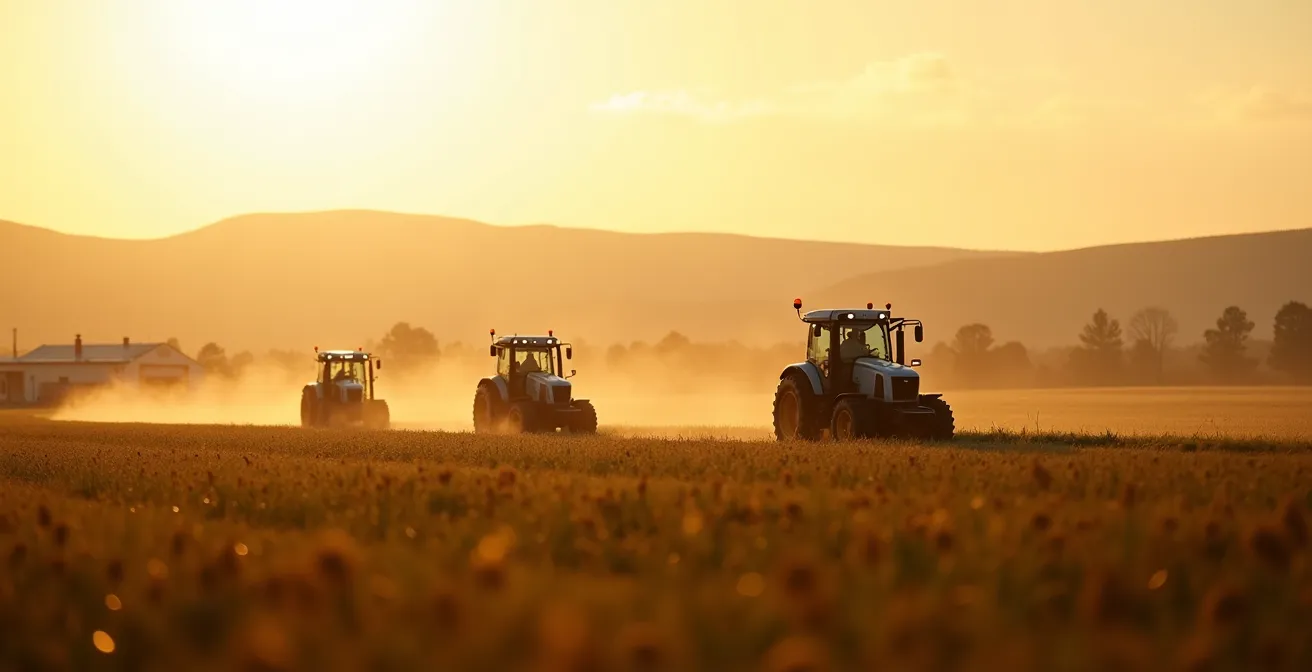
The viability of autonomous tractors on mid-sized farms hinges less on futuristic technology and more on a complete operational and financial re-architecture of the farm itself.
- Retrofit kits offer a faster ROI (2-3 years) by upgrading existing assets, drastically lowering the initial capital barrier compared to new machines.
- “Swarm” models using smaller robots can cut total operational costs by 25-35% and reduce soil compaction, offering greater flexibility than one large, expensive tractor.
Recommendation: Start by analyzing your highest labor and input costs (like spraying) to identify the fastest payback entry point into autonomy, rather than aiming for a full fleet replacement.
For owners of mid-sized farms, the conversation around autonomous tractors often feels like a distant future. You’re facing a very present labor crisis, with skilled operators becoming harder to find and more expensive to hire. The common advice is that “robots are the future,” but this often ignores the staggering half-million-dollar price tag of a new autonomous unit, making it seem like a solution reserved for massive corporate farms. The real question isn’t whether the technology is impressive, but whether it’s a profitable business decision for an operation under 500 hectares today.
The mistake is viewing this technology as a simple one-for-one replacement for a human driver. Adopting autonomy successfully requires a more profound shift in thinking. It’s about fundamentally re-architecting your farm’s entire operational model. This isn’t about buying a single, smarter tractor; it’s about rethinking how you deploy capital, manage labor, and mitigate risk. The key to unlocking ROI on a mid-sized farm lies not in replacing a person, but in transforming your entire system from a dependency on one large machine to a flexible, multi-asset strategy.
This guide moves beyond the hype to provide a clear-eyed analysis for the practical farm owner. We will dissect the true cost-benefit equation, explore pragmatic entry strategies like retrofitting, and show how a hybrid human-robot workforce can enhance productivity and quality of life. By the end, you will have a framework for evaluating if—and how—autonomy can become a profitable reality for your operation.
To help you navigate this complex decision, this article breaks down the key financial and operational considerations. Explore the sections below to build a clear picture of what an autonomous transition really entails for a farm of your scale.
Summary: A Practical Guide to Autonomous Tractor Viability
- Why the Farm Labor Crisis Makes Robots Cheaper than People?
- How to Map Fields for Autonomous Safety Zones?
- Retrofit Kit or New Robot: Which Strategy Fits Your Budget?
- The Network Failure That Strands Robots in the Field
- How to Manage a Swarm of Small Robots vs One Big Tractor?
- Why a Smart Sprayer Pays for Itself Faster Than a New Cab?
- How to Staff Your Farm During Peak Season Without Overpaying?
- How to Utilize Tractor Telemetry to Cut Fuel Costs by 15%?
Why the Farm Labor Crisis Makes Robots Cheaper than People?
The primary driver for autonomy is no longer a futuristic dream; it’s a pragmatic response to a stark economic reality. The shrinking pool of qualified farm labor is directly inflating operating costs, forcing a serious look at automation. When you can’t find a skilled operator, or when wages make a second shift financially unfeasible, the cost of *not* automating begins to outweigh the investment. This isn’t just about saving a salary; it’s about guaranteeing that critical, time-sensitive tasks like planting and spraying get done within their optimal window, regardless of labor availability.
The numbers paint a clear picture. While a simple calculation might show labor savings, the real economic advantage emerges when you analyze cost-per-acre. A traditional high-horsepower setup operated by a skilled worker can be surprisingly expensive. For example, one compelling case study demonstrated that a conventional 4WD tractor setup cost $18.88 per acre for seeding. In contrast, an autonomous system using three smaller, retrofitted machines accomplished the same task for just $6.27/acre for seeding 10,000 acres. This isn’t just an incremental saving; it’s a fundamental change in operational economics.
This shift allows a farm to scale its operations without scaling its permanent workforce. An autonomous tractor can work through the night, effectively doubling the use of a capital asset without incurring overtime pay or facing operator fatigue. This 24/7 operational capability is a force multiplier, enabling you to cover more ground faster, which is critical for maximizing yields and mitigating weather-related risks. The math is becoming undeniable: as human labor costs rise, the break-even point for robotic labor drops every single season.
How to Map Fields for Autonomous Safety Zones?
Before a single autonomous wheel turns, the foundation for safe and efficient operation must be laid. This foundation is not physical; it’s digital. The process begins with creating a “digital twin” of your farm—a highly detailed, layered map that serves as the robot’s brain and eyes. This is the most critical step in de-risking autonomous operations and moving from a concept to a reliable production system. Effective mapping is what separates a functioning autonomous farm from a collection of expensive, idle machinery.
This process goes far beyond a simple Google Maps outline. It requires creating a multi-layered geofenced environment with centimeter-level precision. The first layer involves defining the absolute field boundaries using high-precision GPS. The next layer permanently maps all fixed obstacles: trees, utility poles, irrigation infrastructure, and buildings become digital “no-go” zones. This digital blueprint is the static world the tractor lives in.

The real sophistication, however, lies in creating dynamic and interactive layers. You must program temporary hazards, such as a waterlogged patch of field or a temporary staging area for supplies, with dynamic geofencing. Furthermore, the most advanced systems layer this with historical and real-time data, such as topography maps, soil composition data, and previous yield maps. This allows the tractor to not only navigate safely but also execute tasks with variable-rate precision. Finally, establishing clear safe zones and interaction protocols for human workers is paramount for a hybrid workforce.
Retrofit Kit or New Robot: Which Strategy Fits Your Budget?
The half-million-dollar price tag of a brand-new autonomous tractor is the single biggest barrier for mid-sized farms. This leads to the most important strategic capital allocation decision you will face: do you go all-in on a new, dedicatedly autonomous machine, or do you upgrade your existing, trusted equipment with a retrofit kit? This choice isn’t just about initial cost; it’s a fundamental decision about operational flexibility, depreciation, and the speed of your return on investment.
For most farms under 500 hectares, the retrofit strategy is the most pragmatic entry point. It allows you to leverage your existing fleet—assets you already own and understand—and transform them into autonomous or semi-autonomous units for a fraction of the cost of a new machine. The key advantage is financial accessibility and operational flexibility; if needed, you can always switch the tractor back to manual mode. This de-risks the investment significantly.
A direct comparison reveals the stark differences in financial modeling. While a new autonomous tractor represents a massive capital outlay, a retrofit kit can often be acquired and installed for under $100,000. This dramatically changes the ROI calculation, often shortening the payback period from 4-5 years for a new machine to just 2-3 years for a retrofitted one. The following table, based on industry data, breaks down the core financial trade-offs. As a detailed cost analysis shows, the depreciation on a fully integrated new unit is also much steeper.
| Factor | Retrofit Kit | New Autonomous Tractor |
|---|---|---|
| Initial Cost | $50,000-$100,000 | $500,000+ |
| Installation Time | 2-5 days | Immediate |
| Depreciation Rate | 15-20% yearly (tech only) | 25-30% yearly (full unit) |
| Operational Flexibility | Can switch to manual mode | Dedicated autonomous only |
| ROI Period | 2-3 years | 4-5 years |
| Resale Value | Retains base tractor value | Rapid tech depreciation |
The Network Failure That Strands Robots in the Field
One of the biggest anxieties for any farmer considering autonomy is the image of a multi-ton robot sitting idle in the middle of a field because of a lost cellular signal. In rural areas where connectivity is unreliable, this is not a trivial concern. A network failure during a critical planting or spraying window can be costly, with downtime estimated at $100-$200 per hour. However, framing this as a deal-breaker is a mistake. Instead, it should be treated as a manageable operational risk that requires a dedicated mitigation strategy.
The solution lies in building network redundancy and not relying solely on public cellular infrastructure. Advanced autonomous systems can operate without a cell signal by creating their own private connectivity bubble. This is often achieved using local mesh networks, like LoRaWAN or robust mesh Wi-Fi systems. These networks use a series of small, interconnected radio nodes placed around the farm to ensure the tractor always has a stable, local connection to its base command unit, independent of external service providers. This transforms connectivity from a vulnerability into a controlled piece of farm infrastructure.

Furthermore, robust recovery protocols are essential. The tractor’s software should include pre-programmed “recovery points” or safe stopping zones. If the system detects a prolonged loss of connectivity, it doesn’t just stop dead; it navigates to the nearest pre-defined safe location, such as the edge of the field, to await instructions. This prevents the robot from becoming an obstacle and simplifies recovery. Managing connectivity is no different than managing fuel levels or hydraulic pressure—it’s a critical system that requires monitoring and a clear backup plan.
How to Manage a Swarm of Small Robots vs One Big Tractor?
The traditional model of farming has always been “bigger is better”—larger tractors, wider implements, more horsepower. Autonomy challenges this paradigm by introducing a radically different and potentially more efficient model: the swarm. Instead of relying on one enormous, heavy, and expensive tractor, the swarm concept utilizes a fleet of smaller, lighter, and more agile autonomous units that work in coordination. This approach represents a fundamental shift in operational thinking, moving from rigid power to what could be called asset elasticity.
The economic and agronomic benefits are significant. Firstly, a swarm of smaller robots drastically reduces soil compaction, a major cause of yield loss. Lighter machines mean healthier soil structure. Secondly, this model offers incredible operational resilience. If one large tractor breaks down during planting season, your entire operation grinds to a halt. If one robot in a swarm of five goes down, the other four continue working, and the overall system simply loses 20% of its capacity, a far more manageable problem. According to AgXeed, a leader in this space, this approach can save up to 90% on labor and cut total costs by 25-35% compared to conventional methods.
This model is also becoming more accessible. Companies like Sabanto are pioneering a “farming as a service” model, where they deploy fleets of small autonomous tractors for hire. This allows mid-sized farms to experiment with and benefit from swarm technology without the massive capital outlay. As AI ‘swarm’ technology deploys multiple smaller vehicles, it proves that you can achieve the work rate of a giant machine with the flexibility and lower impact of a distributed system. Managing this fleet is done from a single interface, where the operator acts as a fleet commander, assigning tasks and monitoring progress from a tablet.
Why a Smart Sprayer Pays for Itself Faster Than a New Cab?
For a mid-sized farm, the path to autonomous ROI doesn’t have to be an all-or-nothing leap. The most financially sound strategy is often to find a “Trojan horse”—a single, high-impact application that pays for its own technological upgrade and proves the value of precision automation. Right now, there is no better example of this than smart spraying technology. Investing in a smart sprayer system, whether as a new implement or a retrofit, often delivers a payback period far faster than almost any other equipment upgrade, including a new tractor cab focused on operator comfort.
The reason is simple: targeted herbicide application. Traditional broadcast spraying treats the entire field, wasting the vast majority of chemicals on bare ground. Smart sprayers use a combination of cameras and AI to identify individual weeds in real-time and apply a precise micro-dose of herbicide only where needed. The savings are staggering. Research from Montana State University demonstrates an 84% average herbicide reduction, saving between $43.50 and $45.50 per acre during fallow periods.
Major manufacturers are seeing similar results in the field. John Deere’s See & Spray™ technology, for example, reported that it saved farmers 8 million gallons of herbicide mix in a single year, with an average savings of 59%. One Kansas farmer even reported that his herbicide cost savings were substantial enough to cover the entire payment for the new sprayer. While a new cab might offer an incremental gain in operator efficiency valued at around $5,000 annually, the savings from a smart sprayer can easily reach into the tens or even hundreds of thousands of dollars, leading to a payback period of just 2-3 years. This makes it a powerful, self-funding first step into the world of agricultural robotics.
How to Staff Your Farm During Peak Season Without Overpaying?
The implementation of autonomy fundamentally reshapes the farm’s labor strategy. The goal is not the wholesale replacement of human workers but the creation of a more efficient, resilient, and higher-value hybrid workforce. This approach, which we can call labor augmentation, uses robots to handle the repetitive, grueling, and time-consuming tasks, freeing up your skilled human team to focus on complex, decision-heavy work where their expertise truly matters.
As Sabanto founder Craig Rupp explains, the motivation is often more nuanced than simple cost-cutting:
Farmers may buy as if we’re replacing labor, but they keep the labor, and it’s about quality of life. It’s about not spending 12 to 16 hours a day when they get behind.
– Craig Rupp, Sabanto
This philosophy is key to managing peak season demands without resorting to expensive, and often unreliable, temporary labor. By scheduling autonomous tractors for 24/7 preparatory tasks like tillage and pre-seeding fertilization in the weeks leading up to the crunch, you can effectively flatten the labor demand curve. Your permanent, skilled employees are then deployed for higher-value activities like complex equipment repairs, harvest management, and strategic decision-making. This reduces burnout and improves retention.
Your Action Plan: Implementing a Hybrid Workforce Strategy
- Deploy Autonomy for Repetitive Tasks: Assign autonomous tractors to 24/7 operations like tillage, seeding, and spraying to build a baseline of productivity.
- Retain Humans for Complex Decisions: Reserve your skilled workers for tasks requiring critical thinking and dexterity, such as equipment repairs, harvest optimization, and crop diagnostics.
- Upskill an “Ag-Tech Operator”: Train one of your most reliable permanent employees to manage, monitor, and troubleshoot the autonomous fleet, creating a new, higher-value role.
- Leverage Off-Peak Pre-Work: Use autonomous equipment for preparatory fieldwork weeks before the peak season begins to get ahead of the schedule.
- Schedule Overnight Operations: Run autonomous machines through the night to complete tasks, effectively doubling your operational window and reducing daytime labor pressure.
Key Takeaways
- Autonomous adoption is an operational model change, not just a technology purchase. It requires re-architecting your approach to capital, labor, and risk.
- For mid-sized farms, retrofitting existing tractors is the most financially accessible entry point, offering a payback period of 2-3 years.
- High-ROI smart attachments, especially weed-sensing sprayers, can effectively fund the broader transition to automation by delivering immediate and substantial input cost savings.
How to Utilize Tractor Telemetry to Cut Fuel Costs by 15%?
Beyond labor savings, the hidden ROI of autonomous tractors lies in the data they generate. Every autonomous tractor is a rolling data center, equipped with sensors that monitor every aspect of its performance. This constant stream of telemetry data, when properly analyzed, unlocks a new level of operational efficiency that is nearly impossible to achieve with human operators alone. One of the most immediate and tangible benefits is a significant reduction in fuel consumption, often by as much as 15%.
This efficiency comes from ruthless optimization. For instance, precision farming data shows that GPS guidance ensures autonomous tractors operate with path-to-path accuracy that minimizes overlaps to just a few centimeters. A human operator, no matter how skilled, will have slight variations on every pass. Over hundreds of acres, these small overlaps add up to wasted fuel, seed, and fertilizer. An autonomous system eliminates this waste by executing a perfect path plan, every single time. It ensures uniform coverage and optimal implement engagement, reducing unnecessary engine strain.

Furthermore, telemetry data provides deep insights into machine health and performance. It can identify inefficient engine speeds, suboptimal gear choices for a given task, or excessive idle times. This allows you to fine-tune operational parameters for maximum fuel economy. Is the tractor running at the ideal RPM for tillage? Is wheel slip excessive in a certain part of the field? This data provides the answers, turning your equipment from a black box into a transparent, optimizable asset. This data-driven approach is the final piece of the profitability puzzle, ensuring that every drop of fuel is converted into productive work.
The transition to autonomy is no longer a question of ‘if’ but ‘how’ and ‘when’. For the savvy mid-sized farm owner, the time to start building a strategic plan is now. Begin by conducting a thorough audit of your labor and input costs to identify the most painful and expensive part of your operation—this is your ideal starting point for a high-ROI autonomous investment.