Contrary to the common “set-it-and-forget-it” approach, achieving near-perfect singulation is a dynamic, in-field battle against micro-failures that standard checklists miss.
- Static spring downforce is a primary culprit for inconsistent depth, costing significant yield in variable soils.
- Meter calibration must account for seed lubricant type and variable rate transitions, not just mechanical wear.
Recommendation: Shift your focus from pre-season checks to in-field diagnostics. Continuously verify seed depth, gauge wheel pressure, and meter performance as conditions change throughout the day.
For the farmer who measures success in bushels per acre, the planter pass is the single most critical operation of the year. There are no do-overs. Every mistake—a seed planted too shallow, a skip in the row, or a compacted sidewall—is a permanent decision that caps yield potential before the season has truly begun. You already know the basics: check for worn parts, use seed lubricant, and try to maintain a consistent speed. This is common knowledge, the C-grade work of planting.
But what if the real levers for achieving an elite stand count—that coveted 99% or better singulation—are hidden in the nuances that most operators overlook? The conventional wisdom of a static, pre-season setup is fundamentally flawed. It fails to account for the dynamic reality of the field: changing soil types, moisture levels, and the subtle yet powerful interactions between every component of the row unit. The pursuit of perfection isn’t about a faster planter; it’s about a smarter one.
This guide abandons the generic platitudes. Instead, it offers a perfectionist’s framework for planter calibration, focusing on the system harmony required for absolute precision. We will dissect the micro-failures in downforce systems, seed metering, and soil engagement that collectively rob you of yield. You will learn not just to check your work, but to perform yield forensics in real-time, diagnosing the root cause of every imperfection to ensure what’s in the seed monitor is exactly what’s happening in the furrow. This is the path from ‘good enough’ to verifiably excellent.
To achieve this level of precision, we will dissect each critical component of the planter system. The following sections provide a detailed roadmap for identifying and correcting the most common—and costly—calibration oversights.
Summary: A Deep Dive into High-Precision Planter Tuning
- Why Static Springs Fail to Maintain Depth in Variable Soils?
- How to Dig Seeds to Verify Contact and Depth Correctly?
- High-Speed Planting or Precision: Which Wins on Yield?
- The Gauge Wheel Setting That Causes Sidewall Smearing
- Where to Place Starter Fertilizer to Avoid Seed Burn?
- The Meter Calibration Oversight That Ruins Variable Rate Plans
- How to Set Up Strip-Till Rigs for Perfect Seedbeds?
- How to Push Soybean Yields Past the Plateau?
Why Static Springs Fail to Maintain Depth in Variable Soils?
The core deficiency of static spring downforce systems is their inability to react. A spring, by its nature, provides a fixed amount of pressure. This “one-size-fits-all” approach is a recipe for failure in fields with any degree of variability. As the row unit moves from a zone of mellow loam to a patch of hard clay or a compacted headland, the spring cannot add or subtract pressure. The result is a series of catastrophic micro-failures: in hard zones, the unit rides up, placing seeds too shallow for uniform emergence. In soft zones, the excessive pressure compacts the gauge wheels into the soil, creating sidewall compaction that chokes root development.
Modern hydraulic systems, in contrast, operate on a principle of dynamic calibration. They can make millisecond adjustments, adding or removing hundreds of pounds of force to maintain the target depth with relentless consistency. The yield implications are not trivial. In fact, research from Beck’s Hybrids shows that planters equipped with hydraulic downforce can see a 9.4 bushels per acre average yield increase compared to those with static springs. This gain comes directly from achieving uniform emergence across the entire field, not just in the “easy” spots.
The fundamental flaw is treating downforce as a setting rather than a response. Static springs represent a single setting, whereas hydraulic systems provide a continuous, intelligent response. The goal is not just to get the seed in the ground, but to create an identical environment for every single seed, and static systems are structurally incapable of delivering on that promise when faced with real-world soil variation. It’s the difference between hoping for consistency and engineering it.
How to Dig Seeds to Verify Contact and Depth Correctly?
The act of digging seeds is not a simple check; it’s an exercise in yield forensics. It’s the only way to get unbiased, ground-truth data on planter performance. Relying solely on the in-cab monitor is a critical error, as sensors can be misleading. The goal of a proper seed dig is to answer three questions with absolute certainty: Is the depth correct? Is the seed-to-soil contact firm? Is the spacing uniform? For corn, the ideal depth is typically between 1.5 and 2 inches, ensuring the seed is placed into consistent moisture for uniform germination.
To perform a diagnostic dig, use a trowel or a small spade to carefully excavate a three-foot section of the row. Do not dig directly on top of the furrow. Instead, slice the soil at a 45-degree angle alongside the seed trench and gently lift the wall of the furrow away. This exposes the seeds in a cross-section without disturbing their placement. Look for a firm seedbed beneath each seed, with no air pockets. The seed should be pressed firmly into the bottom of the V-shaped trench. Any seed suspended in loose soil or sitting on a smeared, compacted sidewall is a failure.
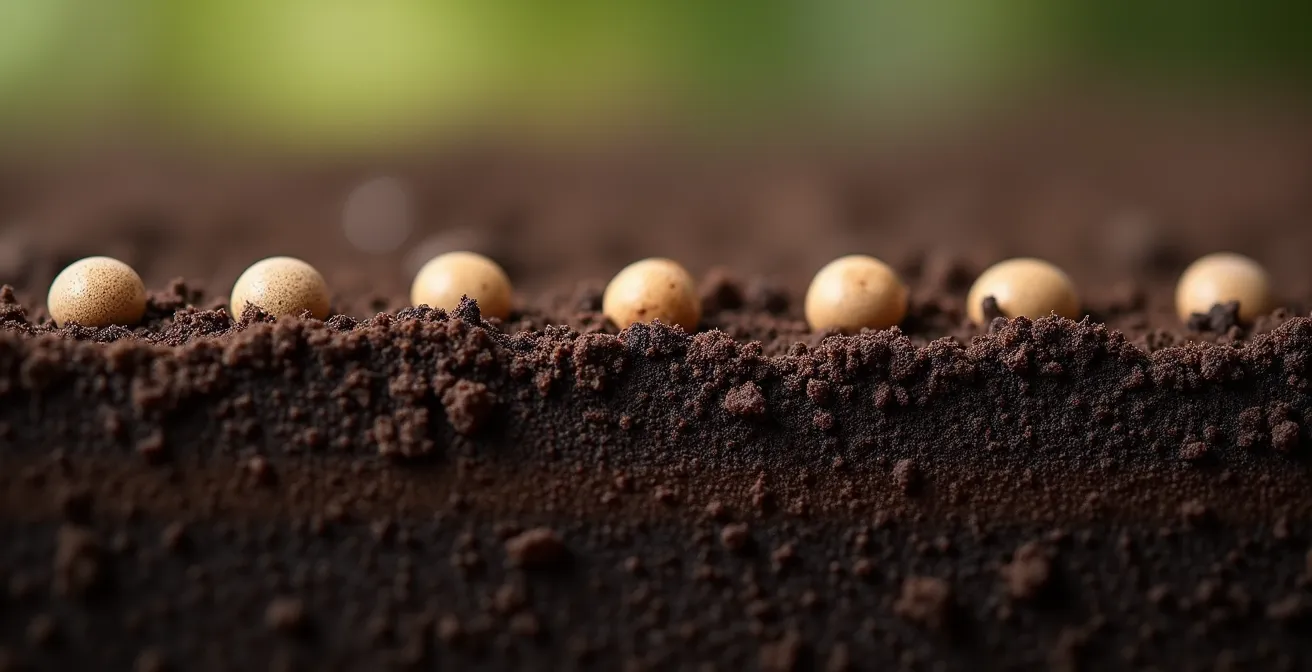
This level of scrutiny may seem excessive, but the financial stakes are enormous. Every small error compounds across millions of seeds. A six-year study from Precision Planting quantified this loss precisely, finding an $8.77 per acre loss for each 1% drop below 99.5% singulation. When you hold a poorly placed seed in your hand, you are holding a tangible piece of that lost revenue. This is why digging isn’t just verification; it’s the most important diagnostic you can run.
High-Speed Planting or Precision: Which Wins on Yield?
The debate between speed and precision is often framed as a false choice. For the perfectionist, the only acceptable answer is both. Modern high-speed planting systems, such as Precision Planting’s SpeedTube and John Deere’s ExactEmerge, are not simply about covering more acres per hour. Their core engineering principle is to eliminate the variables that degrade singulation at higher speeds, namely gravity and seed bounce within the tube. By taking positive control of the seed from the meter all the way to the bottom of the trench, these systems are designed to deliver precision *at* speed.
But does the technology deliver on its promise? Independent research provides a clear answer. The most comprehensive data comes from a long-term Iowa State University study, which offers critical insights into real-world performance.
Case Study: Iowa State’s 5-Year High-Speed Planting Analysis
Over a five-year period, Iowa State University compared high-speed planting systems at speeds up to 10 mph against traditional systems. The study, detailed in a comprehensive crop news report, found that both major high-speed systems maintained excellent corn singulation (98-99%), effectively matching the precision of planters running at half the speed. For soybeans, the results were more nuanced, with one system achieving slightly higher plant survival rates. The key takeaway was that these technologies successfully decouple precision from ground speed, allowing farmers to operate within tight planting windows without sacrificing stand quality.
The decision to invest in high-speed technology is not just about finishing faster. It is a strategic calculation about optimizing the planting window. Being able to plant the majority of your acres during the ideal 2-3 day window, rather than being spread out over a week, has a proven and direct impact on overall yield potential. High-speed systems win because they transform speed from an enemy of precision into an ally of timeliness.
| Metric | Traditional (5 mph) | High-Speed (10 mph) |
|---|---|---|
| Corn Singulation | 98-99% | 98-99% |
| Soybean Survival | 82% | 77-84% |
| Daily Acres | 120 | 240 |
| Planting Window | Standard | 50% more flexible |
| Investment Required | Base | +$30,000 upgrade |
The Gauge Wheel Setting That Causes Sidewall Smearing
Sidewall smearing, or compaction, is one of the most insidious and yield-robbing problems in planting. It occurs when gauge wheels are run with excessive downforce, particularly in moist or high-clay soils. Instead of cleanly forming the furrow, the wheels press and polish the sides of the seed trench, creating an impenetrable wall that roots cannot penetrate. The question of “how much downforce is too much” is critical. The answer is: any more than is necessary to maintain consistent seed depth. The goal is to have the gauge wheels carrying just enough weight to keep the disk openers at the target depth, and no more. A common target is to have 100 pounds of active weight on the gauge wheels, but this must be verified visually.
Over-pressured gauge wheels are a direct consequence of a flawed downforce strategy. If you find yourself needing to apply excessive force just to get the disk openers into the ground, the root problem may not be the gauge wheels themselves, but rather dull disk openers or insufficient row unit weight. The gauge wheels’ primary job is depth control; their secondary, and equally important, job is to do no harm to the furrow. A shiny, polished appearance on the furrow wall is the unmistakable signature of sidewall smearing. This is a five-bushel-per-acre mistake, easily made and easily avoided with careful adjustment.
Action Plan: The Gauge Wheel Adjustment Protocol
- Plant 50 feet then stop to inspect the seed furrow between the gauge wheels and the closing system. Look for shiny, compacted walls.
- Perform the “business card test”: try to slide a business card between the gauge wheel tire and the disk opener. It should slide with light resistance but not fall through freely.
- Check for excessive loose soil falling back into the furrow before the seed drop. If this is happening, downforce may be too light, causing the unit to bounce.
- If sidewall smearing is evident, reduce downforce in increments of 25-50 pounds and re-evaluate. Remember that less is more.
- Readjust for each significant change in soil type or moisture condition throughout the planting day. Dynamic calibration is non-negotiable.
Where to Place Starter Fertilizer to Avoid Seed Burn?
The “2×2” rule for starter fertilizer placement—2 inches to the side and 2 inches below the seed—is not a casual guideline; it is a strict mandate for avoiding catastrophic seed burn. Placing fertilizer any closer, especially high-salt-index liquids, creates a “hot zone” that can desiccate the seed or burn the delicate seminal roots as they emerge, effectively killing the plant before it ever breaks the surface. The goal is to provide early-season nutrition without compromising the safety of the germinating seed. Precision in placement is everything.
Achieving a true 2×2 placement requires meticulous calibration of the fertilizer opener. This opener is a separate cutting component that runs alongside the main seed disk opener, and its alignment is critical. It must be set to run at the correct depth relative to the seed and maintain a consistent lateral distance. Any wear in the opener’s bushings or frame can cause it to wander, shifting the fertilizer band closer to the seed trench. Furthermore, vibration from the fertilizer coulter can transfer through the row unit and interfere with the seed meter’s performance, creating another source of singulation errors.
Before the season, and even between fields, it’s crucial to perform a physical check. Run the planter for a few feet in the field, then carefully excavate a cross-section of the row. Use a tape measure to verify the literal distance between the fertilizer band (identifiable by its color and texture) and the seed trench. Do not trust the settings on the adjuster; trust only what you can measure in the soil. Anything less than a two-inch horizontal separation is an unacceptable risk to your stand.
Key Takeaways
- Static downforce systems are inadequate for variable soils and directly cause yield loss through inconsistent seed depth.
- Meticulous seed digging is non-negotiable for ground-truthing planter performance; monitors alone are insufficient.
- Modern high-speed planters can achieve precision at speed, but require perfect calibration of the entire system.
The Meter Calibration Oversight That Ruins Variable Rate Plans
Executing a variable rate (VR) seeding plan is the pinnacle of precision agriculture, but it’s often sabotaged by a single, critical oversight: linear meter calibration. Most farmers test their meters at a single, average population, but a VR prescription demands that the meter perform flawlessly across a wide range of speeds and populations as the planter moves between zones. A meter calibrated only for 34,000 seeds/acre can experience a significant drop in singulation when the prescription suddenly calls for 28,000 or 40,000. This is because changes in speed affect how seeds feed into the disk and how they are released, often leading to a 5-10% singulation loss at zone boundaries.
True VR-ready calibration involves testing the meter at the minimum, maximum, and median populations of your prescription. This multi-point check reveals how the meter performs under stress and allows for fine-tuning of vacuum pressure, disk speed, and singulator settings. Furthermore, the choice of seed lubricant is not a trivial detail. As the table below shows, different lubricants perform differently with various seed sizes and treatments, directly impacting the meter’s ability to singulate accurately. Using the wrong lubricant can negate the benefits of an otherwise perfectly calibrated meter.
| Lubricant Type | Small Seed (>2,550) | Large Seed (<2,550) | Treated Seed | Singulation % |
|---|---|---|---|---|
| Standard Talc | Good | Poor | Fair | 92-95% |
| Graphite | Fair | Good | Good | 89-94% |
| eFlow (1/4 cup) | Excellent | Good | Excellent | 97-99% |
| eFlow (1/8 cup) | Good | Excellent | Excellent | 96-99% |
The cost of ignoring this level of detail is substantial. A professional meter calibration service is a minor investment compared to the potential losses from seed waste and reduced yield. As LMS Ag Equipment reports, a $35 per-row calibration can prevent thousands of dollars in lost revenue across a farm. For VR planting to be profitable, the execution must be as precise as the prescription itself.
How to Set Up Strip-Till Rigs for Perfect Seedbeds?
Planting into strip-tilled ground presents a unique set of challenges and opportunities. The goal is to place the seed directly into the center of the tilled berm, a zone of ideal soil conditions. However, achieving this perfect alignment requires an obsessive focus on guidance and row unit setup. The entire operation hinges on the planter’s ability to precisely follow the path laid by the strip-till rig, often months earlier. Any deviation means one row unit is planting in loose soil while the other is fighting to penetrate hard, untilled ground, destroying any hope of uniform emergence.
The first step is a data management protocol. The guidance lines from the strip-till pass must be exported and flawlessly imported into the planter’s tractor display. This ensures the planter is following the exact same A-B line. Next, the row unit itself must be adapted for the strip. Row cleaners become non-negotiable; they must be aggressive enough to clear any residue or clods from the berm without gouging into it, typically set just 0.5 inches above the soil surface. Downforce settings also require adjustment. A spring-made strip is often softer and requires less downforce, while a fall-made strip that has settled over winter may require 20-30% more downforce to achieve target depth.
Finally, berm height is a critical factor. An excessively tall or uneven berm will cause the row units to bounce and rock, leading to inconsistent seed depth. The target is a low, uniform berm of no more than 1.5 to 2 inches. Verifying alignment is a continuous process. After setting up, the operator must stop after 100 feet, get out, and dig behind multiple rows to confirm the seed is centered in the tilled zone. This ground-truthing is the only way to ensure the entire system is working in harmony.
How to Push Soybean Yields Past the Plateau?
For many top producers, soybean yields have hit a frustrating plateau. The conventional wisdom of “more seeds, more yield” has reached its point of diminishing returns. The path forward, paradoxically, may lie in planting fewer seeds but making every single one count through radical improvements in singulation and spacing. When soybean plants are perfectly spaced, they are not competing with each other for light, water, and nutrients. This allows for more branching and pod set per plant, leading to higher yields even with lower overall populations.
This strategy is backed by compelling research. A notable case study from Beck’s Hybrids documented farms successfully reducing soybean populations by 10,000-30,000 seeds per acre while maintaining or even increasing yields. The absolute key to their success was achieving near-perfect singulation (98-99%). This allowed them to confidently reduce populations, saving $15-45 per acre in seed costs while maximizing the genetic potential of each plant. This approach requires a planter and meter setup capable of handling soybeans with the same precision as corn, a significant leap for many operations.
| Meter Type | Small (<2,200 seeds/lb) | Medium (2,200-2,750) | Large (>2,750) | Optimal Plate |
|---|---|---|---|---|
| Kinze Brush | 95% singulation | 97% singulation | 92% singulation | 48-cell for large |
| Case IH Vacuum | 97% singulation | 98% singulation | 96% singulation | 80-hole disk |
| John Deere Vacuum | 96% singulation | 97% singulation | 95% singulation | 108-cell disk |
| Precision vSet | 99% singulation | 99% singulation | 99% singulation | 80-cell universal |
Breaking the soybean yield plateau is not about a silver bullet. It is about shifting the mindset from a volume-based approach to a precision-based one. It requires investing in meter technology that can deliver elite singulation with various seed sizes and then having the confidence to strategically lower populations. This is the definition of farming smarter, not harder.
To put these principles into practice, the next logical step is to systematically evaluate your current equipment and protocols against these best practices to identify the highest-impact areas for improvement on your own farm.