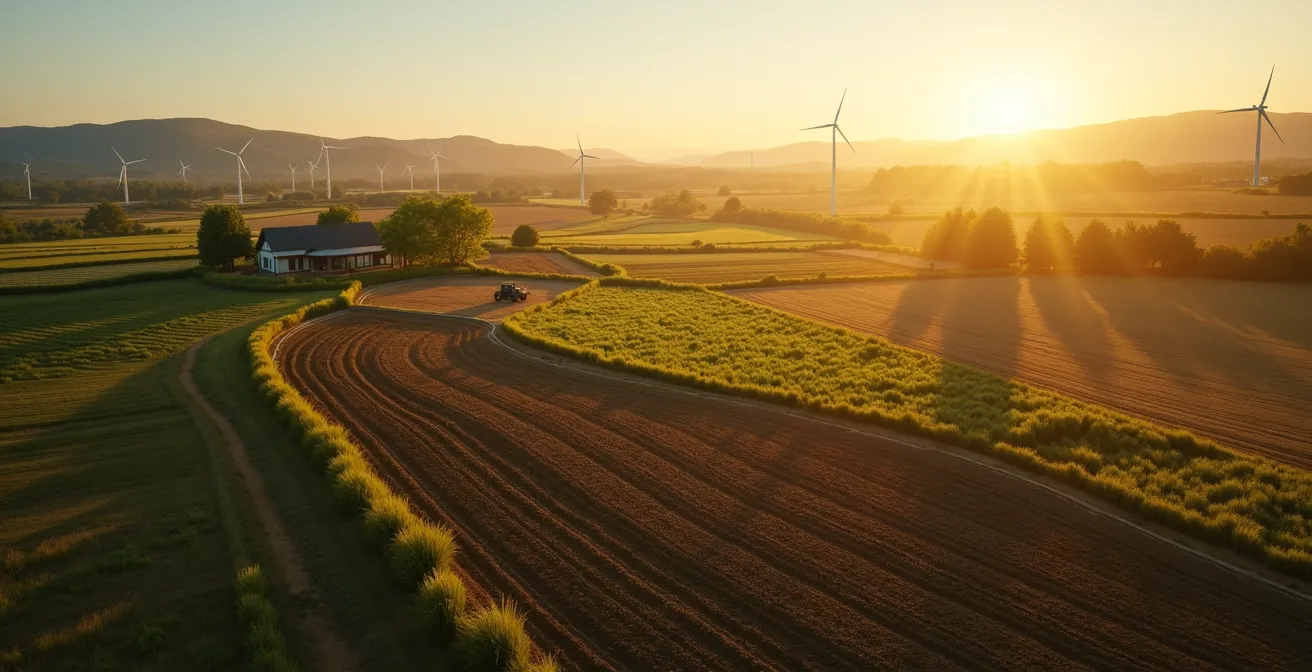
Balancing ecology and economy is not a compromise but a direct path to higher profitability and long-term business resilience in agriculture.
- Market demand for verifiably sustainable goods creates significant premium pricing opportunities.
- Innovative financing models and revenue stacking (e.g., carbon credits, agrivoltaics) can eliminate the cash flow gap during transition periods.
Recommendation: Shift your mindset from viewing sustainability as a cost center to seeing it as a strategic investment in your farm’s core assets, market position, and future profitability.
For modern agricultural entrepreneurs, the pressure is immense. On one side, stringent environmental regulations and shifting consumer demands push for ecological responsibility. On the other, the unforgiving reality of business economics requires a healthy bottom line. The conventional wisdom often frames this as a zero-sum game: a choice between profit and the planet. Many farmers feel trapped, believing that embracing sustainable practices means sacrificing financial viability. The narrative suggests that going green is an expensive luxury, a cost to be borne rather than an opportunity to be seized.
This perspective, however, misses the fundamental shift occurring in the agri-food sector. The most successful modern farm operations are not just complying with regulations; they are building resilient business models where ecological health is the primary driver of economic performance. The true challenge isn’t about spending more to be sustainable; it’s about investing strategically to make your core asset—your land—more productive and valuable. This requires moving beyond generic advice like “use fewer pesticides” and diving into the mechanics of profitability.
But if the key isn’t simply sacrifice, what is the new formula for success? The answer lies in a pragmatic, business-first approach to sustainability. It involves understanding the economic levers at your disposal, from leveraging consumer psychology for premium pricing to mastering the financial “J-curve” of regenerative transitions and stacking new revenue streams on existing acreage. This isn’t about idealism; it’s about superior economic strategy.
This article provides a pragmatic roadmap for agricultural entrepreneurs. We will dissect the market forces driving demand, explore financial models to navigate transitions, analyze operational choices for different land sizes, and outline the marketing and certification strategies that turn ecological stewardship into a measurable competitive advantage.
To navigate this complex landscape, this guide breaks down the key strategic pillars that connect sustainable practices directly to your farm’s profitability. Explore the sections below to build a resilient and economically robust agricultural business.
Summary: A Business-First Approach to Sustainable Farming
- Why 60% of Consumers Now Pay More for Sustainable Labels?
- How to Manage Cash Flow Gaps During an Organic Transition?
- Intensive vs. Extensive Farming: Which Fits Your 50-Hectare Plot?
- The Marketing Error That Can Ruin Your Farm’s Reputation
- When to Invest in Solar Power for Your Farm Operations?
- The Expectation Error That Causes Farmers to Quit Regenerative Ag
- Why Sustainable Intensification is Key to Feeding 10 Billion?
- How to Achieve GlobalGAP Certification for Export Markets?
Why 60% of Consumers Now Pay More for Sustainable Labels?
The single greatest force reshaping agricultural economics is not regulation, but consumer demand. The narrative that sustainability is a niche interest is outdated. Today, it is a powerful market driver creating tangible opportunities for premiumization. When a significant portion of the market actively seeks out and is willing to pay more for products with proven ecological benefits, ignoring this trend is a direct financial misstep. Farmers who adapt can tap into these premium markets, commanding higher prices and building powerful customer loyalty that insulates them from commodity price fluctuations.
This isn’t based on anecdotal evidence. A growing body of market research indicates that consumers are increasingly demanding food produced with lower environmental impacts. This demand is not just a preference; it’s translating into purchasing decisions. The “sustainable” label, when backed by transparent and verifiable practices, acts as a powerful signal of quality, safety, and ethical production, justifying a higher price point in the consumer’s mind.
To capitalize on this, agricultural entrepreneurs must view their sustainable practices as a marketable asset. The key is to move beyond the farm gate and understand the story your product tells on the shelf. The visual and tactile qualities of produce are the first point of contact.
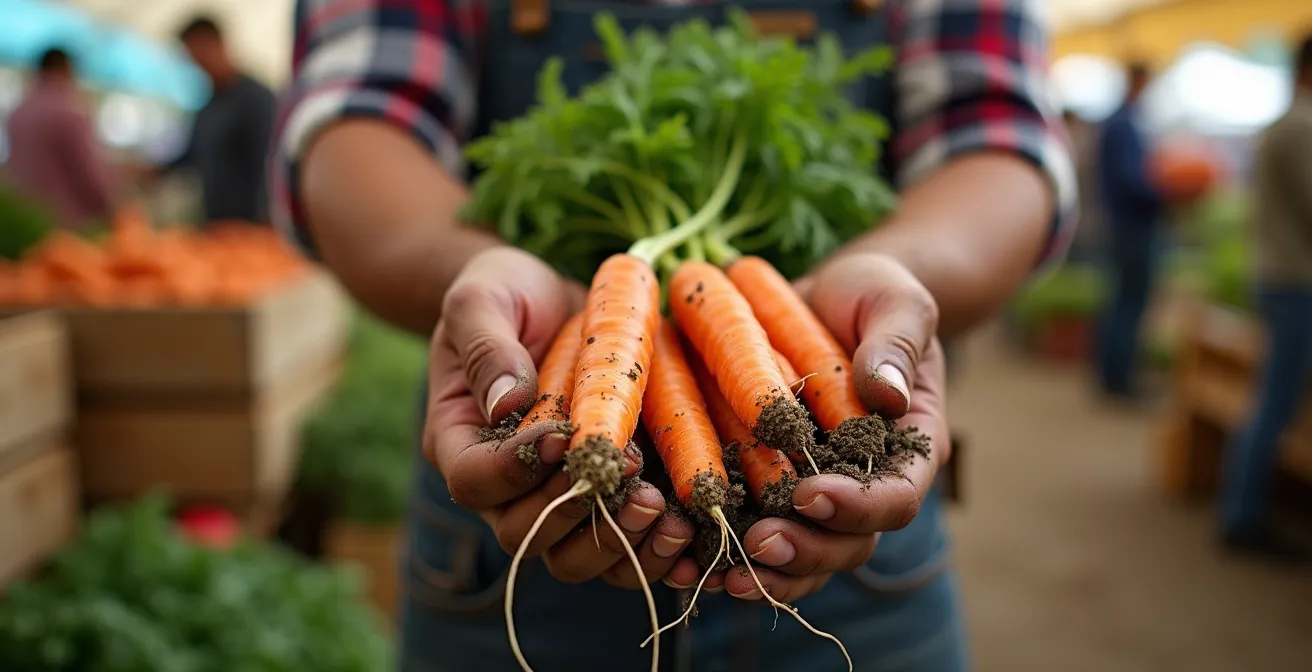
As this image suggests, the perception of value is built on trust and tangible quality. Imperfections in organic produce are no longer seen as defects but as signs of authenticity. This shift in perception allows producers to stop competing solely on price and start competing on brand story and verifiable impact. The farm that can successfully communicate its commitment to soil health, biodiversity, and low-impact methods is not just selling a vegetable; it’s selling peace of mind.
How to Manage Cash Flow Gaps During an Organic Transition?
The most significant barrier for farmers considering a switch to organic or regenerative models is the “transition trough”—the period where yields may temporarily dip and costs can increase before the long-term benefits and certification premiums kick in. This cash flow gap is a real business risk that can derail even the most committed operations. Traditional financing often fails to account for this J-curve, making it difficult to secure capital. However, a new ecosystem of transition finance is emerging, designed specifically to bridge this gap.
The strategy is to stop thinking about a single source of funding and start stacking multiple, innovative financial mechanisms. For instance, forward-thinking farmers are now partnering directly with Consumer Packaged Goods (CPG) companies. These contracts can guarantee a buyer and stable, premium pricing post-certification, effectively de-risking the transition. Others are accessing carbon-linked loans, which monetize the future carbon sequestration benefits of their new practices, providing upfront capital.
The World Economic Forum highlights that a significant portion of funding should come from monetizing the very ecosystem services that regenerative agriculture produces. This includes not just carbon, but also improvements in water quality and biodiversity, which can be quantified and sold as credits. For example, some programs, like Crédit Agricole’s initiative in Europe, offer attractive debt terms specifically for farmers adopting these methods. The key is to see the ecological benefits not just as an outcome, but as a monetizable asset that can be leveraged for financing from day one.
Ultimately, managing the cash flow gap requires a proactive and creative approach to financing. By combining private partnerships, new debt instruments linked to environmental outcomes, and government support, farmers can build a financial bridge that allows them to reach the more profitable and resilient side of sustainable agriculture.
Intensive vs. Extensive Farming: Which Fits Your 50-Hectare Plot?
For an agricultural entrepreneur with a mid-sized plot, say 50 hectares, the choice between intensive and extensive farming models is a critical strategic decision. The conventional intensive approach focuses on maximizing yield per hectare through high inputs of fertilizers, pesticides, and technology. The extensive model, often associated with organic or grazing systems, uses lower inputs over a larger area. However, this dichotomy is becoming obsolete thanks to a third way: regenerative agriculture, which can be considered a form of sustainable intensification.
Regenerative practices focus on rebuilding soil health and ecosystem function to enhance yields naturally over time while drastically reducing dependency on costly external inputs. From a business perspective, this model directly tackles the two biggest variable costs for most farms: fertilizer and pest control. By fostering healthy soil biology, farmers can improve nutrient cycling and water retention, making their operations more resilient to drought and reducing irrigation needs. This isn’t just an ecological benefit; it’s a direct boost to the bottom line through reduced input costs.
Case Study: The Profitability of Regenerative Wheat Farming
The economic argument is compelling. A Boston Consulting Group analysis of wheat farmers in Kansas shows a clear financial advantage over time. Their research found that regenerative agriculture can increase farmer profitability by up to 120%. This dramatic increase was driven by a combination of modest yield gains, premium pricing for their grain, and, most significantly, a sharp reduction in operational expenses. Some farmers in the study successfully decreased their fertilizer use by 50% and pesticides by up to 75%, transforming a major cost center into a source of savings.
For a 50-hectare plot, this model is particularly potent. It allows the farmer to maintain high productivity without the massive capital expenditure and environmental liabilities of traditional intensive farming. The focus shifts from fighting nature with chemicals to partnering with it to build the farm’s most valuable asset: its soil. This strategy transforms the land from a simple production medium into a resilient, self-sustaining economic engine.
The Marketing Error That Can Ruin Your Farm’s Reputation
In the rush to capitalize on the “green” consumer trend, many farms make a critical marketing error: they project an image of perfection. They present their transition to sustainable practices as a flawless, linear journey, hiding the setbacks and challenges. This approach is not only inauthentic but also incredibly fragile. A single pest outbreak, a failed crop rotation, or a skeptical blogger can shatter this perfect image, leading to accusations of “greenwashing” and causing irreparable damage to the farm’s reputation. The most resilient brands are not built on perfection, but on radical transparency.
Authenticity resonates far more powerfully with modern consumers than a polished corporate facade. Sharing the journey—the successes and the failures—builds a level of trust and human connection that slick marketing campaigns cannot replicate. It reframes mistakes not as a sign of incompetence, but as part of a genuine commitment to learning and improvement. This vulnerability is a strength.
This principle is echoed by experienced consultants in the field. As Lindsey Sorah of Good Roots Business Consulting admits when reflecting on her own farming experience:
The early years were a steep learning curve. There were plenty of failures, like my first attempt at growing tomatoes which ended with a high tunnel that was closed up during a heat wave and left us with charred plants.
– Lindsey Sorah, Good Roots Business Consulting
Instead of hiding such stories, a smart marketing strategy would feature them. An article titled “What a Heat Wave Taught Us About Tomato Farming” is far more engaging and trustworthy than a generic post about “Our Perfect Tomatoes.” The key is to lead with emotional storytelling about *why* you are committed to this path before presenting the data. By proactively engaging with critics and documenting your learning process, you build an anti-fragile reputation that strengthens with scrutiny rather than breaking under it.
When to Invest in Solar Power for Your Farm Operations?
For any farm operation, energy is a significant and often volatile operating cost. Investing in on-farm renewable energy, particularly solar power, is frequently presented as a key step towards sustainability. However, from a pragmatic business perspective, the decision to invest must be driven by a clear return on investment (ROI) analysis. The right time to invest is not simply “as soon as possible,” but when the numbers align to make it a financially sound decision. This typically occurs at the intersection of three factors: high and unpredictable energy costs, the availability of government incentives or grants, and the potential for revenue stacking.
The most basic benefit is, of course, cost reduction. On-farm solar can dramatically lower or even eliminate electricity bills for irrigation pumps, cooling systems, and processing facilities. This provides a direct and predictable boost to the bottom line, hedging against future energy price hikes. But the smartest entrepreneurs are looking beyond simple cost savings. They are exploring agrivoltaics—the co-location of solar panels and agricultural production—to create multiple revenue streams from the same parcel of land.
This approach transforms a capital expenditure into a profit center. Farmers implementing dual-use solar systems can sell excess energy back to the grid, lease roof or land space for community solar projects, or even create new agritourism opportunities like EV charging stations. This concept of revenue stacking is a core principle of resilient farm economics.
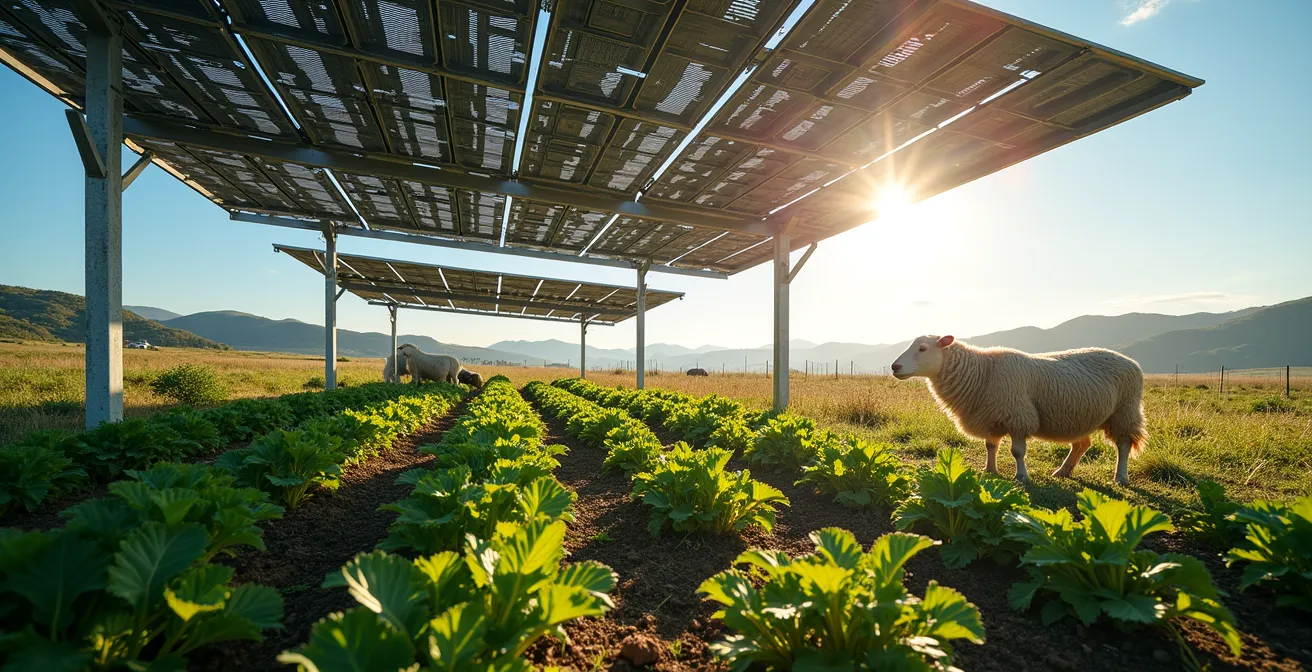
Furthermore, agrivoltaic systems can have direct agricultural benefits. The partial shade from elevated panels can reduce heat stress on livestock and lower soil water evaporation, decreasing irrigation needs for certain crops. The decision to invest in solar, therefore, should be part of a holistic business plan. It’s the right move when it doesn’t just cut a cost, but when it actively generates new income and enhances the operational resilience of the entire farm system.
The Expectation Error That Causes Farmers to Quit Regenerative Ag
One of the most common reasons agricultural entrepreneurs abandon regenerative practices is a fundamental misunderstanding of the profitability timeline. They expect immediate, positive results and become discouraged during the initial transition period when costs might increase and yields can temporarily stagnate or dip. This is the “Expectation Error.” They fail to understand the regenerative J-curve: a well-documented pattern where economic performance first declines before rebounding and ultimately surpassing conventional levels.
Quitting in the trough of the J-curve is a costly mistake. The initial phase requires investment in new equipment, cover crop seeds, and learning. During this time, the soil’s biology is just beginning to recover. The real economic benefits—such as drastically reduced input costs for fertilizers and pesticides, improved water retention, and access to premium markets—only materialize once the soil health “engine” is running efficiently. This can take several seasons.
The key is patience and a long-term perspective. Indeed, USDA research confirms that while practices like no-till improve economic performance due to lower production costs in a relatively short time, significant yield increases often take longer to appear. Farmers who understand this are prepared to weather the initial investment phase because they know the substantial ROI that awaits them on the other side. This is not a leap of faith; it is a calculated business strategy based on agro-ecological science.
Case Study: The Six-Year Payoff of Regenerative Farming
The long-term profitability is not theoretical. Daniel Unruh, a farmer in Colusa, CA, meticulously tracked his finances over a six-year transition to regenerative agriculture. His records showed a net income increase of $425.19 per acre compared to his previous conventional system. Beyond the direct profit, he reported significant improvements in his farm’s operational resilience, including better soil structure, increased water infiltration, reduced erosion, and less pressure from pests. These benefits directly lower business risk and operational costs year after year.
Why Sustainable Intensification is Key to Feeding 10 Billion?
Zooming out from the individual farm, the global challenge is staggering: how to feed a projected population of 10 billion people by 2050 without exhausting the planet’s resources. The agricultural expansion of the 20th century is not a repeatable model. The solution lies in a paradigm known as Sustainable Intensification (SI)—producing more food and agricultural products per unit of input while simultaneously reducing environmental impact and building natural capital.
This is not a contradiction in terms. It represents the crucial shift from a brute-force, high-input model to an intelligent, efficiency-driven one. As the World Economic Forum notes, past successes have already pointed the way:
During the latter part the 20th century, world agriculture made tremendous strides. Compared with 1960, the world now produces 150% more food on only 13% more land.
– World Economic Forum, Farming innovations feed the world and protect the planet
The next leap in productivity, however, cannot come from simply using more land or more fertilizer. It must come from innovation in areas like precision agriculture, advanced genetics, and, most importantly, harnessing natural ecosystem processes through regenerative farming. This approach addresses the dual pressures on the sector. On one hand, it boosts yields to meet growing demand. On the other, it is essential for meeting climate goals, as climate finance experts emphasize that the Agriculture, Forestry, and other Land Use (AFOLU) sector has a critical mandate to reach net-zero emissions before 2050.
For the individual agricultural entrepreneur, this global trend translates into a clear business directive. The farms that will thrive are those that master the principles of sustainable intensification. They will be the ones who can demonstrate higher yields with lower input costs and a verifiable, positive environmental footprint. They will be seen not as part of the problem, but as an essential part of the solution, giving them preferential access to markets, capital, and partnerships. In the 21st-century economy, efficiency and ecology are two sides of the same coin.
Key Takeaways
- Profitability in modern agriculture is increasingly tied to ecological performance, not opposed to it.
- The transition to sustainable models follows a predictable “J-curve,” requiring a long-term strategic view over short-term gains.
- The most resilient farm businesses stack multiple revenue streams (crops, carbon credits, energy) and build brand value through transparent storytelling.
How to Achieve GlobalGAP Certification for Export Markets?
For agricultural entrepreneurs with ambitions to sell in lucrative international markets, especially in Europe and the UK, achieving Global Good Agricultural Practice (GlobalG.A.P.) certification is often not an option—it’s a prerequisite. Many view this as a burdensome administrative hurdle. However, the most strategic producers reframe it: GlobalG.A.P. is not just a certificate; it’s a powerful management system framework that can streamline operations, reduce risk, and unlock significant market premiums.
The certification process requires meticulous documentation of everything from water use and biodiversity actions to worker welfare and traceability systems. Instead of seeing this as mere paperwork, smart farmers use this data collection process as a tool for business intelligence. It provides a granular view of the entire operation, highlighting inefficiencies and areas for improvement. A digital twin of the farm can be created to run virtual audits, ensuring a smooth and successful inspection while identifying cost-saving opportunities long before the auditor arrives on site.
Furthermore, the data required for the audit is a goldmine for marketing. It provides the verifiable proof points needed to craft authentic, compelling stories that resonate with discerning buyers and justify premium pricing. The traceability systems mandated by GlobalG.A.P. go beyond simple compliance; they are a tool to build profound trust with both retailers and end consumers. This trust is the foundation of a strong, defensible brand in the export market. The payoff for this strategic approach is substantial. In fact, research by the Ecdysis Foundation found that regenerative farmers were nearly 80% more profitable than their conventional counterparts, largely because they could capture premiums through robust certifications like ‘Organic’ or ‘Grass-Fed’, which are often built on a GlobalG.A.P. foundation.
Your Action Plan: Achieving GlobalG.A.P. Certification
- Mindset Shift: View GlobalG.A.P. as a management system framework to improve your business, not just a certification hurdle to overcome.
- Digital Preparation: Create a digital twin of your farm operations to run virtual audits and identify gaps before the official inspection.
- Meticulous Documentation: Document all water use, biodiversity actions, worker welfare records, and input applications with rigorous detail.
- Marketing Leverage: Use the required audit data to craft verifiable, data-backed marketing stories for premium brand positioning.
- Traceability as Trust: Implement traceability systems that go beyond compliance to build deep and lasting trust with export partners and consumers.
Ultimately, navigating the intersection of profit and planet is the defining challenge and opportunity for your agricultural business. By adopting these strategic frameworks, you can build an operation that is not only environmentally sound but also more resilient, competitive, and profitable for years to come. The next logical step is to evaluate how these principles apply directly to your unique operation and market.