In summary:
- Transform Growing Degree Days (GDDs) from a passive crop-stage metric into a proactive logistical planning tool for your entire harvest operation.
- Understand that key decisions, like planting date and hybrid selection, create a predictable, interconnected timeline that dictates harvest timing and profitability.
- Use GDD calculations to strategically sequence harvest, manage risks like frost, and make data-driven choices on moisture levels to maximize test weight and reduce costs.
- Calibrate your GDD models with on-the-ground moisture meter readings to achieve temporal precision and improve forecasting year after year.
For generations, harvest timing has felt like a high-stakes reaction to the whims of weather. Planters and harvesters watch the skies, feel the grain, and often make critical decisions based on intuition or what their neighbors are doing. The conventional approach often involves waiting for visual cues, like the famous “black layer” in corn, and then rushing to bring the crop in. While these methods have their place, they leave significant profit and logistical efficiency on the table. This reactive stance makes it nearly impossible to schedule labor, line up trucks, and secure grain drying capacity with any certainty.
The core issue is treating the season as a series of disconnected events rather than a single, continuous timeline. But what if you could trade this uncertainty for predictability? What if the key wasn’t just tracking crop maturity, but forecasting it with enough accuracy to build a complete operational plan weeks in advance? The solution lies in shifting your perspective on a familiar tool: Growing Degree Days (GDDs). Instead of viewing GDDs as a simple academic measure, it’s time to wield them as a powerful logistical framework.
This guide moves beyond the basic GDD formula. It reframes the entire growing season as an interconnected timeline governed by the crop’s internal phenological clock. We will explore how to use GDDs not just to see where you are, but to predict where you’re going. You’ll learn how to calculate risk, sequence harvest across different varieties, and make precise, data-driven decisions that directly translate to higher test weights, lower costs, and a smoother, more profitable harvest. By mastering this temporal precision, you can transform your entire operation from reactive to proactive.
This article provides a complete framework for integrating Growing Degree Days into your harvest strategy. Below is a summary of the key planning stages we will cover, from identifying physiological maturity to making the final profit-driven decisions.
Summary: A GDD-Based Framework for Harvest Planning
- Why Waiting for Black Layer Prevents Test Weight Loss?
- How to Identify R8 Stage in Soybeans for Harvest Timing?
- Chemical Desiccation or Natural Drying: Which Preserves Quality?
- The Frost Probability Calculation Every Late Planter Needs
- Which Variety to Harvest First Based on Shatter Resistance?
- Why Harvesting Corn at 25% Moisture Kills Your Profit Margin?
- Why a 3-Day Planting Delay Can Cost You 10% at Harvest?
- How to Use Grain Moisture Meters to Prevent Storage Spoilage?
Why Waiting for Black Layer Prevents Test Weight Loss?
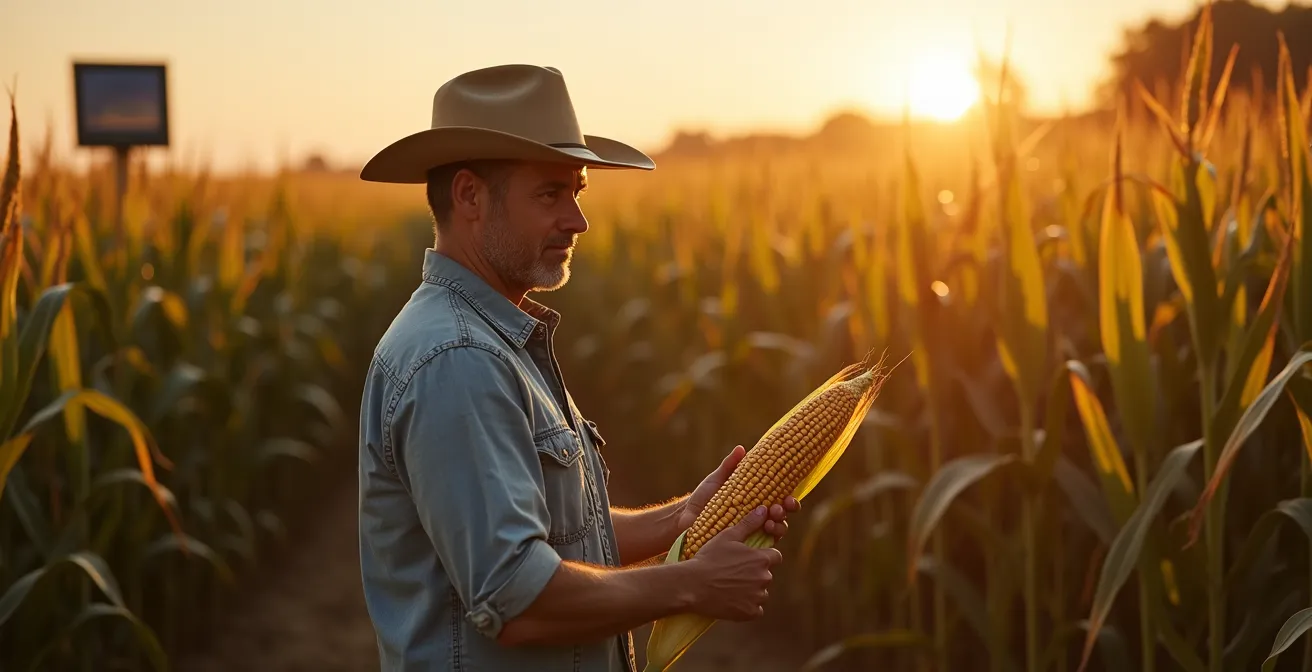
The formation of the “black layer” at the tip of a corn kernel is a pivotal moment in your temporal plan. It signals physiological maturity—the point where the kernel stops accumulating dry matter. Many producers mistakenly believe this is the signal to begin harvesting immediately. However, from a quality and profit perspective, black layer is not the finish line; it is the starting point for the critical dry-down phase that builds test weight. At black layer, kernel moisture is typically high, often between 25% and 35%.
Harvesting at this stage results in a lighter, lower-quality grain that incurs significant drying costs. The real magic happens as the grain dries naturally in the field. Research from the University of Illinois tracked corn from 30% moisture down to 15%. The study revealed that test weight initially dropped slightly, but then increased linearly by 5.3 to 7.7 pounds per bushel as moisture fell from 25% to 15%. This gain is pure profit, turning water weight into valuable dry matter. Waiting for moisture to drop allows the kernel to compact and increase in density, a key factor in achieving high test weight benchmarks.
The goal is to hit the market with a heavy, dense grain. Waiting for the corn to dry down to the low 20s can be the difference between a standard crop and one that meets premium quality standards. For perspective, the 2024 U.S. corn crop report highlights the economic importance of this metric. This proves that patience during the dry-down phase, guided by your GDD timeline, is a direct investment in the final value of your crop.
How to Identify R8 Stage in Soybeans for Harvest Timing?
Just as black layer marks a critical temporal milestone for corn, the R8 stage signals full maturity in soybeans. Correctly identifying this stage is fundamental to scheduling soybean harvest for maximum yield and quality, preventing both premature harvesting of green beans and yield loss from shattering. The R8 stage is defined by a distinct visual cue: the pods, not just the leaves, have reached their mature color—typically brown or tan, depending on the variety. This is the moment the beans are physiologically complete.
The official definition for R8, which should be the trigger in your logistical framework, is when 95% of pods on the plant have achieved their mature coloration. At this point, the beans will begin to rapidly lose moisture, detaching from the pod wall and becoming ready for harvest. It’s crucial to scout multiple areas of a field, as maturity can vary. Look at pods on the main stem, focusing on the top four nodes, as they are the last to mature. The leaves will have already dropped, leaving the pods exposed and making assessment easier.

Once R8 is confirmed, the countdown to harvest begins. The beans will typically dry down to a harvestable moisture level (around 13-15%) within 5 to 10 days, depending heavily on weather conditions. This is a critical window. Waiting too long past R8, especially with varieties prone to shattering, can lead to significant mechanical losses at the header. Your GDD model should predict the onset of R8, allowing you to have combines and grain carts ready to mobilize the moment this visual confirmation is made.
Chemical Desiccation or Natural Drying: Which Preserves Quality?
Once your crop reaches physiological maturity (black layer in corn or R8 in soybeans), the next decision in your temporal plan is how to manage the final dry-down. You have two primary paths: allowing the crop to dry naturally in the field or accelerating the process with a chemical desiccant. This is not just a chemical versus natural debate; it’s a strategic choice with significant implications for logistics, cost, and grain quality.
Natural dry-down relies on favorable weather—warm temperatures, low humidity, and wind—to slowly reduce grain moisture. It costs nothing but time and exposes the crop to field risks like stalk lodging, ear drop, and weather damage. Chemical desiccation, on the other hand, provides a rapid and predictable drying timeline, which is invaluable for harvest planning, especially when facing a late season or an impending frost. However, it comes with the cost of the product and application, and if applied incorrectly, it can negatively impact seed quality. The optimal moisture target to begin harvest generally falls in a specific range; for instance, much research indicates optimal harvest occurs at 23-25% moisture content to balance field loss against drying costs.
The choice depends entirely on your position on the GDD timeline and your risk assessment. If you have ample GDDs remaining before the average first frost and stable weather is forecast, natural drying is the most cost-effective path. If you are behind on GDDs and frost is a looming threat, a desiccant can be a crop-saving tool. This decision matrix helps clarify the trade-offs:
| Factor | Natural Dry-Down | Chemical Desiccation |
|---|---|---|
| Daily Moisture Loss | 0.4-0.8% (weather dependent) | 1.5-2.5% (rapid) |
| Optimal Conditions | Warm, low humidity, windy | Any weather after application |
| Cost | $0 (field drying) | $15-25/acre + application |
| Risk Factors | Stalk lodging, ear drop | Potential seed quality impact |
| Best Use Case | 100+ GDDs to frost, stable weather | <50 GDDs to frost, uneven maturity |
The Frost Probability Calculation Every Late Planter Needs
For any planter pushing the limits of the growing season, frost is the single greatest threat to the GDD timeline. A killing frost before a crop reaches physiological maturity halts development instantly, locking in high moisture levels and dramatically reducing both yield and test weight. This is not a random act of nature; it is a predictable risk that must be calculated and managed within your logistical framework. Ignoring your GDD deficit relative to historical frost dates is a gamble you cannot afford to take.
The impact of a premature frost is severe. The plant is killed before it can translocate sugars to the grain, resulting in lightweight, chaffy kernels. For corn, a killing frost that cuts the season short can have a devastating financial impact. For instance, being caught by a killing frost causing a 150 GDD deficit results in an estimated 10-15% yield loss before even accounting for reduced grain quality and high drying costs. This is where your GDD calculations become a critical risk management tool, allowing you to quantify your exposure and make proactive decisions.
Instead of hoping for a late frost, you must actively calculate your GDD deficit. This involves comparing the GDDs your hybrid still needs to reach maturity against the average GDDs available before the first killing frost in your specific location. If a deficit exists, you must pivot your strategy immediately. This is not a time for guesswork; it is a time for a clear, actionable plan.
Your Frost Risk Action Plan: A 5-Step GDD Deficit Analysis
- Calculate Requirement: Determine the total GDDs your hybrid needs to reach full maturity (e.g., 2400-3200 GDDs).
- Assess Current Status: Calculate the GDDs already accumulated from your planting date to the present day.
- Identify the Gap: Subtract your accumulated GDDs from the total requirement to find the remaining GDDs needed.
- Estimate Time Remaining: Use 10-year historical weather data for your location to estimate the total GDDs you can expect before the average first frost date.
- Formulate a Plan: If the GDDs needed (Step 3) exceed the GDDs available (Step 4), a deficit exists. Immediately plan for a high-moisture harvest, pivot to silage, or prioritize that field for immediate harvest post-frost.
Which Variety to Harvest First Based on Shatter Resistance?
As multiple fields approach maturity, your logistical framework must evolve from tracking a single timeline to managing several concurrent ones. The question is no longer “When is the crop ready?” but “Which crop is the highest priority?” This is the art of harvest sequencing, and it relies on data beyond simple GDD accumulation. For soybeans in particular, a variety’s shatter resistance rating is a critical variable that should directly influence its position in the harvest queue.
Shattering—the splitting of pods and subsequent loss of beans before or during harvest—is a major source of preventable yield loss. Varieties are rated for their resistance to shattering, and this data point is as important as their GDD maturity rating. A field of a shatter-prone variety that is just past its optimal R8 stage may be a higher-risk, higher-priority target than a field with excellent shatter resistance that has been mature for longer. Ignoring these ratings means you could be harvesting a stable field while another is dropping yield on the ground.
Case Study: The Harvest Priority Matrix in Action
A compelling example of this strategy comes from work documented by the Oregon State University Extension. A farm implemented a harvest priority matrix combining GDD tracking with variety-specific shatter ratings. Fields planted with varieties having poor shatter resistance (e.g., a rating of 3 out of 9) and that were 200+ GDDs past their maturity date were moved to the top of the harvest list. By prioritizing these high-risk fields over more stable varieties, the farm prevented estimated losses of 3-5 bushels per acre compared to their previous calendar-based scheduling. This demonstrates a clear financial return on data-driven harvest sequencing.
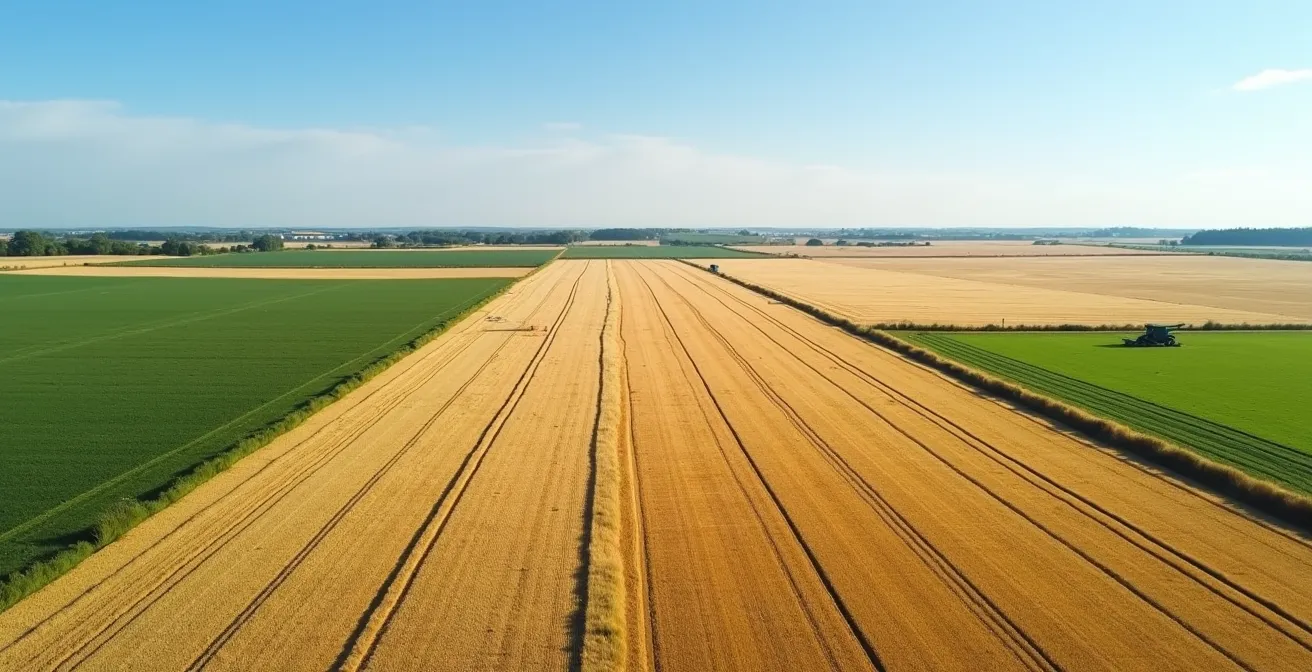
Your GDD forecast tells you when a field is ready. Your shatter resistance data tells you how long you can afford to wait. Combining these two data points allows you to create a dynamic priority list, ensuring you allocate combines and labor to the fields where time is most critical. This transforms your harvest from a linear process into a strategic, multi-variable logistical operation.
Why Harvesting Corn at 25% Moisture Kills Your Profit Margin?
The pressure to get the crop out of the field can lead to a costly mistake: starting the combine when corn moisture is too high. While harvesting at 25% moisture might seem proactive, it often represents a significant, unforced financial error. Every point of moisture above the market standard must be removed with expensive propane and electricity, and it also contributes to excessive “shrink,” or the loss of sellable bushels during the drying process. From a temporal planning perspective, a little patience, guided by GDDs, can yield a substantial return.
Natural field drying is essentially a free service provided by nature, and your GDD forecast can help you predict how much drying you can expect per day. Even a few extra days in the field can make a massive difference to your bottom line. The decision to wait is a calculated trade-off between the cost of mechanical drying and the low-but-present risk of increased field loss (e.g., ear drop or stalk lodging). For most modern, healthy hybrids, the financial benefit of letting the grain dry naturally far outweighs the risk.
This is not an abstract concept; it is a clear-cut calculation. By waiting just one week for corn to dry from 25% to 22% moisture, the financial gains are immediate and significant. As a decision matrix from analysis by Farm Progress shows, the savings on drying costs and gains in test weight create a powerful economic incentive to wait.
| Factor | Harvest at 25% | Harvest at 22% (1 week wait) | Difference |
|---|---|---|---|
| Drying Cost/bu | $0.45 | $0.27 | $0.18 saved |
| Test Weight (lb/bu) | 56.5 | 58.2 | +1.7 lb/bu |
| Shrink Factor | 1.4% | 1.18% | 0.22% less loss |
| Field Loss Risk | Low | Moderate | +1-2% potential |
| Net Profit/acre* | $685 | $724 | +$39/acre |
Why a 3-Day Planting Delay Can Cost You 10% at Harvest?
The foundation of a predictable harvest timeline is laid months earlier, at planting. A seemingly minor delay of even a few days can have an outsized, negative impact on your entire season, fundamentally altering your GDD accumulation and potentially costing you a significant portion of your yield. This is the ultimate proof of the interconnected timeline: decisions made in April directly and predictably shape your logistical reality in October. The reason lies in the rate of GDD accumulation throughout the spring.
GDDs do not accumulate at a linear rate. Early in the season, when temperatures are cool, daily accumulation is slow. As spring progresses, days get longer and warmer, and the rate of GDD accumulation accelerates dramatically. According to Ohio State research, daily GDD accumulation can range from just 8-10 GDDs per day in mid-April to 15-20 GDDs per day in early May. By delaying planting, you miss the opportunity to capture those “faster” GDDs later in the season, effectively shortening your crop’s growing window and pushing its critical reproductive stages into the most stressful summer heat.
This GDD deficit at the front end can lead to lower pollination rates, reduced kernel depth, and ultimately, lower yield. Instead of viewing planting as a race to get everything in the ground, a GDD-based strategy uses this knowledge to its advantage. By staggering plantings with hybrids of different maturity ratings, you can intentionally spread out your GDD timelines. This de-risks your operation by ensuring your entire crop doesn’t pollinate during the same hot week and, crucially, it builds a staggered harvest window right into your plan, easing logistical bottlenecks in the fall.
- Select hybrids with a 200-300 GDD maturity spread (e.g., 2400, 2600, 2800 GDDs).
- Plant the longest-season hybrids first as soon as soil conditions are fit (e.g., 50°F and rising).
- Stagger subsequent plantings by 5-7 days to spread your harvest window by 2-3 weeks.
- Monitor accumulated GDDs to ensure you are on track to hit key milestones like silking before peak summer heat.
Key Takeaways
- Physiological maturity (black layer/R8) is the start of the dry-down phase, not the signal to harvest; patience builds test weight and profit.
- Harvest sequencing is a data-driven process combining GDD maturity, shatter resistance, and moisture levels to prioritize high-risk fields.
- Small decisions, like planting date and initial harvest moisture, have a compounding financial impact that can be forecasted and managed using a GDD timeline.
How to Use Grain Moisture Meters to Prevent Storage Spoilage?
The final, critical checkpoint in your GDD-based logistical framework is the moment you transition from prediction to physical validation. While your GDD model provides an excellent forecast for harvest readiness, the grain moisture meter provides the non-negotiable ground truth. Its role is twofold: first, to confirm the exact moisture content for harvest and storage decisions, and second, to act as a calibration tool to refine your GDD model for future seasons, increasing your temporal precision year after year.
Spoilage in the bin is a catastrophic and entirely preventable failure of planning. Storing grain above its safe moisture threshold creates a perfect environment for mold, insects, and degradation, erasing all the hard-earned value you cultivated throughout the season. The target is clear: for long-term storage, corn should be at or below a specific moisture level. The record-low 15.3% average moisture achieved in the 2024 U.S. corn harvest underscores the industry’s focus on this final metric. Your moisture meter is the only tool that can confirm you’ve hit this mark.
However, its most powerful use is in improving your forecasting. By taking moisture readings at set GDD intervals after silking, you can plot your own field-specific dry-down curve. This allows you to see how your GDD model’s predictions line up with reality. If the model predicts 22% moisture but your meter reads 24%, you know your model needs adjustment. This calibration process turns a simple reading into a powerful feedback loop, making your future logistical planning even more accurate. You can create a simple process to formalize this calibration and build confidence in your GDD-based harvest schedule.
Begin building your farm’s temporal framework today. Start by calculating the GDD requirements for your specific hybrids and mapping out your interconnected timeline from planting to storage to transform your harvest from a reaction into a meticulously planned operation.