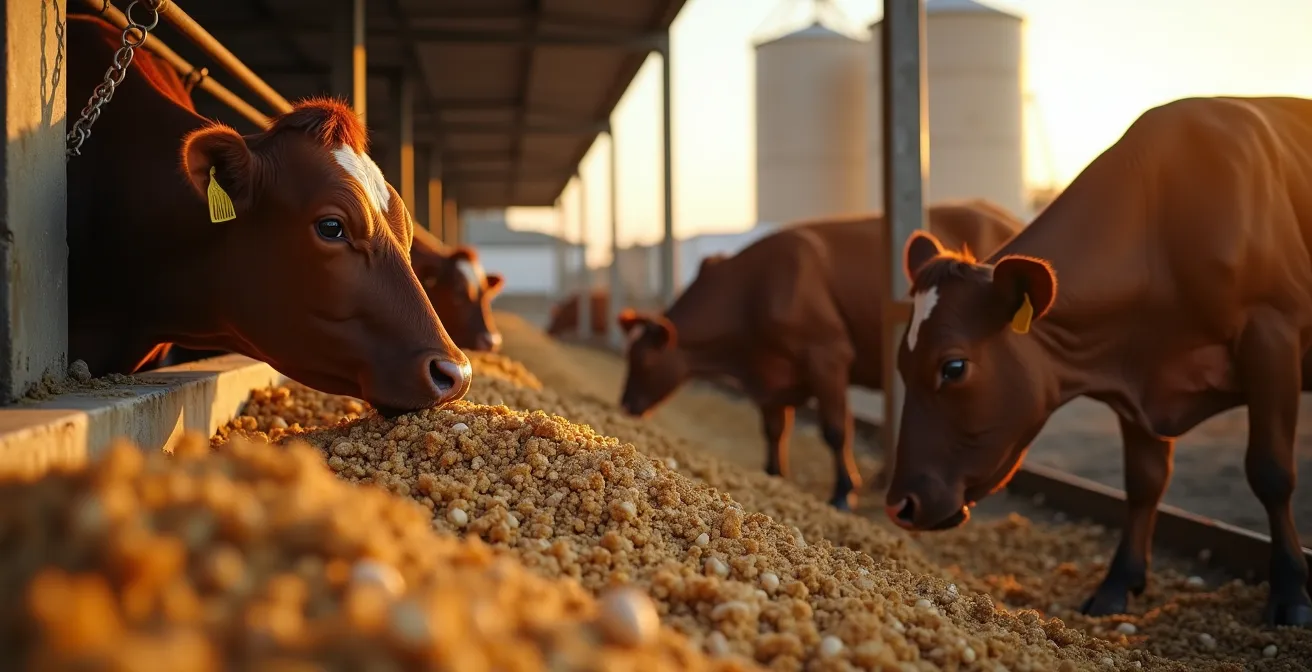
Maximizing weight gain is not about hitting abstract protein targets, but about managing the metabolic cost and economic efficiency of every feed component.
- Overfeeding protein creates a direct metabolic burden that can impair fertility and waste money, even if it seems to meet a crude protein goal.
- Ration integrity, determined by particle size and mixing time, is as critical as the nutritional content itself, directly impacting intake and preventing acidosis.
Recommendation: Shift from a ‘cost-per-ton’ mindset to a ‘cost-per-unit-of-performance’ analysis, using proactive veterinary and nutritional audits to preemptively manage risk.
For feedlot managers and dairy nutritionists, formulating a ration is a constant balancing act. The conventional wisdom dictates a straightforward approach: provide enough protein for growth and milk production, and enough fiber for healthy rumen function. This often leads to a search for the cheapest sources of crude protein and a focus on meeting minimum fiber requirements. However, this simplistic view overlooks the significant, and often hidden, metabolic and economic costs of imbalance. An improperly formulated ration doesn’t just underperform; it actively drains profitability through reduced fertility, subclinical disease, and inefficient feed conversion.
The true challenge lies not in meeting abstract percentages on a feed tag, but in understanding nutrient partitioning within the animal. Where does that extra point of protein go? Is it converted into profitable weight gain, or is it metabolized at a high energy cost and excreted, damaging fertility in the process? The most common formulation errors stem from this disconnect—treating ingredients as interchangeable commodities rather than as complex biological inputs with cascading effects. The pursuit of a lower cost-per-ton can paradoxically lead to a much higher cost-per-pound-of-gain when factoring in these hidden metabolic penalties.
This analysis moves beyond the platitudes of “balancing protein and fiber.” We will adopt a more calculating perspective, focusing on the economic efficiency and risk management inherent in ration formulation. The central argument is that profitability is driven by precision, not by crude approximation. It’s about quantifying the impact of Blood Urea Nitrogen (BUN) on conception rates, understanding the precise particle size needed to prevent sorting, and making ingredient choices based on a rigorous cost-benefit analysis. This guide provides the framework to dissect each component of your ration, identify points of financial leakage, and build a feeding strategy that maximizes performance by minimizing metabolic cost.
This article will dissect the critical decision points in ration formulation, from the metabolic consequences of protein excess to the physical mechanics of TMR mixing. The following sections provide a data-driven approach to help you refine your calculations and optimize herd performance.
Summary: A Precision Approach to Ration Formulation
- Why Overfeeding Protein Reduces Fertility in Dairy Cows?
- How to Adjust Rations Based on Hay Analysis Reports?
- Soybean Meal or Distillers Grains: Which is More Cost-Effective?
- The Ration Formulation Error That Causes Subacute Acidosis
- How Long to Mix TMR to Prevent Sorting by Cattle?
- How to Graze Cover Crops Without Compacting the Soil?
- Why Your Wheat Protein Drops Despite High Nitrogen?
- Why Monthly Veterinary Audits Save Money on Emergency Calls?
Why Overfeeding Protein Reduces Fertility in Dairy Cows?
Overfeeding protein is a common and costly error, often driven by a “more is better” fallacy or reliance on cheap, high-protein ingredients. The immediate consequence is not muscle growth but an increased metabolic load. When protein intake exceeds the animal’s requirements for maintenance and production, the excess ammonia is converted into urea in the liver, a process that consumes valuable energy. This elevates Blood Urea Nitrogen (BUN) levels, a key diagnostic indicator. According to recent research, BUN levels above 25 mg/dL can negatively affect milk quality and yield, while also serving as a clear marker for reproductive inefficiency.
The link between high BUN and poor fertility is direct and physiological. Research demonstrates that in cows fed high-protein diets, the elevated urea levels alter the uterine environment. This change in uterine pH is detrimental to both embryo establishment and subsequent development. The result is a quantifiable increase in early pregnancy loss, often within the first 10 days post-conception. This is a perfect example of a hidden metabolic cost: the money saved on a “cheaper” high-protein ration is quickly lost through lower conception rates and extended days open.

This oxidative stress and altered uterine environment represent a critical failure in nutrient partitioning. Instead of being channeled towards productive functions like milk or fetal growth, the energy is diverted to detoxify excess nitrogen. For a nutritionist, monitoring BUN is not just a health check; it is an economic tool. It provides a clear, data-driven signal to recalibrate the ration, reduce protein content to required levels, and redirect the cow’s metabolic energy back toward profitability—namely, getting her back in calf.
How to Adjust Rations Based on Hay Analysis Reports?
A hay analysis report is the foundational dataset for any fiber-based ration. Formulating without it is pure guesswork. The report provides objective, quantifiable metrics on the core components of your forage, allowing for precise adjustments to the concentrate and protein portions of the diet. The goal is to use this data to build a ration that meets the animal’s needs without over- or under-supplementing, thereby maximizing economic efficiency. The first step is always to convert all values to a dry matter (DM) basis, which creates a standardized platform for comparing different feedstuffs and accurately calculating intake.
Once on a DM basis, the key metrics to analyze are Crude Protein (CP), Neutral Detergent Fiber (NDF), Acid Detergent Fiber (ADF), and Total Digestible Nutrients (TDN). NDF is an indicator of bulk and gut fill; a high NDF percentage means the animal will feel full faster, limiting total DM intake and, consequently, energy intake. ADF is correlated with digestibility; lower ADF values suggest the energy within the fiber is more accessible. TDN provides a summary of the overall energy content. By comparing these values against the requirements for a specific class of animal (e.g., a growing steer vs. a lactating cow), you can identify nutritional gaps with precision.
Your Action Plan: Interpreting a Hay Analysis Report
- Focus on dry matter content first: Use this to compare feeds on an equal basis and convert rations from DM to as-fed.
- Evaluate crude protein (CP): Compare to animal requirements (e.g., 8-12% for beef brood cows, 12-18% for growing cattle) to determine the need for protein supplementation.
- Analyze fiber content (NDF/ADF): High NDF (>65%) indicates lower potential intake, while high ADF (>45%) indicates lower digestibility.
- Check TDN as a summary of energy content: This is the primary indicator for whether energy supplementation (like corn or fats) is necessary.
- Review macro minerals (Ca, P, Mg, K): Compare to animal needs to formulate a custom mineral program and avoid costly, generic supplements.
The following table provides clear benchmarks for classifying forage quality based on these key metrics. Using this allows for rapid decision-making on supplementation strategies.
| Metric | Poor Quality | Average Quality | High Quality | Action Required |
|---|---|---|---|---|
| CP (%) | <7 | 7-12 | >12 | Supplement protein if below requirements |
| NDF (%) | >65 | 50-65 | <50 | Lower NDF = higher intake potential |
| TDN (%) | <55 | 55-65 | >65 | Energy supplementation needed if low |
| ADF (%) | >45 | 35-45 | <35 | Lower ADF = better digestibility |
Soybean Meal or Distillers Grains: Which is More Cost-Effective?
The choice between soybean meal (SBM) and dried distillers grains (DDGs) is a classic example of where a purely “cost-per-ton” analysis fails. A precise, calculated decision requires evaluating them on a “cost-per-unit-of-nutrient” basis, particularly cost per unit of protein and energy. SBM is a highly concentrated source of protein (44-48% CP) with an excellent amino acid profile, especially in lysine, which is critical for growth and milk production. DDGs offer a lower concentration of protein (25-30% CP) but contribute significantly more energy from fat and digestible fiber. Therefore, the choice is not a simple protein substitution; it’s a recalibration of the entire ration’s protein and energy balance.
The economic calculation must also account for other nutritional factors. DDGs are high in phosphorus, which can reduce the need for supplemental phosphorus in the mineral mix, representing a cost saving. However, this can also lead to over-feeding phosphorus, with negative environmental implications. Furthermore, the protein in DDGs is less consistent and has a poor lysine profile compared to SBM, which might necessitate the addition of synthetic lysine to meet requirements, adding another cost. The physical properties also differ; the variability and flowability of DDGs can present storage and mixing challenges, affecting the overall ration integrity.
To determine true cost-effectiveness, a nutritionist must perform a comparative analysis, as shown below. The decision depends on the baseline ration, current ingredient prices, and the specific performance goals (e.g., maximum gain in a feedlot vs. milk components in a dairy). A balanced approach often involves using both ingredients to capture the benefits of each while mitigating their respective drawbacks.
| Factor | Soybean Meal | Distillers Grains (DDGs) | Consideration |
|---|---|---|---|
| Protein Content | 44-48% CP | 25-30% CP | SBM more concentrated |
| Energy Source | Moderate | High (fat & fiber) | DDGs provide more energy |
| Lysine Profile | Excellent | Poor | Critical for growth/milk |
| Phosphorus | Low | High (0.8-1.0%) | DDGs reduce mineral costs but environmental risk |
| Consistency | Very consistent | Variable | SBM easier to formulate |
| Storage | Easy, dry | Can be challenging | DDGs flowability issues |
The Ration Formulation Error That Causes Subacute Acidosis
Subacute ruminal acidosis (SARA) is a pervasive and economically devastating metabolic disorder caused by a fundamental ration formulation error: an imbalance between rapidly fermentable carbohydrates (starches and sugars) and effective fiber. When the diet contains too much grain or finely chopped forage, the fermentation in the rumen produces volatile fatty acids (VFAs) faster than they can be absorbed or buffered by saliva. This drops the rumen pH below the optimal range (typically below 5.8), impairing fiber digestion, reducing feed intake, and causing a cascade of health problems like laminitis and liver abscesses.
The critical mistake is often a failure to ensure ration integrity in terms of both formulation and physical form. It’s not just about the NDF percentage on paper; it’s about the “effective” NDF—the particle size of the forage that stimulates chewing, saliva production, and the formation of a healthy rumen mat. Research from Penn State highlights the direct impact of this imbalance. During digestive upsets like SARA, cattle intakes can plummet to just 1% of their body weight, a drastic reduction from the normal 2-3.5%. This demonstrates that a “hot” ration designed for high performance can backfire completely if it compromises rumen health, ultimately destroying the very intake it was meant to support.

Preventing SARA is a matter of precise calculation. The formulation must balance VFA production from concentrates with the buffering capacity generated by effective fiber. This involves setting minimums for forage NDF and ensuring adequate particle length in the TMR. Symptoms of SARA can be subtle—inconsistent manure, decreased cud-chewing, or reduced milk fat—making it difficult to spot without proactive auditing. The formulation error is not just about too much corn; it’s about too little respect for the rumen’s biology and the critical role that physical fiber plays in maintaining its stability.
How Long to Mix TMR to Prevent Sorting by Cattle?
The perfectly formulated ration is useless if the cow doesn’t consume it as intended. Sorting is the primary enemy of ration integrity. When cattle can selectively eat the tastier grain components and leave behind the longer forage particles, they are not consuming the balanced diet you formulated; they are creating their own high-risk, low-fiber diet, predisposing themselves to subacute acidosis. The key to preventing this lies in the physical characteristics of the Total Mixed Ration (TMR), which is controlled by mixing time and procedure.
Under-mixing results in a loose mix where concentrates and forages are easily separated. Dominant cows will consume the grain, while timid cows are left with a high-fiber, low-energy diet. Over-mixing, conversely, can be just as damaging. It pulverizes the long fiber particles, reducing their effectiveness in stimulating rumination and buffering. This effectively lowers the “effective fiber” of the ration, even if the NDF content on paper is adequate. The goal is a homogenous mix with consistent particle size distribution, where every mouthful is as close to the formulated ration as possible.
The Penn State Particle Separator is the industry-standard tool for quantifying this. It provides objective data on particle size distribution, allowing nutritionists to move from subjective “art” to objective science. According to research, an optimal TMR should have 2-8% of its particles on the top sieve (>19mm), 30-50% on the middle sieve (8-19mm), and a smaller fraction on the lower sieves. Achieving this distribution is a function of mixer type, loading order (hay first), and, critically, mixing time. Typically, 3-5 minutes of mixing after the last ingredient is added is sufficient. Regularly using a particle separator to audit the TMR at the feed bunk provides the data needed to fine-tune this process and ensure every cow receives the intended ration.
How to Graze Cover Crops Without Compacting the Soil?
Integrating cover crops into a grazing system offers a dual benefit: providing a high-quality, low-cost source of protein and fiber for livestock while simultaneously improving soil health. However, this strategy is not without risk. The primary challenge is managing the animals to prevent soil compaction, which can negate many of the soil health benefits the cover crops were planted to provide. The key is controlled, high-density, short-duration grazing, often referred to as “flash grazing” or mob grazing. This approach mimics natural herd behavior, maximizing forage utilization while minimizing the time hooves are on any given piece of ground.
The selection of cover crop species is a critical calculation. The ideal mix should provide excellent nutrition while contributing to soil structure. A combination of species with different root structures—such as the deep taproot of a radish to break up compaction pans and the dense, fibrous root system of cereal rye to build soil aggregate stability—is often most effective. The nutritional profile, particularly the crude protein content, will dictate the need for supplementation and the class of animal best suited for grazing.
This table compares common cover crop species based on their value for both grazing and soil health. A calculated blend can provide a balanced diet for cattle while actively improving the underlying soil resource. For example, pairing a high-protein legume like crimson clover with a high-biomass grass like annual ryegrass can create a nearly complete ration on its own, maximizing the economic efficiency of the system.
| Cover Crop | CP Content | Root Structure | Grazing Tolerance | Soil Benefit |
|---|---|---|---|---|
| Annual Ryegrass | 15-25% | Fibrous | Excellent | Erosion control |
| Crimson Clover | 20-28% | Taproot | Moderate | N-fixation |
| Cereal Rye | 10-20% | Fibrous | Good | Weed suppression |
| Turnips/Radishes | 15-22% | Deep taproot | Good | Compaction relief |
Why Your Wheat Protein Drops Despite High Nitrogen?
A common frustration for producers growing their own forage is seeing wheat protein levels fall short of expectations, even when significant nitrogen (N) has been applied. This paradox highlights a crucial concept in plant nutrition: nutrient synergy. Protein synthesis in plants is a complex process that depends on more than just nitrogen. One of the most common limiting factors is sulfur (S). Nitrogen and sulfur are both essential building blocks for amino acids, the constituents of protein. If sulfur is deficient, the plant cannot effectively convert the available nitrogen into protein, leading to lower protein content in the grain, regardless of how much N was applied.
The optimal nitrogen-to-sulfur (N:S) ratio in plant tissue is a critical metric, typically falling in the range of 10:1 to 15:1. When this ratio is too high, it’s a clear indicator of a sulfur deficiency. Another factor is the timing of nitrogen application. Early-season N is primarily used by the plant to build biomass and yield potential. To specifically boost protein content in the grain, a later-season foliar N application, often at the flag leaf stage, is much more effective. This is because it provides a direct source of nitrogen during the critical grain-fill period when protein is being actively synthesized and stored.
Finally, environmental stress, particularly water stress during grain fill, can severely hamper the plant’s ability to translocate nutrients and synthesize protein. Ensuring adequate soil moisture during this final stage is paramount. A systems approach is necessary to consistently achieve high-protein wheat for forage or feed.
- Check nitrogen-sulfur ratio: Aim for a 10:1 to 15:1 N:S ratio in tissue tests for optimal protein synthesis.
- Time nitrogen applications: Use early-season N to build yield and a late-season foliar application to specifically boost grain protein.
- Monitor soil sulfur availability: Test for plant-available sulfate-sulfur, not just total elemental S, as availability can be a bottleneck.
- Select appropriate varieties: Choose wheat cultivars that are genetically predisposed to maintaining high protein levels under local conditions.
- Manage water stress: Ensure adequate soil moisture through irrigation or conservation practices during the critical grain-fill period.

Key Takeaways
- Metabolic disorders like acidosis and negative energy balance are not diseases, but symptoms of formulation and management errors with direct, calculable costs.
- The physical form of a ration (particle size, mix consistency) is equally as important as its nutritional content for preventing sorting and ensuring planned intake.
- Profitability is maximized by shifting focus from minimizing cost-per-ton of feed to minimizing cost-per-unit of production (gain, milk, or pregnancy).
Why Monthly Veterinary Audits Save Money on Emergency Calls?
The most expensive veterinary call is almost always an emergency. A displaced abomasum surgery, treatment for severe clinical acidosis, or managing a major disease outbreak all carry substantial costs in terms of treatment, lost production, and animal welfare. A system of proactive auditing, conducted monthly by a veterinarian or nutritionist, fundamentally changes this economic equation from reactive and expensive to proactive and cost-effective. These audits are not about treating sick animals; they are about using data to identify subclinical trends before they escalate into costly clinical problems.
A nutritionally-focused audit involves a systematic evaluation of key performance indicators across the herd. This includes routine Body Condition Scoring (BCS) to assess energy balance, locomotion scoring to catch early signs of laminitis (often linked to SARA), and rumen fill scoring as an indicator of recent feed intake. Critically, it also involves objective evaluation of outputs: systematic manure scoring to assess digestion and TMR analysis at the bunk to check for sorting and particle size consistency. This creates a monthly dashboard of the herd’s metabolic health.
By tracking these metrics over time, subtle negative trends can be identified. For instance, a slight drop in the average BCS or an increase in the number of cows with loose manure can signal an emerging issue with the ration days or weeks before a major problem occurs. This allows for small, precise adjustments to the ration or management, heading off the “emergency” before it ever happens. The return on investment is clear: the cost of one displaced abomasum surgery can easily exceed the cost of six to twelve months of preventative audit visits. This data-driven approach transforms herd health management into a calculated, strategic process of risk mitigation, directly improving the operation’s bottom line.
Frequently Asked Questions on Ration Formulation and Audits
What should a nutritionally-focused vet audit include?
A comprehensive audit should include Body Condition Scoring (BCS), locomotion scoring, rumen fill scoring, systematic manure scoring, and an objective evaluation of feed particle size distribution using a tool like the Penn State Particle Separator.
How often should audits be performed?
Monthly audits are recommended as the ideal frequency for early detection of subclinical issues. This allows for timely intervention before they develop into costly clinical emergencies that impact production and profitability.
What is the ROI of preventive audits?
The return on investment is exceptionally high. For example, the cost of a single displaced abomasum surgery can often be greater than the combined cost of 6 to 12 monthly audit visits, making prevention a highly cost-effective strategy.