In summary:
- True water savings come from creating a data-driven ecosystem, not just using a sensor.
- Automating irrigation based on real-time soil data—not timers or forecasts—is the key to precision.
- Sensor data can be used as a powerful diagnostic tool to identify hidden issues like salt buildup and emitter clogs.
- Integrating sensors with Variable Rate Irrigation (VRI) allows for zone-specific management based on actual soil capacity.
- This technology is foundational for building a truly drought-resilient farming operation.
For farmers facing rising water costs and increasingly unpredictable weather, the question of irrigation is no longer just about *when* to water, but *how efficiently*. The standard advice often revolves around simple tactics like watering at night or installing basic timers. While these methods offer marginal gains, they operate on assumptions and static schedules, treating water as a blunt instrument rather than a precision input. This approach fundamentally fails to account for the two most critical variables in the field: real-time weather fluctuations and the unique water-holding capacity of different soil types across a property.
The true revolution in water management isn’t just about knowing if the soil is wet or dry. It’s about shifting from a reactive or scheduled approach to a predictive, data-driven ecosystem. This is where soil moisture sensors transcend their role as simple monitors and become the central nervous system of an intelligent irrigation strategy. They provide the “ground truth” that static timers and even weather-based evapotranspiration (ET) forecasts can’t deliver on their own. By understanding the principles behind this technology, you can move beyond saving a few percentage points of water and begin to fundamentally re-engineer your farm’s relationship with this critical resource.
This guide moves beyond the basics. As a hydrological engineer, my focus is on the system, not just the tool. We will dissect how to integrate sensors, interpret their data for system diagnostics, and build a framework for genuine drought resilience. We’ll explore the crucial differences in system design, the hidden pitfalls that undermine efficiency, and the long-term strategies that turn data into a more profitable and sustainable operation.
Table of Contents: A Guide to Precision Irrigation with Soil Sensors
- Why Scheduling by Timer Wastes Water Compared to ET Data?
- How to Automate Valves for Remote Control via Smartphone?
- Drip Tape or Center Pivot: Which ROI is Better for Corn?
- The Filtration Oversight That Clogs Emitters with Salt
- How to Map VRI Zones Based on Soil Water Holding Capacity?
- Why a Hot Canopy Means Your Crop Stopped Drinking?
- How to Read Soil Dielectric Sensors for Irrigation Timing?
- How to Build a Drought-Resilient Farm Ecosystem?
Why Scheduling by Timer Wastes Water Compared to ET Data?
Traditional irrigation scheduling relies on a fixed timer—a static, “set it and forget it” approach. This method is fundamentally flawed because it ignores the two most dynamic factors in agriculture: daily weather changes and actual crop water consumption. A timer will apply the same amount of water on a cool, overcast day as it does during a heatwave, leading to chronic overwatering or underwatering. The waste is staggering; the EPA estimates that replacing clock-based controllers with WaterSense labeled soil moisture sensors could save 390 billion gallons of water annually in the U.S. alone.
A more advanced method uses evapotranspiration (ET) data, which predicts crop water needs based on weather forecasts (temperature, humidity, wind). While this is a significant improvement over static timers, it remains a predictive model. It estimates what the crop *should* need, but it lacks “ground-truthing”—it doesn’t know the actual moisture level in the root zone. A sudden, localized rain shower or variations in soil type are not captured. Soil moisture sensors provide this crucial ground-truth. They measure the volumetric water content (VWC) directly in the soil, telling you what *is*, not what is predicted. The ultimate strategy is a hierarchy: use ET data for predictive scheduling and soil moisture sensors for real-time validation, triggering irrigation only when the soil has reached a predetermined level of dryness, known as the Maximum Allowable Depletion (MAD).
By moving from a static timer to a dynamic, sensor-validated system, water becomes a precision input applied only when and where it is truly needed. This conserves the resource and prevents issues like nutrient leaching and root disease caused by over-saturated soils.
How to Automate Valves for Remote Control via Smartphone?
Collecting soil moisture data is only half the battle; true efficiency is achieved when that data automatically triggers an action. Automating irrigation valves based on sensor readings closes the loop, creating a self-regulating system that operates with minimal human intervention. This data-driven ecosystem transforms irrigation from a manual chore into a precise, automated process controlled directly from a smartphone or computer. The core components of this system form a clear chain of command: from soil to screen to solenoid.
The automation chain typically consists of three key elements:
- Wireless Sensor Modules: These are placed in the root zone of representative areas of the field. They measure soil moisture and temperature, transmitting the data wirelessly.
- Gateway/Controller: This device collects data from all the sensors in the field. It connects to the internet via cellular or Wi-Fi and serves as the brain of the operation, executing the irrigation rules you define.
- Valve Actuators/Solenoids: The controller sends a signal to these devices, which physically open or close the irrigation valves to start or stop water flow to a specific zone.
This setup allows a farmer to set rules such as, “If the VWC in Zone 3 drops below 25%, open the valve for 45 minutes.” The entire process is managed through a software application, providing real-time status updates, historical data graphs, and the ability to manually override the system from anywhere in the world.
Case Study: SoilSense Implementation at an Organic Farm
Godis Grønt, an organic vegetable farm in Denmark, provides a powerful example of this technology in action. By implementing a system of SoilSense wireless sensors with smartphone control, the farm gained the ability to make real-time irrigation adjustments remotely. The results were dramatic: the farm achieved water savings of up to 45% while simultaneously increasing crop yield by up to 25%. The solar-powered system, connected via an IoT network, demonstrates how a well-designed automation chain can deliver a significant return on investment through both resource conservation and improved productivity.
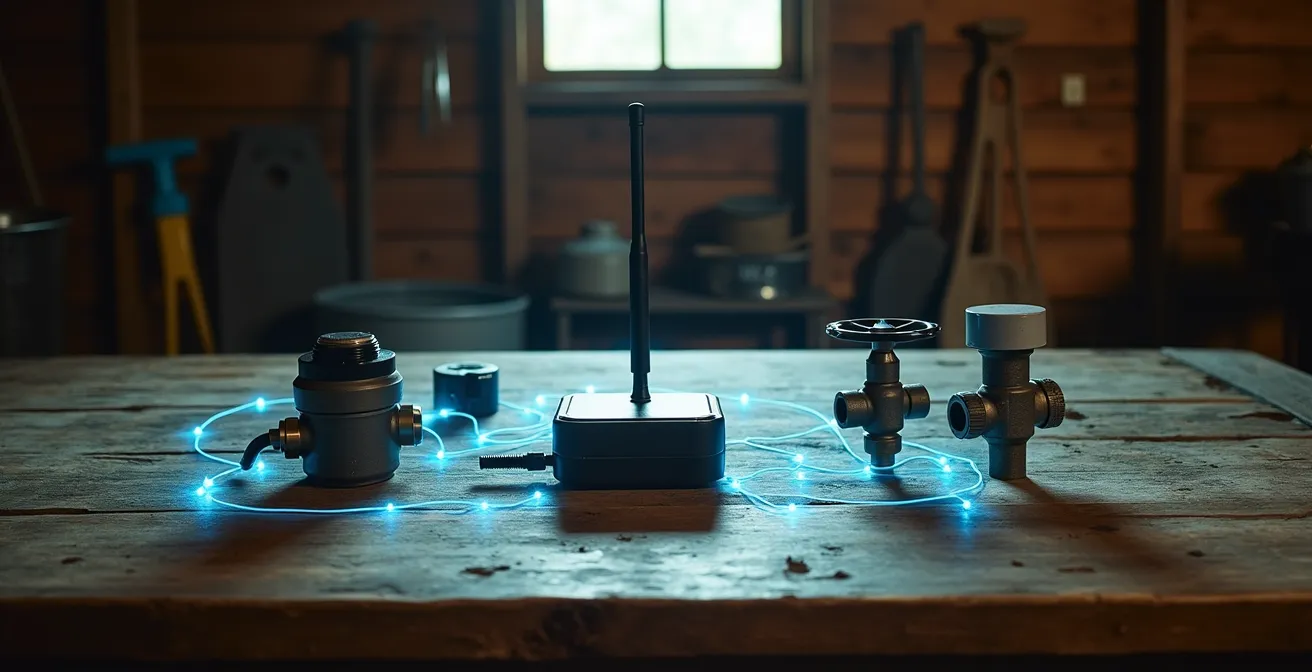
As this diagram illustrates, the flow of information is seamless. The sensor acts as the trigger, the gateway as the decision-maker, and the valve as the executor. This level of control is what allows for the shift from blanket watering to precision irrigation, a cornerstone of modern, sustainable agriculture.
Drip Tape or Center Pivot: Which ROI is Better for Corn?
When implementing soil moisture sensors, the choice of irrigation delivery system—drip tape or center pivot—has a major impact on the potential return on investment (ROI), especially for large-scale crops like corn. Both systems benefit immensely from sensor integration, but their efficiency gains and costs differ. Drip irrigation, by its nature, delivers water directly to the root zone, minimizing evaporation and runoff. When combined with sensors, it becomes a hyper-efficient system ideal for high-value crops. For a commodity crop like corn, however, the high upfront cost of drip tape across hundreds of acres can be prohibitive.
Center pivot systems, while less efficient in their basic form, can see dramatic improvements when upgraded with sensor technology. The key is integrating sensors with Variable Rate Irrigation (VRI). A standard pivot applies water uniformly, but VRI allows the pivot to apply different amounts of water to different zones within the same field, based on sensor data and soil maps. This is where the ROI for corn becomes compelling. For example, one Nebraska corn farmer achieved a 40% reduction in irrigation by using sensors, saving an incredible 55 million gallons of water annually on a single 130-acre field.
The decision ultimately comes down to a cost-benefit analysis based on the specific context of the farm, including soil variability, water cost, and crop value. As the following comparison shows, adding sensors elevates the performance of any system.
| System Type | Water Savings | Precision Level | Best Use Case |
|---|---|---|---|
| Drip with Sensors | 30-45% | Zone-specific | High-value crops |
| Center Pivot + VRI + Sensors | 20-30% | Variable rate zones | Large corn fields |
| Center Pivot without VRI | 10-15% | Uniform application | Homogeneous soils |
For corn farmers, upgrading an existing center pivot with VRI and a network of soil moisture sensors often presents the most pragmatic path to significant water savings and a faster ROI than a complete conversion to drip.
The Filtration Oversight That Clogs Emitters with Salt
One of the most insidious problems in modern irrigation, especially in arid regions or areas with hard water, is not a lack of water but the accumulation of salts in the soil. This issue is often exacerbated by hyper-efficient irrigation systems like drip tape. As water is applied precisely, there is less deep percolation to leach salts away from the root zone. Over time, these salts can precipitate and clog the tiny orifices of drip emitters, leading to non-uniform watering, plant stress, and eventual system failure. This is a filtration and management oversight that can completely undermine the investment in a precision irrigation system.
The solution lies in using sensors for more than just moisture. Many advanced soil probes also measure Electrical Conductivity (EC), which is a direct indicator of soil salinity. By monitoring both VWC and EC, a farmer can practice proactive salt management. When EC levels rise above a critical threshold (typically 1.5-2.0 dS/m), even if moisture levels are adequate, it’s a sign that salts are accumulating. This data can trigger a “flushing” event—a deliberate, slightly longer irrigation cycle designed to push the accumulated salts below the root zone. Research on drip-irrigated tomatoes has shown that combining moisture and EC monitoring is critical for maintaining optimal root zone conditions and preventing yield loss from salt stress.
This dual-monitoring approach transforms the sensor from a simple irrigation trigger into a sophisticated system diagnostic tool. It allows for targeted interventions before a problem like widespread emitter clogging becomes catastrophic.
Your Action Plan: Dynamic EC-Based Flushing Protocol
- Continuously monitor both volumetric water content (VWC) and electrical conductivity (EC) with multi-function probes.
- Establish a baseline EC threshold for your operation based on your specific water source’s salinity.
- If EC levels begin to climb above this threshold while soil moisture remains sufficient, trigger a diagnostic alert in your system.
- Implement automated “flushing cycles” when the measured EC exceeds your established threshold by a set percentage, for example, 20%.
- Document and map EC patterns over the season to identify zones with chronic salt accumulation for more targeted management.
How to Map VRI Zones Based on Soil Water Holding Capacity?
Variable Rate Irrigation (VRI) is a powerful technology, but its effectiveness is entirely dependent on the accuracy of the management zones it uses. A common mistake is to create these zones based solely on preliminary data, such as satellite imagery or yield maps. While these are good starting points, they don’t reveal the most critical factor for irrigation: the Available Water Capacity (AWC) of the soil. AWC is the amount of water a particular soil type can hold and make available to plant roots. A sandy patch will hold far less water than a clay or loam section, and they must be irrigated on different schedules.
Soil moisture sensors are the definitive tool for “ground-truthing” and refining VRI zones. The methodology involves a systematic process of measurement and analysis. First, preliminary zones are identified using tools like EM38 soil surveys or aerial imagery. Then, sentinel sensors are installed at multiple depths (e.g., 12″, 24″, and 36″) within each of these potential zones. The entire field is irrigated to full field capacity, and then the sensors are left to monitor the differential dry-down rates over a period of 7-10 days without any further irrigation. This reveals precisely how quickly each zone depletes its water stores.
The data collected allows for the precise calculation of AWC for each zone. The VRI map is then refined based on this ground-truth data. For example, zone boundaries might be redrawn wherever the AWC differs by more than 15%. The result is a highly accurate management map that reflects the true hydrological behavior of the field. Irrigating based on these sensor-validated zones ensures that water is applied according to the specific needs of each soil type, maximizing efficiency and preventing over- or under-watering in different parts of the same field.
Why a Hot Canopy Means Your Crop Stopped Drinking?
A plant’s canopy temperature is a powerful, if delayed, indicator of its health. Healthy, well-hydrated plants actively “drink” water from the soil and release it through their leaves in a process called transpiration. This process has a cooling effect, much like perspiration in humans. When a plant cannot access enough water from the soil, transpiration slows or stops, and the leaf surface temperature begins to rise. A hot canopy, therefore, is a direct sign that the crop is experiencing water stress—it has essentially stopped drinking.
While thermal imaging from drones or fixed sensors can detect this temperature rise, it’s crucial to understand its place in the timeline of plant stress. As experts in an Agricultural Engineering Research study on thermal imaging point out, canopy temperature is a lagging indicator. By the time the canopy is measurably hotter, the plant is already stressed, and some degree of yield potential may have already been lost. This makes it a useful tool for confirming stress but a poor one for preventing it.
Soil moisture depletion is a leading indicator that predicts future stress, while a rise in canopy temperature is a lagging indicator that confirms current stress.
– Agricultural Engineering Research, Thermal Imaging Integration Study
Soil moisture sensors, in contrast, are a leading indicator. They detect the depletion of water in the root zone *before* the plant begins to experience physiological stress. This proactive information allows a farmer to irrigate just in time to prevent the stress from ever occurring. The ideal system uses both: soil moisture sensors for predictive, preventative irrigation scheduling, and occasional thermal canopy monitoring as a high-level check to validate that the irrigation strategy is working effectively across the entire field.
How to Read Soil Dielectric Sensors for Irrigation Timing?
Dielectric soil moisture sensors don’t just provide a single number; they generate a continuous stream of data that, when graphed over time, tells a detailed story about what is happening beneath the surface. Learning to interpret these graphs is essential for moving beyond simple threshold-based irrigation and into advanced system diagnostics. Different patterns on the graph can reveal not only when to water but also potential problems with your soil or irrigation system.
A typical graph will show the Volumetric Water Content (VWC) on the y-axis and time on the x-axis. After an irrigation event, the VWC will spike upwards and then gradually decline as the crop consumes water and gravity pulls it deeper. The goal is to irrigate again just before the VWC drops below the pre-set Maximum Allowable Depletion (MAD) line. However, anomalies in this pattern are where the real insights lie:
- Sharp, stair-step patterns: This is the classic signature of sandy soils. They take in water quickly and drain just as fast. This requires more frequent, shorter irrigation cycles.
- Smooth, gradual curves: This indicates a clay or loam soil that absorbs water slowly and retains it for much longer. Irrigation cycles can be less frequent but longer in duration.
- A sudden vertical spike during a dry period: This often points to “preferential flow,” where water is running down a crack or wormhole directly past the sensor, not properly saturating the soil matrix. The sensor placement should be verified.
- A line that never declines: This is a major red flag for waterlogging. The sensor may be in a compacted clay lens or a low spot where water is pooling, starving roots of oxygen.
- A flat or noisy, erratic line: This usually indicates a technical problem, such as a disconnected sensor, a bad cable connection, or electrical interference.
By understanding these visual signatures, a farmer can adjust irrigation thresholds (e.g., 20-30% VWC for sand, 35-45% for clay) and diagnose hidden issues that would otherwise go unnoticed. This turns the sensor graph into a daily report on both soil hydrology and system health.
Key Takeaways
- Go Beyond Timers: True efficiency comes from using sensors to provide “ground-truth” data, validating predictive models like ET and replacing static schedules.
- Automate the Action: A complete system links sensors to automated valves, closing the loop from data collection to precise water application without manual intervention.
- Use Data for Diagnostics: Advanced sensors that measure Electrical Conductivity (EC) can identify and help manage hidden problems like salt accumulation before they clog emitters and damage crops.
How to Build a Drought-Resilient Farm Ecosystem?
Ultimately, soil moisture sensors are more than just a tool for saving water in a single season. They are a foundational technology for building a truly drought-resilient farm. Their greatest long-term value lies in their ability to measure and validate the effectiveness of broader regenerative agriculture practices. By providing consistent, year-over-year data on soil water dynamics, sensors offer empirical proof of how practices like cover cropping, no-till farming, and compost application are improving the soil’s structure and its water-holding capacity.
When a farmer sees on a graph that their soil is holding onto water for two extra days after a rain event compared to three years ago, that is concrete evidence that their soil health initiatives are working. This data-driven feedback loop is incredibly powerful. It justifies the investment in regenerative practices and provides the confidence to continue them. As noted in research on deficit irrigation, even small, controlled water reductions can be beneficial; a UC research study on strawberries and almonds showed 10-16% water savings while maintaining maximum yield, a feat only possible with precise sensor monitoring.
This transforms the conversation from short-term cost savings to long-term asset building, where the soil itself becomes a more effective reservoir. The sensor becomes the scorecard for your farm’s most valuable asset.
Sensors don’t just guide irrigation; they are a tool to measure the effectiveness of other regenerative practices. Year-over-year sensor data proves how cover crops or no-till practices are increasing soil’s water-holding capacity.
– University of California Cooperative Extension, Irrigation and Nutrient Management Guide
Building this resilient ecosystem means viewing water management not as an isolated task, but as an integrated part of overall soil health. The technology and the biology must work in concert. Sensors provide the language that allows us to understand and optimize that relationship, ensuring the farm is not just surviving the next drought, but thriving through it.
The first step toward building this resilient, data-driven operation is to assess your specific field conditions and operational goals. Begin by evaluating your soil variability and current water costs to identify the areas with the highest potential for return on investment.