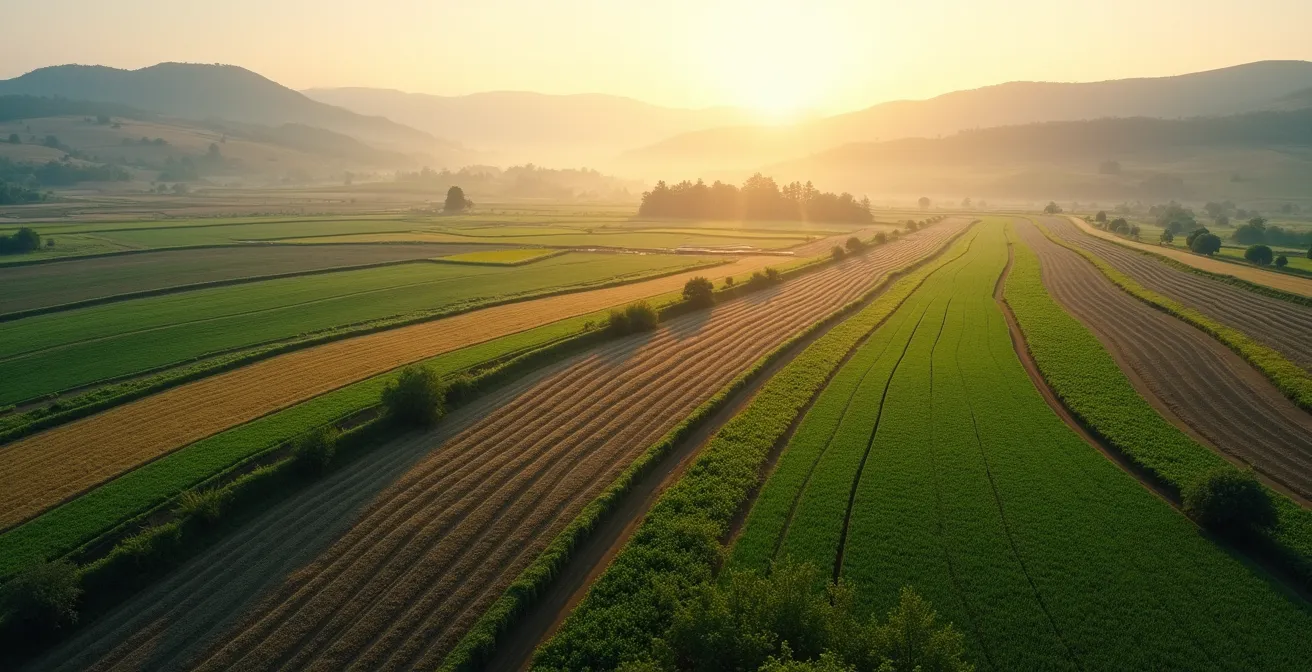
To scale food production sustainably, producers must shift from isolated ‘green’ tactics to a complete redesign of their production architecture, where ecological efficiency becomes a primary driver of economic resilience.
- Boosting “effective yield” by tackling post-harvest loss is a more immediate lever for growth than simply increasing crop output.
- Strategic land-use models and digital traceability are no longer optional compliance costs but essential keys to accessing premium markets and de-risking the supply chain.
Recommendation: Move beyond incremental changes and start architecting a holistic system that integrates post-harvest technology, precision resource management, and digital provenance from the ground up.
For large-scale agricultural producers, the directive is clear yet seemingly contradictory: meet the escalating global demand for food while simultaneously reducing environmental impact and operating within fixed land constraints. The conventional playbook, focused on maximizing raw tonnage per hectare through intensive inputs, is reaching its economic and ecological limits. Producers are under immense pressure from regulators, consumers, and major retailers to become “greener,” a demand often perceived as a threat to volume and profitability.
The common advice—use less water, optimize fertilizer, improve soil health—is sound but tactical. It treats sustainability as a series of add-ons to an existing model. But what if this entire framework is outdated? The true challenge isn’t about making industrial agriculture slightly more efficient; it’s about re-architecting the very system of production. This involves seeing the operation not as a linear process of ‘grow and sell,’ but as an integrated ecosystem where resource efficiency, waste reduction, and data transparency are core components of the business model itself.
This strategic shift requires moving beyond the farm gate to understand the entire value chain. It’s a transition from being a mere commodity supplier to becoming a strategic partner whose value proposition is built on resilience, transparency, and quantifiable sustainability. This guide will not offer simple tips. Instead, it will lay out a strategic blueprint for large-scale producers, focusing on the systemic levers that unlock the ability to produce more from the same acreage, not by working harder, but by working smarter at an architectural level.
For those who prefer a condensed visual format, the following video offers practical insights into soil testing, a fundamental aspect of understanding and improving your land’s productive capacity.
To navigate this complex transition, this article breaks down the core strategic pillars. We will explore the macro-economic case for sustainable intensification, dissect critical operational levers like post-harvest loss and water management, and connect on-farm practices to the non-negotiable demands of the modern marketplace.
Contents: A Strategic Framework for Sustainable Scaling
- Why Sustainable Intensification is Key to Feeding 10 Billion
- How to Reduce Post-Harvest Losses to Boost Effective Yield
- Land Sharing or Sparing: Which Model Preserves More Nature?
- The Cropping Intensity Mistake That Depletes Micro-Nutrients
- How to Lower the Water Footprint of Your Crop Portfolio?
- Intensive vs. Extensive Farming: Which Fits Your 50-Hectare Plot?
- Why Major Retailers Reject Produce Without Digital Traceability?
- Profit vs. Planet: How to Balance Ecology and Economy?
Why Sustainable Intensification is Key to Feeding 10 Billion
The challenge of feeding a future global population of 10 billion people cannot be met by simply expanding agricultural land; we are already pushing planetary boundaries. The strategic answer lies in Sustainable Intensification (SI), a concept that fundamentally redefines productivity. It’s not about a brute-force increase in inputs but about intelligently generating more output from the same or fewer resources. This approach moves beyond the false dichotomy of industrial versus organic, creating a third way focused on efficiency and resilience.
At its core, SI is about boosting the yield gap—the difference between a farm’s potential and its actual output. Rather than viewing land as a passive substrate, it treats it as a dynamic asset whose productivity can be enhanced through knowledge-intensive practices. This includes optimizing genetics, improving soil health, and implementing precision agriculture. As defined by leading academics in the field, it is a paradigm shift in how we view agricultural growth. This perspective is articulated clearly by Professor Jules Pretty:
Sustainable intensification is defined as a process or system where agricultural yields are increased without adverse environmental impact and without the conversion of additional non-agricultural land.
– Jules Pretty, Annals of Botany
Despite its critical importance, adoption remains nascent. Global research indicates that only 9% of the world’s agricultural land had undergone sustainable intensification by 2018. This gap represents a massive opportunity. For large-scale producers, embracing SI is not just an environmental choice but a strategic imperative to secure long-term viability and profitability in a resource-constrained world. The success of CIMMYT’s research in India, which influenced policies to raise farmer income while cutting pollution, proves that this model is scalable and economically sound.
How to Reduce Post-Harvest Losses to Boost Effective Yield
One of the most significant flaws in the traditional production architecture is the immense value destroyed after the crop has already been grown. Focusing solely on field-based yield ignores a critical metric: effective yield, which is the volume of product that actually reaches the market. Post-harvest losses (PHL) due to spoilage, inadequate storage, and poor handling represent a direct and avoidable drain on profitability. Globally, the scale of this problem is staggering; according to FAO statistics, 13.2% of food is lost in the supply chain between the farm and retail stages.
For a large-scale producer, a 13% loss is equivalent to leaving 13 hectares fallow for every 100 hectares farmed. Tackling this issue is not a peripheral activity; it is a primary lever for boosting revenue without increasing acreage or inputs. The solution lies in shifting processing and preservation capabilities directly onto or near the farm. This strategic move shortens the time between harvest and stabilization, drastically reducing the window for degradation.

Technologies like modular, on-farm processing units for washing, sorting, and packaging allow producers to capture more value from their existing output. As the image above illustrates, integrating clean, efficient processing technology at the source is key. This approach turns a raw agricultural commodity into a value-added product before it even leaves the property. Case studies confirm the impact: targeted training on better handling and packaging led to a 38% reduction in losses for tomato farmers in the Philippines and less than 5% PHL for dasheen farmers in Trinidad, proving the immense return on investment from focusing on this crucial stage.
Land Sharing or Sparing: Which Model Preserves More Nature?
Once you’ve committed to maximizing the output from every hectare, a larger strategic question emerges: how should agricultural landscapes be designed to balance food production and biodiversity? The debate has largely been framed as a choice between two competing models: land sparing and land sharing. Land sparing advocates for segregating land uses: farming is intensified on the smallest possible footprint to allow large, separate tracts of land to be set aside exclusively for nature. Conversely, land sharing promotes integrating conservation and production on the same land, using agro-ecological methods like agroforestry and integrated pest management.
For a large-scale producer, the choice is not merely philosophical; it dictates investment strategy, operational complexity, and long-term land value. A systematic review of studies found that land sparing is often strongly promoted, with the argument that it is the only way to protect large, untouched habitats. However, this black-and-white view is increasingly seen as a false dichotomy. The most resilient and productive landscapes often blend elements of both. A “sparing” approach might protect a core wetland or forest on the property, while “sharing” principles are used in the surrounding agricultural matrix to create wildlife corridors and enhance ecosystem services like pollination.
Both large, protected regions and favorable surrounding matrices are needed to promote biodiversity conservation; they work synergistically and are not mutually exclusive.
– Claire Kremen, Conservation Biology Review
The optimal strategy is not “either/or” but “both/and.” A visionary producer can design a production architecture that incorporates high-yield intensive plots (sparing) within a broader, regeneratively managed landscape that supports biodiversity (sharing). This hybrid model optimizes for both ecological resilience and economic output, creating a more defensible and valuable asset in the long run.
The Cropping Intensity Mistake That Depletes Micro-Nutrients
A common pitfall of naive intensification is focusing solely on macronutrients (Nitrogen, Phosphorus, Potassium – NPK) to boost yields. While this approach can deliver short-term gains, it often leads to a critical long-term problem: the depletion of essential micronutrients in the soil. High-yielding crops are voracious consumers of trace minerals like zinc, iron, selenium, and boron. When these are extracted year after year without replenishment, the result is a decline in both soil health and the nutritional quality of the food produced, a phenomenon known as “hidden hunger.”
This creates a vicious cycle. Depleted soils require ever-increasing inputs to maintain yields, driving up costs and environmental impact. Furthermore, produce with lower nutritional density is less appealing to health-conscious consumers and can fail to meet the stringent quality standards of premium buyers. Addressing this requires a more sophisticated approach to soil management, one that views soil not as an inert medium but as a living biological system. This involves moving beyond simple NPK application to a holistic strategy that restores and maintains the full spectrum of soil nutrients.
The key is to proactively manage soil biology and chemistry. This includes diversifying crop rotations to include deep-rooted plants that can “mine” minerals from lower soil layers and bring them to the surface. It also requires precision testing and targeted supplementation to address specific deficiencies before they impact crop health and yield. Building a resilient production system means building resilient soil from the ground up.
Action Plan: Restoring Soil Micronutrient Balance
- Implement functional biodiversity through strategic crop rotations and intercropping systems to activate soil life.
- Conduct real-time plant sap analysis for immediate nutrient uptake assessment, moving beyond slow soil tests.
- Design biological pumps using specific crop combinations to actively redistribute micronutrients throughout the soil profile.
- Apply hyper-targeted micronutrient supplementation based on precision testing results, avoiding blanket applications.
- Monitor a broad range of trace minerals including zinc, selenium, and boron regularly, not just NPK.
How to Lower the Water Footprint of Your Crop Portfolio?
In an era of increasing water scarcity and climate volatility, water is arguably the most critical input and the greatest financial risk for any large-scale agricultural operation. The traditional method of flood or furrow irrigation is not only wasteful but also increasingly untenable from both a regulatory and economic standpoint. Reducing the water footprint of your crop portfolio is a cornerstone of sustainable intensification, and technology is the primary enabler of this shift. The goal is to deliver the precise amount of water a plant needs, exactly when and where it needs it, eliminating runoff and evaporation.
This is the domain of precision irrigation. Systems leveraging real-time data from soil moisture sensors, weather stations, and satellite imagery can create hyper-accurate irrigation schedules. Drip irrigation and micro-sprinklers deliver water directly to the root zone, minimizing waste. The efficiency gains are dramatic; precision irrigation systems can achieve up to a 50% reduction in water usage compared to traditional methods. This translates directly into lower pumping costs, reduced energy consumption, and greater resilience during droughts.

The next frontier is the creation of a “digital twin” for farm hydrology, as metaphorically suggested by the image of integrated water capture and monitoring. This involves using AI and predictive analytics to model the entire water cycle of the farm—from rainfall and irrigation to evapotranspiration and soil absorption. Such a system allows producers to not only react to current conditions but also to forecast future needs and optimize water allocation across their entire crop portfolio. It transforms water management from a reactive chore into a predictive, strategic advantage.
Intensive vs. Extensive Farming: Which Fits Your 50-Hectare Plot?
The strategic principles of sustainable intensification must ultimately be translated into a concrete operational model. For a mid-to-large-scale plot, such as 50 hectares, the choice between an intensive or extensive approach has profound implications for cost, market access, and profitability. An intensive model focuses on maximizing yield on a small portion of the land, often with high-value crops requiring significant capital investment in technology and infrastructure. An extensive model utilizes the entire area with lower input costs and lower yields per hectare, typically for commodity crops.
However, the most resilient and often most profitable approach is a hybrid. For instance, a producer could dedicate 2-5 hectares to a highly intensive, high-value operation (e.g., vertical farming or greenhouses for specialty greens) that targets direct-to-consumer or high-end retail markets. The remaining 45-48 hectares could be managed extensively using regenerative principles for grazing or commodity crops, providing a stable, lower-risk revenue stream. This diversification of both production intensity and market channels creates a robust business model that can weather market fluctuations and environmental shocks.
The following table, based on comparative analyses, breaks down the core differences and highlights the potential of a balanced, hybrid strategy.
| Aspect | Intensive Model | Extensive Model | Hybrid Approach |
|---|---|---|---|
| Land Use | High-yielding on small footprint | Low-yielding on larger area | 2ha intensive + 48ha extensive |
| Production Cost | Higher per hectare | Lower per hectare | Balanced investment |
| Market Access Required | Direct-to-consumer essential | Commodity markets acceptable | Multiple channels viable |
| Environmental Impact | Potential for high local impact | Lower impact per unit area | Optimized sustainability |
| Profitability Potential | High with value chain control | Moderate, volume-dependent | Diversified income streams |
Case Study: Modular Intensive Production with Regenerative Grazing
Research published in Science highlights the growing trend of integrating small, patch-based intensive systems with broader regenerative practices. By combining intensive horticulture with managed pasture and integrated pest management, producers are maximizing biodiversity and resource efficiency. This modular approach allows for targeted investment where returns are highest while using the majority of the land to build ecological resilience and generate a secondary, stable income stream, proving the viability of the hybrid model.
Why Major Retailers Reject Produce Without Digital Traceability?
In the modern food system, the product is no longer just the physical crop; it is the crop plus its data. Major retailers, under pressure from consumers and regulators, are increasingly demanding full transparency across their supply chains. They need to verify claims about sustainability, origin, and safety. A producer without a robust digital traceability system is, in effect, a black box—a risk that premium buyers are no longer willing to take. Rejections of produce lacking this data layer are becoming standard practice.
This demand is driven by several factors. Firstly, food safety requires rapid track-and-trace capabilities in the event of a recall. Secondly, retailers are building their brand reputation on sustainability, and they need verifiable data to back up their marketing claims, particularly regarding Scope 3 emissions. Food loss and waste, which traceability helps to monitor and reduce, account for an estimated 8 to 10 percent of global greenhouse gas emissions. Finally, provenance—the story of where and how a food was grown—is a powerful driver of premium pricing. Digital traceability provides the authenticated narrative that justifies a higher price point.
For a large-scale producer, investing in traceability is not a compliance cost; it is an investment in market access. A comprehensive system should include several key components:
- Blockchain-based tracking from farm to retail to ensure data is immutable and trustworthy.
- Digital passports with QR codes for each batch, giving every stakeholder access to its history.
- Verified data recording for key metrics like water usage, carbon footprint, and input application (Scope 3).
- Predictive analytics to identify vulnerabilities and inefficiencies in the supply chain in real-time.
- Transparent provenance storytelling that can be leveraged for marketing and premium pricing.
Without this digital architecture, a producer’s high-quality, sustainably grown product is invisible to the market. Traceability is the language the modern supply chain speaks; failing to learn it means being locked out of the most valuable conversations.
Key Takeaways
- Sustainable Intensification (SI) is the only viable path to increase yields without expanding agricultural land, focusing on efficiency over raw input.
- Reducing post-harvest loss to boost “effective yield” offers a more immediate and impactful return on investment than simply trying to grow more.
- Digital traceability is no longer a “nice-to-have” but a mandatory key for accessing premium markets and de-risking supply chains against retailer rejection.
Profit vs. Planet: How to Balance Ecology and Economy?
The narrative that pits profitability against planetary health is the single greatest obstacle to progress in agriculture. It perpetuates a model where environmental stewardship is seen as a cost center, a luxury to be afforded only when margins are high. A visionary production architecture, however, is built on the opposite premise: that ecology and economy are two sides of the same coin. This is the principle of ecological-economic synthesis, where actions that enhance the environment directly strengthen the business’s financial foundation.
Consider the economic impact of inefficiency. As highlighted by the World Food Programme, the total cost of food loss and waste for the global economy is estimated at roughly $1 trillion annually. For an individual producer, a portion of that loss occurs directly on their balance sheet through wasted inputs, lost revenue, and disposal costs. By redesigning the system to minimize this waste—through precision irrigation, reduced post-harvest loss, and optimized nutrient cycling—a producer is not just “being green”; they are plugging significant financial leaks.
Furthermore, a business model built on verifiable sustainability opens doors to new revenue streams. It allows access to premium markets, attracts ESG-focused investment, and builds a brand that resonates with modern consumers. Projections from the OECD-FAO show that ambitious sustainability goals have massive economic upsides. Halving food loss and waste, for instance, could not only reduce agricultural GHG emissions but also decrease the number of undernourished people by 153 million by 2030, demonstrating a powerful link between planetary health and human prosperity. The producer who masters this synthesis is not just a farmer; they are the architect of a resilient, profitable, and future-proof food system.
The path forward requires a strategic commitment to redesigning your entire production architecture. By integrating these principles of efficiency, resilience, and transparency, you can move beyond the constraints of the current model and build an operation that is both highly productive and deeply sustainable. Assess your current system, identify the key leverage points for change, and begin architecting the future of your farm today.